Nan'ao Island
⭐ 4.20
Nan'ao Island, Nan'ao County, Shantou City, Guangdong Province, China
 Nan'ao's strategic position at the gateway between Fujian and Guangdong has shaped its destiny for centuries. The island served as a vital naval outpost during the Ming and Qing dynasties, when the Zongbingfu (General's Headquarters) in Shen'ao Town coordinated maritime defense across the South China Sea—much like Britain's Dover Castle once guarded the English Channel. Historical echoes include the famous Song Dynasty Well, where Song-era soldiers reportedly found freshwater during their coastal campaigns, and the legendary recruitment tree under which Ming-loyalist hero Zheng Chenggong (known in the West as Koxinga) mustered forces in the 17th century before expelling the Dutch from Taiwan.
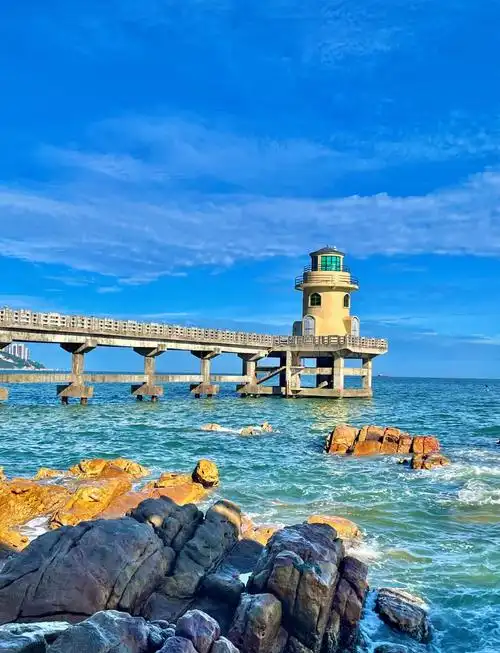
The island's landscapes rival Mediterranean beauty spots, with a dramatic 68-kilometer coastline studded with iconic lighthouses. Qing'ao Bay stretches in a perfect crescent, its fine golden sand and gentle surf drawing comparisons to Sicily's Taormina beaches. Standing sentinel along the bay, the "Gateway of Nature" monument marks the Tropic of Cancer's passage—a concrete sphere split by a celestial arch reminiscent of modernist sculptures found in Barcelona's Parc Güell. The Sancong Cliff Lighthouse has become Instagram-famous for its ice-cream-cone silhouette: twin pink-and-white towers perched above turquoise waves. Equally photogenic is the red-and-white Changshanhui Lighthouse, which frames perfectly with the sweeping 11-kilometer Nan'ao Bridge.
Beyond the scenic facade, Nan'ao pulses with living maritime culture. Yun'ao fishing harbor remains a working port, its floating fish farms providing the fresh catch served at waterfront restaurants—a scene little changed since the days when Zheng He's treasure fleets might have sailed past during their Ming-era voyages. The harbor gained cinematic fame as a key filming location for the 2022 blockbuster "All Ears." Inland, Huanghua Mountain National Forest Park blankets nearly 73% of the island in subtropical greenery, while the remote Hou Garden eco-village protects ancient cycad trees, living fossils from the dinosaur era. Visitors can sample traditional clay-oven roasted chicken amid the forest canopy.
Nan'ao's cuisine reflects its position where Cantonese, Teochew, and Fujianese flavors converge. The signature dish—fried rice tossed with "first harvest" seaweed—delivers an oceanic umami punch that rivals any Italian risotto al nero di seppia. Squid dried using heritage craft methods along the island's sun-baked racks rivals Spanish pulpo for flavor concentration. Fresh-from-the-net seafood appears simply steamed or poached to preserve pure sea flavors, while the regional Chaoshan beef hotpot—with hand-cut slices that melt on the tongue—compares favorably to Japan's celebrated Kobe beef.
Reaching Nan'ao requires crossing the impressive 11-kilometer Nan'ao Bridge from Shantou (toll: 96 RMB per vehicle; parking on the bridge is strictly prohibited and fined). The ideal way to explore is by rental car or e-scooter (60-80 RMB daily), as public transport is limited. Best visiting months are May through November, avoiding typhoon season and the suffocating humidity of midsummer. Always wear strong sun protection; UV intensity rivals the Australian outback. Book accommodations at least one week ahead during peak season. Qing'ao Bay offers sunrise-view rooms at premium prices, while Houzhai Town's guesthouses deliver better value and local convenience. Confirm seafood prices and units before ordering.
Nan'ao's strategic position at the gateway between Fujian and Guangdong has shaped its destiny for centuries. The island served as a vital naval outpost during the Ming and Qing dynasties, when the Zongbingfu (General's Headquarters) in Shen'ao Town coordinated maritime defense across the South China Sea—much like Britain's Dover Castle once guarded the English Channel. Historical echoes include the famous Song Dynasty Well, where Song-era soldiers reportedly found freshwater during their coastal campaigns, and the legendary recruitment tree under which Ming-loyalist hero Zheng Chenggong (known in the West as Koxinga) mustered forces in the 17th century before expelling the Dutch from Taiwan.
The island's landscapes rival Mediterranean beauty spots, with a dramatic 68-kilometer coastline studded with iconic lighthouses. Qing'ao Bay stretches in a perfect crescent, its fine golden sand and gentle surf drawing comparisons to Sicily's Taormina beaches. Standing sentinel along the bay, the "Gateway of Nature" monument marks the Tropic of Cancer's passage—a concrete sphere split by a celestial arch reminiscent of modernist sculptures found in Barcelona's Parc Güell. The Sancong Cliff Lighthouse has become Instagram-famous for its ice-cream-cone silhouette: twin pink-and-white towers perched above turquoise waves. Equally photogenic is the red-and-white Changshanhui Lighthouse, which frames perfectly with the sweeping 11-kilometer Nan'ao Bridge.
Beyond the scenic facade, Nan'ao pulses with living maritime culture. Yun'ao fishing harbor remains a working port, its floating fish farms providing the fresh catch served at waterfront restaurants—a scene little changed since the days when Zheng He's treasure fleets might have sailed past during their Ming-era voyages. The harbor gained cinematic fame as a key filming location for the 2022 blockbuster "All Ears." Inland, Huanghua Mountain National Forest Park blankets nearly 73% of the island in subtropical greenery, while the remote Hou Garden eco-village protects ancient cycad trees, living fossils from the dinosaur era. Visitors can sample traditional clay-oven roasted chicken amid the forest canopy.
Nan'ao's cuisine reflects its position where Cantonese, Teochew, and Fujianese flavors converge. The signature dish—fried rice tossed with "first harvest" seaweed—delivers an oceanic umami punch that rivals any Italian risotto al nero di seppia. Squid dried using heritage craft methods along the island's sun-baked racks rivals Spanish pulpo for flavor concentration. Fresh-from-the-net seafood appears simply steamed or poached to preserve pure sea flavors, while the regional Chaoshan beef hotpot—with hand-cut slices that melt on the tongue—compares favorably to Japan's celebrated Kobe beef.
Reaching Nan'ao requires crossing the impressive 11-kilometer Nan'ao Bridge from Shantou (toll: 96 RMB per vehicle; parking on the bridge is strictly prohibited and fined). The ideal way to explore is by rental car or e-scooter (60-80 RMB daily), as public transport is limited. Best visiting months are May through November, avoiding typhoon season and the suffocating humidity of midsummer. Always wear strong sun protection; UV intensity rivals the Australian outback. Book accommodations at least one week ahead during peak season. Qing'ao Bay offers sunrise-view rooms at premium prices, while Houzhai Town's guesthouses deliver better value and local convenience. Confirm seafood prices and units before ordering.