Queshi Scenic Garden
⭐ 4.30
Queshi Scenic Garden, Chenghai District, Shantou City, Guangdong Province, China
 Shantou's Que Shi owes its character to a fascinating collision of geography and history. Geologically, the headland is a mass of weathered granite pushed up from the seabed, sculpted over millennia into the striking peaks and caverns that define the park today. Historically, the cliffs served as a natural fortress guarding the Chao Shan heartland until the Treaty of Nanjing in 1842 opened this coast to foreign trade. Shantou became one of China's earliest treaty ports, and Que Shi hilltop hosted the British Consulate, customs offices, and European merchant residences—the ruins of which still stand among the pines, offering a parallel to Hong Kong's Victoria Peak or Macau's historic quarter, but without the crowds.
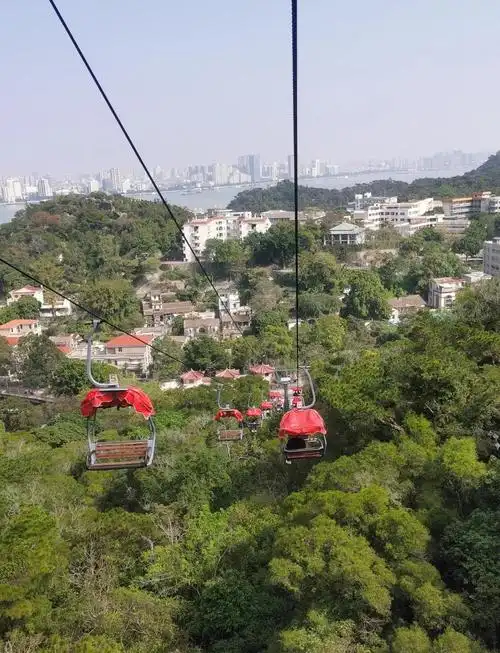
The park's signature feature is the Tuishan cave complex, a labyrinth of nineteen interconnected granite chambers threaded by an underground stream. Known as China's longest granite cavern system, it rivals the famous limestone grottoes of France's Vézère Valley, though its sculpted pink-grey walls feel distinctly Chinese. Above ground, the Xianglu Mountain summit rises to 198 meters, accessed by a Swiss-style open-air cable car that swings visitors over forested slopes before releasing them onto viewing platforms with 360-degree vistas. From here, the entire Shantou Bay unfurls below—the old town on one side, the South China Sea on the other.
Beyond natural splendor, Que Shi weaves in rich cultural texture. The Yanfeng district cradles the ancient Qingyunyan Temple, where spring brings cascades of peach blossoms across the valley, evoking Japan's Yoshino cherry season but with a Lingnan Buddhist twist. Along the coastal boardwalk, whimsically named rock formations—the Sea Dog Stone, the Beauty Stone, the Awakening Lion—reward leisurely exploration, much like the rocky shorelines of Portugal's Algarve or Cornwall's coastal footpaths.
Visiting requires some planning but rewards generously. Begin at the old town's ferry terminal near Shantou Plaza, where a one-yuan, eight-minute crossing offers its own "harbor cruise" experience—boats depart frequently throughout the day. Disembark and enter the park on foot; a clockwise route from Tuishan to Xianglu Peak is the gentlest ascent, taking two to three hours. Aim for late afternoon: temperatures soften, golden light bathes the bay, and the city skyline ignites at sunset.
Practical considerations enhance the visit. Entrance remains free, though the cable car and the exhilarating mountain slide require separate tickets. Wear sturdy non-slip shoes—the cave floors are damp and uneven—and carry sufficient water, as on-site refreshments are limited. Mobile payment dominates; foreign visitors should activate international card services on Alipay or WeChat Pay in advance, though small cash remains useful for ferry tickets. Combine the trip with an evening exploration of Shantou's old town to savor legendary Chaoshan cuisine—beef hotpot, seafood congee, and hand-pulled rice noodles—making Que Shi the gateway to a full cultural immersion on China's storied southeast coast.
Shantou's Que Shi owes its character to a fascinating collision of geography and history. Geologically, the headland is a mass of weathered granite pushed up from the seabed, sculpted over millennia into the striking peaks and caverns that define the park today. Historically, the cliffs served as a natural fortress guarding the Chao Shan heartland until the Treaty of Nanjing in 1842 opened this coast to foreign trade. Shantou became one of China's earliest treaty ports, and Que Shi hilltop hosted the British Consulate, customs offices, and European merchant residences—the ruins of which still stand among the pines, offering a parallel to Hong Kong's Victoria Peak or Macau's historic quarter, but without the crowds.
The park's signature feature is the Tuishan cave complex, a labyrinth of nineteen interconnected granite chambers threaded by an underground stream. Known as China's longest granite cavern system, it rivals the famous limestone grottoes of France's Vézère Valley, though its sculpted pink-grey walls feel distinctly Chinese. Above ground, the Xianglu Mountain summit rises to 198 meters, accessed by a Swiss-style open-air cable car that swings visitors over forested slopes before releasing them onto viewing platforms with 360-degree vistas. From here, the entire Shantou Bay unfurls below—the old town on one side, the South China Sea on the other.
Beyond natural splendor, Que Shi weaves in rich cultural texture. The Yanfeng district cradles the ancient Qingyunyan Temple, where spring brings cascades of peach blossoms across the valley, evoking Japan's Yoshino cherry season but with a Lingnan Buddhist twist. Along the coastal boardwalk, whimsically named rock formations—the Sea Dog Stone, the Beauty Stone, the Awakening Lion—reward leisurely exploration, much like the rocky shorelines of Portugal's Algarve or Cornwall's coastal footpaths.
Visiting requires some planning but rewards generously. Begin at the old town's ferry terminal near Shantou Plaza, where a one-yuan, eight-minute crossing offers its own "harbor cruise" experience—boats depart frequently throughout the day. Disembark and enter the park on foot; a clockwise route from Tuishan to Xianglu Peak is the gentlest ascent, taking two to three hours. Aim for late afternoon: temperatures soften, golden light bathes the bay, and the city skyline ignites at sunset.
Practical considerations enhance the visit. Entrance remains free, though the cable car and the exhilarating mountain slide require separate tickets. Wear sturdy non-slip shoes—the cave floors are damp and uneven—and carry sufficient water, as on-site refreshments are limited. Mobile payment dominates; foreign visitors should activate international card services on Alipay or WeChat Pay in advance, though small cash remains useful for ferry tickets. Combine the trip with an evening exploration of Shantou's old town to savor legendary Chaoshan cuisine—beef hotpot, seafood congee, and hand-pulled rice noodles—making Que Shi the gateway to a full cultural immersion on China's storied southeast coast.