Gude Temple
⭐ 4.20
No. 18, East Lake Road, Wuchang District, Wuhan City, Hubei Province, China
 Gude Temple was founded in 1877 during the late Qing Dynasty, originally known as Gude Maopeng, before its expansion into its present form between 1921 and 1934. It ranks among Wuhan's four great Buddhist monasteries and is now a nationally protected cultural heritage site. The grounds carry layered historical memories: they served as a field hospital during the 1911 Battle of Yangxia, a pivotal clash of the Xinhai Revolution, and Sun Yat-sen himself once visited to pay his respects. In more recent decades, the complex even functioned as a camera equipment factory, an unexpected chapter in Wuhan's industrial history.
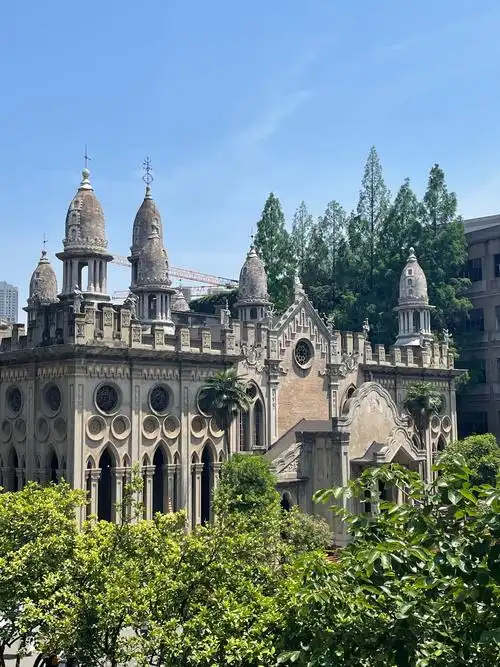
The undisputed centerpiece is the Hall of Perfect Enlightenment (Yuantong Baodian), an architectural hybrid without parallel in Chinese Buddhist architecture. Walk beneath its colonnade and you might think you've stepped into a Roman basilica; glance upward and Gothic pointed windows pierce the walls; trace the doorways and their floral ogees reveal unmistakable Islamic influence. Crowning the structure, nine pagodas reference the Burmese Ananda Temple, though only seven are visible from outside. Two remain concealed within the roof, a quiet nod to the Daoist concept of the Nine Stars of the Big Dipper.
What makes Gude especially remarkable is its rare blending of the three great streams of Buddhism: Mahayana, Theravada, and Tibetan Vajrayana, all practiced under one roof. This architectural pluralism mirrors Wuhan's identity as a former treaty port, where British, French, Russian, and Japanese concessions once shaped the city's cosmopolitan character along the Yangtze. The temple stands today as tangible evidence of how Wuhan absorbed global influences during its opening to the world, much like a Chinese cousin to the eclectic facades of Marseille's Nouvelle Vague or Istanbul's later Ottoman-European hybrids.
Visiting requires some planning. Entry is free, but reservations must be made in advance through the WeChat account "Hankou Gude Si," with crowd limits in peak season. Hours run 8:00 to 17:30 from May through October (last entry at 17:00) and 8:30 to 16:30 from November through April (last entry at 16:00). The temple sits at No. 74 Shangpo Road on Huangpu Road in Jiang'an District, easily reached via Luojiazhuang or Zhaojiatao stations on Metro Lines 3 and 8. Driving is discouraged, as parking is extremely limited.
A weekday morning offers the best experience: soft natural light bathes the cream-colored facade, the surrounding gardens are quiet, and white pigeons gather around the lotus pond, creating ideal conditions for photography. Plan on 1 to 1.5 hours to absorb the details. Visitors should dress modestly, speak softly, refrain from flash photography near Buddha statues, and avoid photographing monks at prayer. The temple pairs beautifully with a stroll down nearby Lihuangpi Road, a former concession-era street now lined with cafés, galleries, and early 20th-century European-style buildings, perfect for a half-day cultural excursion in old Hankou.
[BRIEF] and [DETAILED] sections complete.
Gude Temple was founded in 1877 during the late Qing Dynasty, originally known as Gude Maopeng, before its expansion into its present form between 1921 and 1934. It ranks among Wuhan's four great Buddhist monasteries and is now a nationally protected cultural heritage site. The grounds carry layered historical memories: they served as a field hospital during the 1911 Battle of Yangxia, a pivotal clash of the Xinhai Revolution, and Sun Yat-sen himself once visited to pay his respects. In more recent decades, the complex even functioned as a camera equipment factory, an unexpected chapter in Wuhan's industrial history.
The undisputed centerpiece is the Hall of Perfect Enlightenment (Yuantong Baodian), an architectural hybrid without parallel in Chinese Buddhist architecture. Walk beneath its colonnade and you might think you've stepped into a Roman basilica; glance upward and Gothic pointed windows pierce the walls; trace the doorways and their floral ogees reveal unmistakable Islamic influence. Crowning the structure, nine pagodas reference the Burmese Ananda Temple, though only seven are visible from outside. Two remain concealed within the roof, a quiet nod to the Daoist concept of the Nine Stars of the Big Dipper.
What makes Gude especially remarkable is its rare blending of the three great streams of Buddhism: Mahayana, Theravada, and Tibetan Vajrayana, all practiced under one roof. This architectural pluralism mirrors Wuhan's identity as a former treaty port, where British, French, Russian, and Japanese concessions once shaped the city's cosmopolitan character along the Yangtze. The temple stands today as tangible evidence of how Wuhan absorbed global influences during its opening to the world, much like a Chinese cousin to the eclectic facades of Marseille's Nouvelle Vague or Istanbul's later Ottoman-European hybrids.
Visiting requires some planning. Entry is free, but reservations must be made in advance through the WeChat account "Hankou Gude Si," with crowd limits in peak season. Hours run 8:00 to 17:30 from May through October (last entry at 17:00) and 8:30 to 16:30 from November through April (last entry at 16:00). The temple sits at No. 74 Shangpo Road on Huangpu Road in Jiang'an District, easily reached via Luojiazhuang or Zhaojiatao stations on Metro Lines 3 and 8. Driving is discouraged, as parking is extremely limited.
A weekday morning offers the best experience: soft natural light bathes the cream-colored facade, the surrounding gardens are quiet, and white pigeons gather around the lotus pond, creating ideal conditions for photography. Plan on 1 to 1.5 hours to absorb the details. Visitors should dress modestly, speak softly, refrain from flash photography near Buddha statues, and avoid photographing monks at prayer. The temple pairs beautifully with a stroll down nearby Lihuangpi Road, a former concession-era street now lined with cafés, galleries, and early 20th-century European-style buildings, perfect for a half-day cultural excursion in old Hankou.
[BRIEF] and [DETAILED] sections complete.