Qingchuan Pavilion

⭐ 3.50

No. 86, Xima Chang Street, Hanyang District, Wuhan, Hubei Province, China
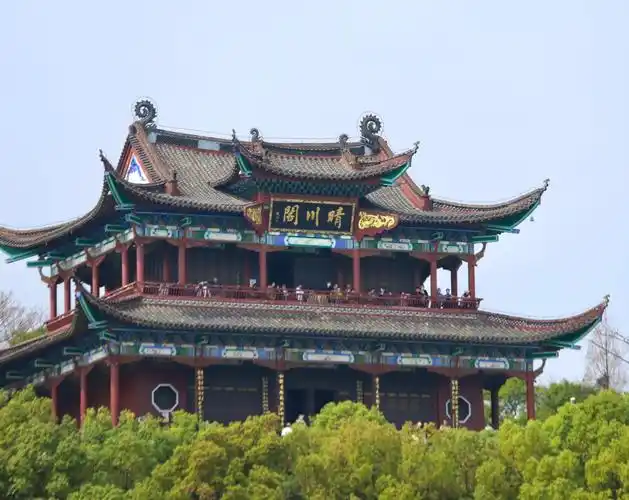
Qingchuan Pavilion
Qingchuan Pavilion dates to the Jiajing era of the Ming dynasty (1522–1566), though its poetic name echoes a far older masterpiece: Cui Hao's legendary Tang dynasty verse about Yellow Crane Tower, written in the 8th century when the Abbasid Caliphate was flowering in Baghdad. After centuries of decline, the surviving structure was faithfully reconstructed between 1983 and 1986 based on late Qing architectural drawings. The pavilion's philosophical counterpart across the Yangtze, Yellow Crane Tower, plays a similar role in Chinese literary imagination that Edinburgh Castle plays in Scottish folklore—an enduring symbol rising above the river. Architecturally, the pavilion blends the bold, upturned eaves and vermilion columns of ancient Chu style with the refined landscaping traditions of Jiangnan gardens. Imagine a grand Chinese pavilion transplanted into a setting resembling the manicured elegance of Versailles, yet framed by a river ten times wider than the Thames. Inside the complex, the Southern Song–era Yuji Palace (built during the same period as England's Magna Carta) stands as a rare surviving timber structure and a nationally protected monument, while Iron Gate Pass evokes the martial atmosphere of the Three Kingdoms era—roughly contemporary with Rome's Severan dynasty. Culturally, the site functions as a living museum to the legendary Great Yu, the flood-taming sage-king whose mythical exploits predate written Chinese history itself. Stele corridors display centuries of calligraphy and poetry, while stone inscriptions commemorate Yu's legendary taming of the Yangtze's floods. For Western visitors, this is a chance to encounter a flood myth as foundational to Chinese identity as Noah's tale is to Judeo-Christian tradition. Entry is completely free, but advance reservation via the WeChat account "Qingchuan Pavilion · Dayu Cultural Museum" is required. Opening hours run Tuesday through Sunday, 9:00 to 17:00, with last entry at 16:30; the site closes on Mondays. Reaching the pavilion is straightforward: take bus to "Binjiang Avenue Qingchuan Pavilion Station," disembark at "Yangtze Bridge Hanyang End," or ride Metro Line 4 to Lanjiang Road Station. Adventurous travellers can even board a ferry at nearby Qingchuan Wharf, crossing the Yangtze to reach Wuchang's riverside attractions. Plan your visit for the 9–10 a.m. opening to enjoy soft morning light and minimal crowds. Begin on the second floor of the main pavilion for that quintessential photo framing Yellow Crane Tower and the Yangtze Bridge together, then explore Yuji Palace, the Stele Pavilion, and finish at Iron Gate Pass. Comfortable walking shoes are essential, as the site climbs a hillside. With extra time, pair your visit with the nearby ancient Guqin Terrace or take the ferry onward to Yellow Crane Tower, creating a classic "two banks, one river" itinerary that captures the soul of Wuhan where the Han and Yangtze rivers meet.

Traveler reviews

Coming down from Yellow Crane Tower, I walked along the Wuhan Yangtze River Bridge. I've actually been to the Nanjing Yangtze River Bridge before, but pedestrians aren't allowed on that one anymore. I've also walked across Hangzhou's Qiantang River Bridge. Today I finally got to set foot on this "First Bridge of the Mighty Yangtze." Got super lucky—I managed to capture that moment when Yellow Crane Tower and a passing train are in the same frame. River breeze, speeding train, ancient tower all in one shot, what a storytell...
⭐ 5 · Avery Expand
Qingchuan Pavilion has serious historical roots. From up top you can see the Yangtze River Bridge and the rolling river—on a clear day the views are absolutely spectacular. The whole area is pretty compact, one hour is more than enough to see everything. The nearby shop sells Qingchuan Pavilion themed cultural-creative ice cream, 18 yuan a pop, tastes pretty good. Right now entry to Qingchuan Pavilion is still free, which is an amazing deal 👍. Right next to it is ...
⭐ 4 · Sage Expand