Hubei Provincial Museum
⭐ 4.80
Changsha City, Hunan Province, China
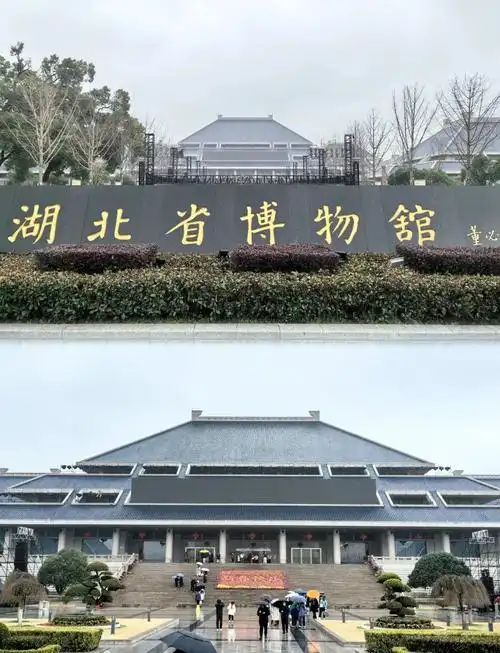 Founded in 1953 and reopened in a striking modern complex in 2007, Hubei Provincial Museum is one of only eight Chinese museums jointly administered by national and provincial authorities. Its collection draws on Hubei's extraordinarily rich archaeological record, particularly the bronzes of the ancient State of Zeng, artifacts of the Chu culture, and treasures excavated from the tomb of Prince Liangzhuang of the Ming dynasty. Together these holdings trace civilization along the middle Yangtze from the Paleolithic era through imperial China—a span comparable to following European history from the cave paintings at Lascaux to the Renaissance under one roof.
The museum's architecture itself tells a story: three connected halls (South, North, and West) are shaped like ancient ritual bronze cauldrons known as ding, with sweeping eaves that echo traditional Chu-style roofs while revealing a contemporary steel-and-glass skeleton. The result is reminiscent of how the Louvre merges historic palace facades with I.M. Pei's modern pyramids. Aerial walkways link the halls, weaving the building seamlessly into the surrounding East Lake landscape and creating an unhurried flow between exhibitions.
The crown jewel is the Zenghouyi Bianzhong, a complete set of 65 bronze bells cast in the early Warring States period (around 433 BCE). Weighing more than 2,500 kilograms, it remains the largest and most intact pre-Qin chime bells ever discovered—offering an audio experience akin to hearing an ancient European carillon like those at Bruges or Mechelen, but more than a millennium older. Equally legendary is the Sword of Goujian, its blade still mirror-bright after 2,400 years, a feat of metallurgy that has been compared to the legendary Roman Gladius or Toledo steel.
Beyond these headline pieces, visitors encounter the Yunxian Man skull (approximately one million years old), which fills a crucial gap in East Asian human evolution much as the Java Man or Neanderthal discoveries did for Europe, and the Yuan-dynasty Meiping vase decorated with the "Four Loves," representing the pinnacle of Chinese ceramic artistry. The Chu lacquerware and Prince Liangzhuang's Ming-era gold regalia further reveal a regional culture as artistically distinctive as ancient Etruscan or Celtic craftsmanship.
Practical planning is essential: admission is free but requires advance booking through the museum's official WeChat account or website (passport details accepted for foreign visitors), with new tickets released daily at 17:18 for entry within five days. The museum is closed on Mondays and open Tuesday through Sunday, 9:00 to 17:00, with last entry at 16:00. Free volunteer-led tours run throughout the day and are highly recommended for context. A half-day itinerary begins at opening in the South Hall with the bells and sword, continues through the third-floor Chu lacquerware and Liangzhuang gold, crosses to the North Hall for the chronological "Eyes Over Chu" exhibition, and culminates in the West Hall with a ticketed bell concert (about 50 yuan, roughly 30 minutes)—an experience as moving as hearing evensong in an English cathedral.
Come for the headline objects, but stay for the deeper revelation: an entire regional civilization that flourished alongside, and traded with, the Greek and Persian worlds of antiquity, yet followed its own magnificent artistic and philosophical path along the Yangtze.
Founded in 1953 and reopened in a striking modern complex in 2007, Hubei Provincial Museum is one of only eight Chinese museums jointly administered by national and provincial authorities. Its collection draws on Hubei's extraordinarily rich archaeological record, particularly the bronzes of the ancient State of Zeng, artifacts of the Chu culture, and treasures excavated from the tomb of Prince Liangzhuang of the Ming dynasty. Together these holdings trace civilization along the middle Yangtze from the Paleolithic era through imperial China—a span comparable to following European history from the cave paintings at Lascaux to the Renaissance under one roof.
The museum's architecture itself tells a story: three connected halls (South, North, and West) are shaped like ancient ritual bronze cauldrons known as ding, with sweeping eaves that echo traditional Chu-style roofs while revealing a contemporary steel-and-glass skeleton. The result is reminiscent of how the Louvre merges historic palace facades with I.M. Pei's modern pyramids. Aerial walkways link the halls, weaving the building seamlessly into the surrounding East Lake landscape and creating an unhurried flow between exhibitions.
The crown jewel is the Zenghouyi Bianzhong, a complete set of 65 bronze bells cast in the early Warring States period (around 433 BCE). Weighing more than 2,500 kilograms, it remains the largest and most intact pre-Qin chime bells ever discovered—offering an audio experience akin to hearing an ancient European carillon like those at Bruges or Mechelen, but more than a millennium older. Equally legendary is the Sword of Goujian, its blade still mirror-bright after 2,400 years, a feat of metallurgy that has been compared to the legendary Roman Gladius or Toledo steel.
Beyond these headline pieces, visitors encounter the Yunxian Man skull (approximately one million years old), which fills a crucial gap in East Asian human evolution much as the Java Man or Neanderthal discoveries did for Europe, and the Yuan-dynasty Meiping vase decorated with the "Four Loves," representing the pinnacle of Chinese ceramic artistry. The Chu lacquerware and Prince Liangzhuang's Ming-era gold regalia further reveal a regional culture as artistically distinctive as ancient Etruscan or Celtic craftsmanship.
Practical planning is essential: admission is free but requires advance booking through the museum's official WeChat account or website (passport details accepted for foreign visitors), with new tickets released daily at 17:18 for entry within five days. The museum is closed on Mondays and open Tuesday through Sunday, 9:00 to 17:00, with last entry at 16:00. Free volunteer-led tours run throughout the day and are highly recommended for context. A half-day itinerary begins at opening in the South Hall with the bells and sword, continues through the third-floor Chu lacquerware and Liangzhuang gold, crosses to the North Hall for the chronological "Eyes Over Chu" exhibition, and culminates in the West Hall with a ticketed bell concert (about 50 yuan, roughly 30 minutes)—an experience as moving as hearing evensong in an English cathedral.
Come for the headline objects, but stay for the deeper revelation: an entire regional civilization that flourished alongside, and traded with, the Greek and Persian worlds of antiquity, yet followed its own magnificent artistic and philosophical path along the Yangtze.