Urumqi Old Street
⭐ 4.20
Urumqi Old Street, Tianshan District, Urumqi, Xinjiang Uygur Autonomous Region, China
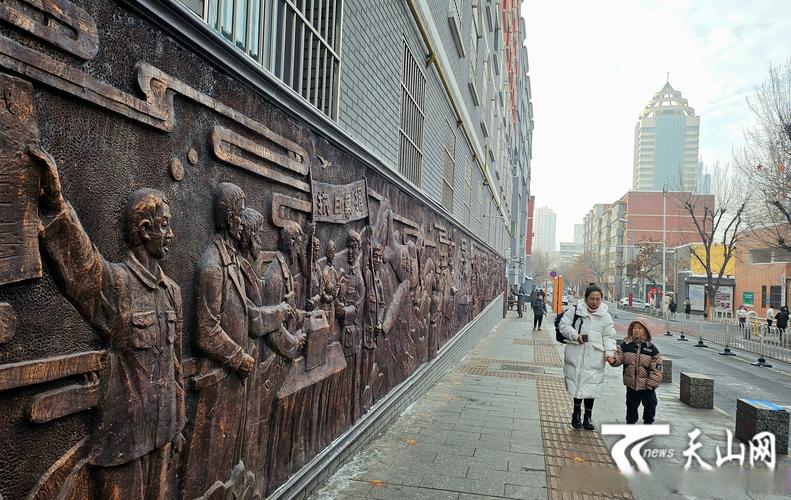 Hetian Er Street sits on ground that has traded for centuries. Its origins trace to the southern Silk Road corridor, where caravans loaded with Kashgar-grown dried fruits, cumin, and hand-woven Atlas silk entered what was then Tihua, Urumqi's old Turkic name meaning "field of the pasture." Like the Grand Bazaar in Istanbul or Jerusalem's Old City markets, this was a wholesale nerve center where Uyghur, Kazakh, Hui, and Han merchants negotiated side by side. Modern paving has smoothed the surface, but the original grid of narrow lanes survives, making the block a living archaeological layer rather than a rebuilt theme park.
Architecturally the street is a study in vernacular Uyghur restraint: low-rise shop-houses with flat roofs, stucco facades, and hand-painted timber doors. Municipal designers have woven in playful touches that travelers love photographing, including crosswalks styled as foil-wrapped roasted buns, lamp boxes wrapped in rainbow Atlas-silk patterns, and strings of copper ewers suspended overhead. The result recalls the color sensibility of Marrakech's medina reimagined for a 21st-century Chinese city, with the patina of Soviet-era grey brick still visible between bursts of turquoise and saffron.
Culturally, the street is the most accessible window onto Urumqi's Uyghur soul. Families queue for gangzi rou, mutton slow-baked in tall ceramic mugs, and for crisp samsa still pulled from clay tandoors. On weekend evenings the air fills with the nasal drone of the dutar lute, and visitors are routinely pulled into circle dances that have been performed at harvest weddings for generations. It is the kind of spontaneous, unscripted encounter that the more scripted International Bazaar cannot replicate, and the reason food writers now rank this block alongside Xi'an's Muslim Quarter as China's great street-eating frontier.
Logistics are simple. Take Metro Line 1 to Nanmen Station and walk ten minutes, or hop off any local bus at the "Hetian Erjie" stop. The street is free, open 24 hours, and requires no reservation, though peak crowds between 20:00 and 23:00 mean you should keep wallets secure and bring small cash, as many family-run grills refuse mobile payments. Aim to arrive after 19:00 in summer, when daytime heat has broken and the lanterns flicker on; in winter the covered arcades shelter you from the bitter cold.
Pair Hetian Er Street with the Xinjiang International Grand Bazaar for its soaring Islamic architecture and nightly song-and-dance theater, then walk ten minutes north to Erdaoqiao for bulk almonds and saffron at bazaar prices. If the weather turns foul, duck into the Xinjiang Folk Street, a 4A indoor complex just 500 meters away that compresses all fifteen prefectures of the region into miniature landscapes and a surprisingly thorough ethnographic museum. Together the three stops trace a compact arc through Xinjiang's commercial past, present, and curated memory.
Why visit? Because in a region most Western travelers only glimpse from a Silk Road tour bus, this single 600-meter lane delivers Uyghur Xinjiang at street level, unfiltered, edible, and still awake when you finally stumble back to your hotel at three in the morning.
Hetian Er Street sits on ground that has traded for centuries. Its origins trace to the southern Silk Road corridor, where caravans loaded with Kashgar-grown dried fruits, cumin, and hand-woven Atlas silk entered what was then Tihua, Urumqi's old Turkic name meaning "field of the pasture." Like the Grand Bazaar in Istanbul or Jerusalem's Old City markets, this was a wholesale nerve center where Uyghur, Kazakh, Hui, and Han merchants negotiated side by side. Modern paving has smoothed the surface, but the original grid of narrow lanes survives, making the block a living archaeological layer rather than a rebuilt theme park.
Architecturally the street is a study in vernacular Uyghur restraint: low-rise shop-houses with flat roofs, stucco facades, and hand-painted timber doors. Municipal designers have woven in playful touches that travelers love photographing, including crosswalks styled as foil-wrapped roasted buns, lamp boxes wrapped in rainbow Atlas-silk patterns, and strings of copper ewers suspended overhead. The result recalls the color sensibility of Marrakech's medina reimagined for a 21st-century Chinese city, with the patina of Soviet-era grey brick still visible between bursts of turquoise and saffron.
Culturally, the street is the most accessible window onto Urumqi's Uyghur soul. Families queue for gangzi rou, mutton slow-baked in tall ceramic mugs, and for crisp samsa still pulled from clay tandoors. On weekend evenings the air fills with the nasal drone of the dutar lute, and visitors are routinely pulled into circle dances that have been performed at harvest weddings for generations. It is the kind of spontaneous, unscripted encounter that the more scripted International Bazaar cannot replicate, and the reason food writers now rank this block alongside Xi'an's Muslim Quarter as China's great street-eating frontier.
Logistics are simple. Take Metro Line 1 to Nanmen Station and walk ten minutes, or hop off any local bus at the "Hetian Erjie" stop. The street is free, open 24 hours, and requires no reservation, though peak crowds between 20:00 and 23:00 mean you should keep wallets secure and bring small cash, as many family-run grills refuse mobile payments. Aim to arrive after 19:00 in summer, when daytime heat has broken and the lanterns flicker on; in winter the covered arcades shelter you from the bitter cold.
Pair Hetian Er Street with the Xinjiang International Grand Bazaar for its soaring Islamic architecture and nightly song-and-dance theater, then walk ten minutes north to Erdaoqiao for bulk almonds and saffron at bazaar prices. If the weather turns foul, duck into the Xinjiang Folk Street, a 4A indoor complex just 500 meters away that compresses all fifteen prefectures of the region into miniature landscapes and a surprisingly thorough ethnographic museum. Together the three stops trace a compact arc through Xinjiang's commercial past, present, and curated memory.
Why visit? Because in a region most Western travelers only glimpse from a Silk Road tour bus, this single 600-meter lane delivers Uyghur Xinjiang at street level, unfiltered, edible, and still awake when you finally stumble back to your hotel at three in the morning.