Reed Flute Cave
⭐ 4.60
Reed Flute Cave, Xiufeng District, Guilin, Guangxi Zhuang Autonomous Region, China
 **A Living Scroll of History**
The cave's modern fame belies a much older story. Travellers have been leaving their mark here since the Tang dynasty, with 77 inscriptions dating back to AD 792 still visible on the walls — poems, travel notes, and calligraphic signatures spanning the Song, Ming, Qing, and modern eras. Comparable in spirit to the ancient graffiti found in the Roman catacombs or the pilgrim scratchings in medieval European chapels, these writings offer an unusually continuous literary record. Since opening to the public in the twentieth century, the cave has hosted more than 300 heads of state and foreign dignitaries, earning its proud nickname "Cave of State Guests."
**A Geological Masterpiece**
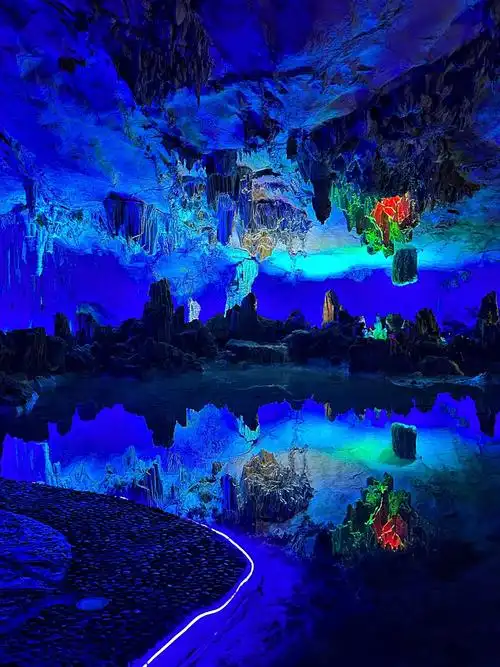
Reed Flute is a textbook example of karst topography, the same limestone-dissolving process that shaped Slovenia's Škocjan Caves and Vietnam's Phong Nha. Over tens of millions of years, mineral-rich dripwater has sculpted stalactites, stalagmites, and stone columns into uncanny likenesses — a crouching lion bidding farewell, a "golden-banded club" that inspired the Monkey King's weapon, rippling draperies cascading from the ceiling. Multicoloured lighting transforms the chambers into something resembling a Baroque opera house frozen in stone, with each turn revealing a new dramatic tableau.
**Where Myth Meets Stone**
For Western visitors familiar with the cultural reach of Tolkien or C.S. Lewis, Reed Flute occupies a similar mythic space in the Chinese imagination. The 1986 Chinese television series Journey to the West — an epic adaptation of the Ming-dynasty novel as globally beloved as Homer's Odyssey — filmed key scenes inside these very chambers, particularly the "Mountain of Flowers and Fruit" and the dazzling "Crystal Palace." Fans still make pilgrimages to stand where the Monkey King once battled demons, giving the cave an atmosphere somewhere between a sacred site and a fantasy-film set.
**Planning Your Visit**
The cave opens daily from 7:30 a.m. to 6:00 p.m., with last tickets sold at 5:00 p.m. Adult admission runs roughly 82–90 RMB and includes a guided tour; Guilin residents pay half price. Aim to arrive between 9:00 and 10:30 a.m. to beat the coach tours — a wise strategy, much like visiting the Vatican before midday. The fully paved route takes 40–60 minutes and is gentle enough for children and older travellers, though the interior stays a brisk 18–20°C, so a light jacket is essential in summer.
**Photography, Transport, and Pairings**
Flash photography is strictly prohibited to protect the slow-growing formations (stalactites grow only about one centimetre per century), so switch to a phone night mode or a camera with a wide aperture and lean into the natural reflections in the underground pools. The site lies about 5 km from central Guilin, easily reached by bus 3 or a short taxi ride, with parking around 10 RMB. Most travellers combine Reed Flute with nearby Elephant Trunk Hill and an afternoon Li River cruise for a compact half-day itinerary, while an optional "Hidden Dragon" extension at the exit rewards those with extra curiosity.
**Why It Belongs on Your Itinerary**
Few natural sites manage to be simultaneously a scientific marvel, an open-air archive of Chinese literature, and a touchstone of national mythology — Reed Flute manages all three with operatic flair. For visitors who have marvelled at the painted caves of Lascaux, drifted through the glow-worm grottos of New Zealand, or descended into the marble quarries of Carrara, this is the Eastern Hemisphere's answer: a place where geology, history, and legend converge in a single, walkable wonder.
**A Living Scroll of History**
The cave's modern fame belies a much older story. Travellers have been leaving their mark here since the Tang dynasty, with 77 inscriptions dating back to AD 792 still visible on the walls — poems, travel notes, and calligraphic signatures spanning the Song, Ming, Qing, and modern eras. Comparable in spirit to the ancient graffiti found in the Roman catacombs or the pilgrim scratchings in medieval European chapels, these writings offer an unusually continuous literary record. Since opening to the public in the twentieth century, the cave has hosted more than 300 heads of state and foreign dignitaries, earning its proud nickname "Cave of State Guests."
**A Geological Masterpiece**
Reed Flute is a textbook example of karst topography, the same limestone-dissolving process that shaped Slovenia's Škocjan Caves and Vietnam's Phong Nha. Over tens of millions of years, mineral-rich dripwater has sculpted stalactites, stalagmites, and stone columns into uncanny likenesses — a crouching lion bidding farewell, a "golden-banded club" that inspired the Monkey King's weapon, rippling draperies cascading from the ceiling. Multicoloured lighting transforms the chambers into something resembling a Baroque opera house frozen in stone, with each turn revealing a new dramatic tableau.
**Where Myth Meets Stone**
For Western visitors familiar with the cultural reach of Tolkien or C.S. Lewis, Reed Flute occupies a similar mythic space in the Chinese imagination. The 1986 Chinese television series Journey to the West — an epic adaptation of the Ming-dynasty novel as globally beloved as Homer's Odyssey — filmed key scenes inside these very chambers, particularly the "Mountain of Flowers and Fruit" and the dazzling "Crystal Palace." Fans still make pilgrimages to stand where the Monkey King once battled demons, giving the cave an atmosphere somewhere between a sacred site and a fantasy-film set.
**Planning Your Visit**
The cave opens daily from 7:30 a.m. to 6:00 p.m., with last tickets sold at 5:00 p.m. Adult admission runs roughly 82–90 RMB and includes a guided tour; Guilin residents pay half price. Aim to arrive between 9:00 and 10:30 a.m. to beat the coach tours — a wise strategy, much like visiting the Vatican before midday. The fully paved route takes 40–60 minutes and is gentle enough for children and older travellers, though the interior stays a brisk 18–20°C, so a light jacket is essential in summer.
**Photography, Transport, and Pairings**
Flash photography is strictly prohibited to protect the slow-growing formations (stalactites grow only about one centimetre per century), so switch to a phone night mode or a camera with a wide aperture and lean into the natural reflections in the underground pools. The site lies about 5 km from central Guilin, easily reached by bus 3 or a short taxi ride, with parking around 10 RMB. Most travellers combine Reed Flute with nearby Elephant Trunk Hill and an afternoon Li River cruise for a compact half-day itinerary, while an optional "Hidden Dragon" extension at the exit rewards those with extra curiosity.
**Why It Belongs on Your Itinerary**
Few natural sites manage to be simultaneously a scientific marvel, an open-air archive of Chinese literature, and a touchstone of national mythology — Reed Flute manages all three with operatic flair. For visitors who have marvelled at the painted caves of Lascaux, drifted through the glow-worm grottos of New Zealand, or descended into the marble quarries of Carrara, this is the Eastern Hemisphere's answer: a place where geology, history, and legend converge in a single, walkable wonder.