Seven Star Park
⭐ 4.00
No. 26, Qixing Road, Xiufeng District, Guilin City, Guangxi Zhuang Autonomous Region, China
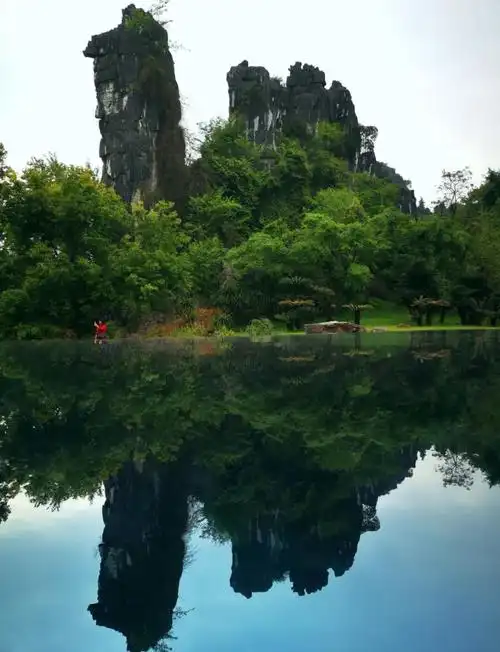 Dating back to the Sui and Tang dynasties, Seven Star Park ranks among China's oldest continuously cultivated pleasure grounds, comparable in age and layered function to the pleasure gardens of imperial Chang'an or Kyoto's ancient temple complexes. The seven principal peaks emerged some 300 million years ago through the same limestone dissolution that shaped much of southern China's karst terrain, eventually named for their resemblance to the stars of the Big Dipper. For over a millennium, scholars, monks, and officials retreated here, leaving behind a cultural palimpset that today's visitors can still read in stone.
The park's centerpiece is Seven Star Cave, a sprawling limestone grotto often called the "First Cavern Under Heaven." Comparable in scale and drama to France's Gouffre de Padirac or Slovenia's Postojna Cave, its chambers stay at a refreshing 16°C year-round and showcase a surreal gallery of stalactites, stalagmites, and flowstone formations. Clever lighting highlights natural shapes alongside miniature replicas of the Great Wall and terraced rice fields, weaving geological wonder with human imagination.
Qixia Temple, founded during the Tang dynasty around 1,200 years ago, anchors the park's spiritual heritage. Its tranquil courtyards, weathered stone foundations, and lingering incense recall the atmosphere of Kyoto's older Zen compounds, while also echoing the contemplative sites that drew Tang-dynasty poets such as Han Yu to Guilin. Just downstream stands Hua Bridge, one of southern China's oldest surviving multi-arch stone bridges, whose slender piers span the confluence of two streams and glow with reflected peach blossoms each spring.
The Guihai Stele Forest gathers more than 200 cliff inscriptions spanning the Tang, Song, Yuan, Ming, and Qing dynasties, forming one of the largest open-air epigraphy collections in the country. Works by masters such as Yan Zhenqing and Mi Fu share the rock faces with Buddhist sutras, travel poems, and official edicts, creating an experience that parallels a walk through Athens' ancient inscriptions or Rome's epigraphic museums. Camel Hill, named for its distinctive humped silhouette, gained modern fame when U.S. President Bill Clinton delivered an environmental address here in 1998, and its lawns remain a favorite gathering spot.
Practical details make the park easy to enjoy. Entry costs about 55 yuan, with combined tickets including Seven Star Cave running near 100 yuan. The grounds open from 8:00 a.m. to 6:00 p.m., and the cave from 9:00 a.m. to 5:00 p.m. The park sits roughly 1.5 kilometers from the city center, and a suggested two-and-a-half to four-hour route begins at the main gate by Hua Bridge, passes Camel Hill and the Potuo Mountain trails, explores Seven Star Cave, then loops through Qixia Temple and the stele forest before exiting. Wear sturdy, non-slip shoes, bring a light jacket for the cave's chill, and ignore unsolicited low-priced guides at the gates, who are typically unofficial.
Dating back to the Sui and Tang dynasties, Seven Star Park ranks among China's oldest continuously cultivated pleasure grounds, comparable in age and layered function to the pleasure gardens of imperial Chang'an or Kyoto's ancient temple complexes. The seven principal peaks emerged some 300 million years ago through the same limestone dissolution that shaped much of southern China's karst terrain, eventually named for their resemblance to the stars of the Big Dipper. For over a millennium, scholars, monks, and officials retreated here, leaving behind a cultural palimpset that today's visitors can still read in stone.
The park's centerpiece is Seven Star Cave, a sprawling limestone grotto often called the "First Cavern Under Heaven." Comparable in scale and drama to France's Gouffre de Padirac or Slovenia's Postojna Cave, its chambers stay at a refreshing 16°C year-round and showcase a surreal gallery of stalactites, stalagmites, and flowstone formations. Clever lighting highlights natural shapes alongside miniature replicas of the Great Wall and terraced rice fields, weaving geological wonder with human imagination.
Qixia Temple, founded during the Tang dynasty around 1,200 years ago, anchors the park's spiritual heritage. Its tranquil courtyards, weathered stone foundations, and lingering incense recall the atmosphere of Kyoto's older Zen compounds, while also echoing the contemplative sites that drew Tang-dynasty poets such as Han Yu to Guilin. Just downstream stands Hua Bridge, one of southern China's oldest surviving multi-arch stone bridges, whose slender piers span the confluence of two streams and glow with reflected peach blossoms each spring.
The Guihai Stele Forest gathers more than 200 cliff inscriptions spanning the Tang, Song, Yuan, Ming, and Qing dynasties, forming one of the largest open-air epigraphy collections in the country. Works by masters such as Yan Zhenqing and Mi Fu share the rock faces with Buddhist sutras, travel poems, and official edicts, creating an experience that parallels a walk through Athens' ancient inscriptions or Rome's epigraphic museums. Camel Hill, named for its distinctive humped silhouette, gained modern fame when U.S. President Bill Clinton delivered an environmental address here in 1998, and its lawns remain a favorite gathering spot.
Practical details make the park easy to enjoy. Entry costs about 55 yuan, with combined tickets including Seven Star Cave running near 100 yuan. The grounds open from 8:00 a.m. to 6:00 p.m., and the cave from 9:00 a.m. to 5:00 p.m. The park sits roughly 1.5 kilometers from the city center, and a suggested two-and-a-half to four-hour route begins at the main gate by Hua Bridge, passes Camel Hill and the Potuo Mountain trails, explores Seven Star Cave, then loops through Qixia Temple and the stele forest before exiting. Wear sturdy, non-slip shoes, bring a light jacket for the cave's chill, and ignore unsolicited low-priced guides at the gates, who are typically unofficial.