Hongshan Park
⭐ 3.80
Shuimogou District, Urumqi, Xinjiang, China
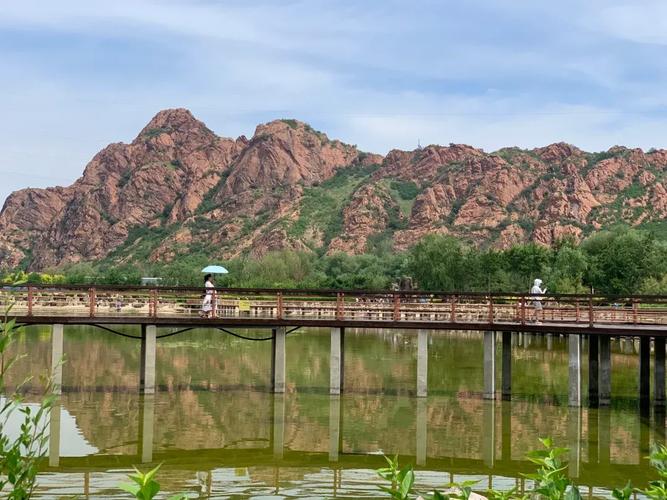 Rising some forty meters above the surrounding city, Hongshan is named for the deep rust-red sandstone laid down roughly 280 million years ago during the Permian period, when this inland sea region resembled today's Sahara. Geologists often compare its banded cliffs to Arizona's Sedona or Petra's rose-colored facades in Jordan. Recognized as Urumqi's defining landmark long before the park was formalized in 1985, the mountain has appeared on local seals and skylines for centuries, anchoring the Silk Road oasis town the way Arthur's Seat anchors Edinburgh.
The nine-tiered Zhenlong Pagoda, built in the 1780s during the reign of the Qianlong Emperor, is among the oldest surviving pavilion-style brick towers in Xinjiang. Comparable in age and modest stature to England's early Georgian steeples, it was raised, according to local lore, to "pin down" subterranean dragons said to cause earthquakes. Climbing its internal stairwell—or simply framing it from the surrounding terraces—offers the park's signature composition: a Qing-era spire silhouetted against jagged snowy summits more than 5,000 meters high, a juxtaposition reminiscent of Alpine postcards from Chamonix.
Beyond the pagoda, the three-story Yuanwang ("Far-Sight") Pavilion delivers a 360-degree sweep over downtown Urumqi and the ribbon of the Hetian Expressway below. Nearby stands a rebuilt Mahayana Buddhist temple complex—Tianwang Hall and Daxiong Hall—echoing the layout of Beijing's Lama Temple but on a quieter, more contemplative scale. A bronze statue of the Qing official Lin Zexu, famed for destroying British opium in 1839 at Humen, commemorates his later exile to Xinjiang and the anti-drug legacy he left behind, adding a sober historical layer to the park's cultural tapestry.
Families appreciate the southern lake, a modest Ferris wheel, shaded walking paths beneath ancient elm and poplar trees, and a small circular altar inspired by Beijing's Temple of Heaven. The well-irrigated greenery provides welcome relief from Urumqi's summer heat, while a clutch of food stalls and the adjacent Xibei Road snack street make lunchtime effortless.
Practical advice: enter between 9 and 11 a.m. on a clear day for the softest light and sharpest view of the Bogda snowfields; return around 6 to 7 p.m. for golden-hour city silhouettes. The park is free, no reservation required, and is reached directly via Metro Line 1 or numerous buses. Bring water and sun protection—the climb is easy, but the altitude and UV exposure are not.
Rising some forty meters above the surrounding city, Hongshan is named for the deep rust-red sandstone laid down roughly 280 million years ago during the Permian period, when this inland sea region resembled today's Sahara. Geologists often compare its banded cliffs to Arizona's Sedona or Petra's rose-colored facades in Jordan. Recognized as Urumqi's defining landmark long before the park was formalized in 1985, the mountain has appeared on local seals and skylines for centuries, anchoring the Silk Road oasis town the way Arthur's Seat anchors Edinburgh.
The nine-tiered Zhenlong Pagoda, built in the 1780s during the reign of the Qianlong Emperor, is among the oldest surviving pavilion-style brick towers in Xinjiang. Comparable in age and modest stature to England's early Georgian steeples, it was raised, according to local lore, to "pin down" subterranean dragons said to cause earthquakes. Climbing its internal stairwell—or simply framing it from the surrounding terraces—offers the park's signature composition: a Qing-era spire silhouetted against jagged snowy summits more than 5,000 meters high, a juxtaposition reminiscent of Alpine postcards from Chamonix.
Beyond the pagoda, the three-story Yuanwang ("Far-Sight") Pavilion delivers a 360-degree sweep over downtown Urumqi and the ribbon of the Hetian Expressway below. Nearby stands a rebuilt Mahayana Buddhist temple complex—Tianwang Hall and Daxiong Hall—echoing the layout of Beijing's Lama Temple but on a quieter, more contemplative scale. A bronze statue of the Qing official Lin Zexu, famed for destroying British opium in 1839 at Humen, commemorates his later exile to Xinjiang and the anti-drug legacy he left behind, adding a sober historical layer to the park's cultural tapestry.
Families appreciate the southern lake, a modest Ferris wheel, shaded walking paths beneath ancient elm and poplar trees, and a small circular altar inspired by Beijing's Temple of Heaven. The well-irrigated greenery provides welcome relief from Urumqi's summer heat, while a clutch of food stalls and the adjacent Xibei Road snack street make lunchtime effortless.
Practical advice: enter between 9 and 11 a.m. on a clear day for the softest light and sharpest view of the Bogda snowfields; return around 6 to 7 p.m. for golden-hour city silhouettes. The park is free, no reservation required, and is reached directly via Metro Line 1 or numerous buses. Bring water and sun protection—the climb is easy, but the altitude and UV exposure are not.