Bailian Cave
⭐ 3.80
Bailian Cave Scenic Area, Yufeng District, Liuzhou City, Guangxi Zhuang Autonomous Region, China
 Bailian Cave preserves one of southern China's rare continuous archaeological records, spanning the late Paleolithic into the early Neolithic—roughly 37,000 to 7,000 years ago. In 1956, the eminent paleoanthropologist Pei Wenzhong, already celebrated for his 1929 discovery of Peking Man at Zhoukoudian near Beijing, led excavations here that unearthed human teeth, stone tools, and ancient hearths. Like France's Chauvet or Slovenia's Divje Babe, the site offers a tangible window into deep human prehistory, yet with the added distinction of an unbroken cultural sequence rarely matched in European caves.
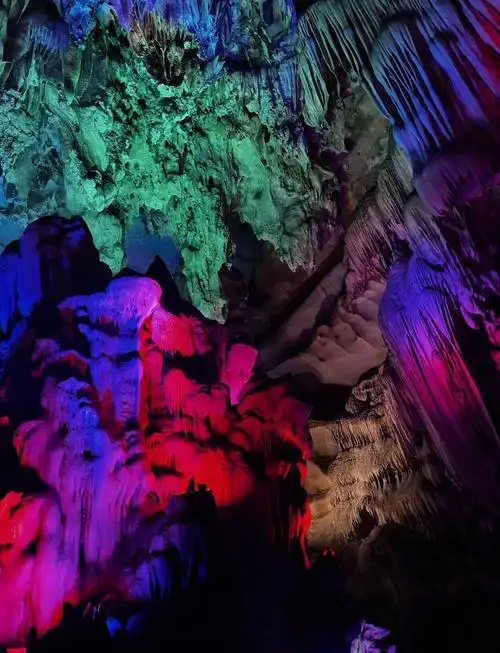
The attraction cleverly fuses a wild natural cave with a purpose-built museum. The cave stretches 1,870 meters across six stacked levels, threaded with five entrances, a 370-meter underground river, and a glittering gallery of stalactites, stalagmites, and stone curtains preserved in their original state. Blind fish still swim in its pools—a living biology lesson. Adjacent stands a sleek exhibition complex with two themed halls, "Earth: Past" and "Cave: Home," showcasing real fossils, reconstructed scenes, and interactive screens that bring deep time within reach.
As one of the birthplaces of Chinese cave science, Bailian holds a distinguished place in paleoanthropology, Quaternary geology, and karst research. The "Liujiang Man" fossil displays and the complete stratigraphic profile documenting the transition from hunting-gathering to early farming make this a hands-on textbook no traditional museum can replicate. For school groups, curious travelers, and anyone drawn to the origins of humanity, it offers a rare blend of rigorous scholarship and public accessibility.
The site sits at 472 Liushi Road, about 12 kilometers southeast of Liuzhou's city center. The modern exhibition halls are free but require advance booking through the WeChat account "Bailian Cave Science Museum"; the natural cave section costs roughly 10 yuan per person. Doors open daily from 9:00 to 16:30, with last entry at 16:00 and full closures on Mondays. From July through October 2026, a special 70th-anniversary exhibition celebrating the 1956 discovery will be free to all visitors.
A half-day itinerary works best: begin in the climate-controlled museum to absorb the prehistoric context, then collect your timed ticket for the cave. The interior stays a refreshing 18°C year-round—delightful in summer—so bring a light jacket and sturdy, non-slip footwear. Self-driving is the most convenient option, with parking on-site. Afterward, continue to the scenic Longtan Park or track down an authentic bowl of Liuzhou's celebrated snail rice noodles for a perfect cultural-and-culinary finish.
Bailian Cave preserves one of southern China's rare continuous archaeological records, spanning the late Paleolithic into the early Neolithic—roughly 37,000 to 7,000 years ago. In 1956, the eminent paleoanthropologist Pei Wenzhong, already celebrated for his 1929 discovery of Peking Man at Zhoukoudian near Beijing, led excavations here that unearthed human teeth, stone tools, and ancient hearths. Like France's Chauvet or Slovenia's Divje Babe, the site offers a tangible window into deep human prehistory, yet with the added distinction of an unbroken cultural sequence rarely matched in European caves.
The attraction cleverly fuses a wild natural cave with a purpose-built museum. The cave stretches 1,870 meters across six stacked levels, threaded with five entrances, a 370-meter underground river, and a glittering gallery of stalactites, stalagmites, and stone curtains preserved in their original state. Blind fish still swim in its pools—a living biology lesson. Adjacent stands a sleek exhibition complex with two themed halls, "Earth: Past" and "Cave: Home," showcasing real fossils, reconstructed scenes, and interactive screens that bring deep time within reach.
As one of the birthplaces of Chinese cave science, Bailian holds a distinguished place in paleoanthropology, Quaternary geology, and karst research. The "Liujiang Man" fossil displays and the complete stratigraphic profile documenting the transition from hunting-gathering to early farming make this a hands-on textbook no traditional museum can replicate. For school groups, curious travelers, and anyone drawn to the origins of humanity, it offers a rare blend of rigorous scholarship and public accessibility.
The site sits at 472 Liushi Road, about 12 kilometers southeast of Liuzhou's city center. The modern exhibition halls are free but require advance booking through the WeChat account "Bailian Cave Science Museum"; the natural cave section costs roughly 10 yuan per person. Doors open daily from 9:00 to 16:30, with last entry at 16:00 and full closures on Mondays. From July through October 2026, a special 70th-anniversary exhibition celebrating the 1956 discovery will be free to all visitors.
A half-day itinerary works best: begin in the climate-controlled museum to absorb the prehistoric context, then collect your timed ticket for the cave. The interior stays a refreshing 18°C year-round—delightful in summer—so bring a light jacket and sturdy, non-slip footwear. Self-driving is the most convenient option, with parking on-site. Afterward, continue to the scenic Longtan Park or track down an authentic bowl of Liuzhou's celebrated snail rice noodles for a perfect cultural-and-culinary finish.