Liuzhou Museum
⭐ 4.50
Liuzhou Museum, Yufeng District, Liuzhou City, Guangxi Zhuang Autonomous Region, China
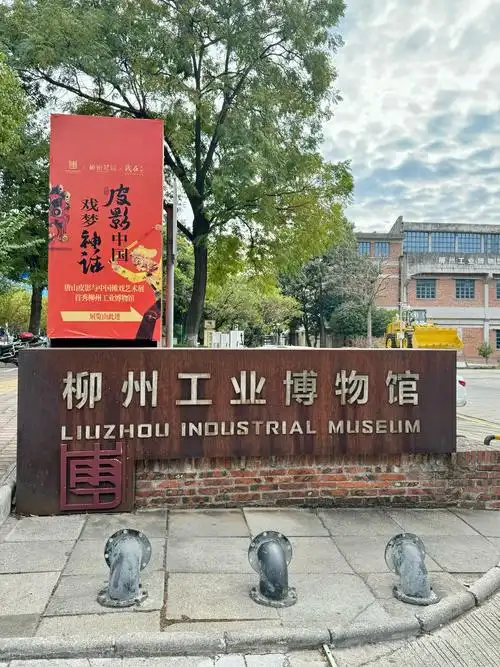 The museum's narrative arc reaches remarkably far back into deep time. Its paleontological hall showcases fossils from the Bailiandong site, a Middle Paleolithic limestone cave whose age is comparable to European sites such as France's La Chapelle-aux-Saints or the Swanscombe finds in England, both pivotal in establishing our understanding of early Homo sapiens and archaic human relatives. The star exhibit, the Liujiang Man remains, push human presence in the region back roughly 67,000 years, predating many of the famous Upper Paleolithic European fossils. This makes the museum a quietly significant stop for travelers interested in human origins and the wider story of how our species populated the planet.
Approach the building and you encounter a striking architectural gesture: a fortress-gate silhouette clad in pale granite, its facade ringed by 21 bas-relief panels tracing civilization from prehistory into a speculative future. Think of it as a regional cousin to London's Wellington Arch or the Albert Memorial in scale and civic ambition, though the granite massing is more reminiscent of a Mediterranean citadel. Step inside the entrance hall and the ceiling transforms into a constellation of oil-paper umbrellas, the traditional Liuzhou craft motif deployed as a luminous canopy over the lobby. It is the building's most photographed feature and an immediate cue that the city takes design seriously.
Culturally, the museum functions as a guardian of Guangxi's distinct identity within modern China. The Bronze Ware Gallery holds over 150 vessels dating from the Western Zhou through the Han dynasty, including rare southern pieces such as anthropomorphic sword hilts and a Han-era distillation apparatus, evidence of sophisticated metallurgy that parallels contemporaneous advances in Roman glassblowing or Celtic metalwork in Europe. The Ethnic Cultures hall is equally vivid, presenting the dress, silverwork, woven textiles, and stilted wooden house models of the Zhuang, Miao, Yao, and Dong peoples, communities whose traditions connect to the broader Austroasiatic and Tai-speaking worlds stretching across Southeast Asia.
Plan your visit carefully to get the most from the experience. The museum is open Tuesday through Sunday, 9 a.m. to 5 p.m., with last entry at 4 p.m.; it closes Mondays except during public holidays. Admission is free, and individual visitors typically walk in without reservation, though groups of ten or more and visitors during holidays should book ahead by phone at 0772-2831519 or via the official WeChat account. Friday evenings occasionally feature extended hours until 10 p.m., a quieter window for unhurried contemplation. Allow roughly two and a half to three hours for a thorough tour, and bring a light jacket since summer air conditioning runs cool.
Begin your route on the first floor with the History Gallery and Ethnic Cultures hall, which establish the chronological and cultural foundation, then ascend to the second floor for the bronze collection and the elegant Fan Painting Gallery, where works by Ming and Qing masters such as Dong Qichang and modern masters including Qi Baishi echo the calligraphic traditions found in any great European print room. The third-floor paleontology wing rewards the extra time with multimedia reconstructions of prehistoric lifeways, well suited to families. Photography is permitted without flash, but touching displays is strictly prohibited. Directly across the square lies the Liu Hou Temple and its memorial park honoring Tang dynasty poet Liu Zongyuan, offering a seamless half-day cultural circuit that any European visitor accustomed to tracing Chaucer through Canterbury or Dante through Florence will find immediately familiar in spirit.
Visit Liuzhou Museum because it does something few regional Chinese museums achieve so confidently: it places a single mid-sized industrial city within both the deep human story and the wider tapestry of southern Chinese civilization. For travelers departing the well-worn eastern circuits, it offers quiet galleries, world-class Bronze Age artifacts, and an architectural landmark that rewards photographers, all without the crowds of the megacity museums. It is, quite simply, the best single introduction to one of China's most under-the-radar destinations.
The museum's narrative arc reaches remarkably far back into deep time. Its paleontological hall showcases fossils from the Bailiandong site, a Middle Paleolithic limestone cave whose age is comparable to European sites such as France's La Chapelle-aux-Saints or the Swanscombe finds in England, both pivotal in establishing our understanding of early Homo sapiens and archaic human relatives. The star exhibit, the Liujiang Man remains, push human presence in the region back roughly 67,000 years, predating many of the famous Upper Paleolithic European fossils. This makes the museum a quietly significant stop for travelers interested in human origins and the wider story of how our species populated the planet.
Approach the building and you encounter a striking architectural gesture: a fortress-gate silhouette clad in pale granite, its facade ringed by 21 bas-relief panels tracing civilization from prehistory into a speculative future. Think of it as a regional cousin to London's Wellington Arch or the Albert Memorial in scale and civic ambition, though the granite massing is more reminiscent of a Mediterranean citadel. Step inside the entrance hall and the ceiling transforms into a constellation of oil-paper umbrellas, the traditional Liuzhou craft motif deployed as a luminous canopy over the lobby. It is the building's most photographed feature and an immediate cue that the city takes design seriously.
Culturally, the museum functions as a guardian of Guangxi's distinct identity within modern China. The Bronze Ware Gallery holds over 150 vessels dating from the Western Zhou through the Han dynasty, including rare southern pieces such as anthropomorphic sword hilts and a Han-era distillation apparatus, evidence of sophisticated metallurgy that parallels contemporaneous advances in Roman glassblowing or Celtic metalwork in Europe. The Ethnic Cultures hall is equally vivid, presenting the dress, silverwork, woven textiles, and stilted wooden house models of the Zhuang, Miao, Yao, and Dong peoples, communities whose traditions connect to the broader Austroasiatic and Tai-speaking worlds stretching across Southeast Asia.
Plan your visit carefully to get the most from the experience. The museum is open Tuesday through Sunday, 9 a.m. to 5 p.m., with last entry at 4 p.m.; it closes Mondays except during public holidays. Admission is free, and individual visitors typically walk in without reservation, though groups of ten or more and visitors during holidays should book ahead by phone at 0772-2831519 or via the official WeChat account. Friday evenings occasionally feature extended hours until 10 p.m., a quieter window for unhurried contemplation. Allow roughly two and a half to three hours for a thorough tour, and bring a light jacket since summer air conditioning runs cool.
Begin your route on the first floor with the History Gallery and Ethnic Cultures hall, which establish the chronological and cultural foundation, then ascend to the second floor for the bronze collection and the elegant Fan Painting Gallery, where works by Ming and Qing masters such as Dong Qichang and modern masters including Qi Baishi echo the calligraphic traditions found in any great European print room. The third-floor paleontology wing rewards the extra time with multimedia reconstructions of prehistoric lifeways, well suited to families. Photography is permitted without flash, but touching displays is strictly prohibited. Directly across the square lies the Liu Hou Temple and its memorial park honoring Tang dynasty poet Liu Zongyuan, offering a seamless half-day cultural circuit that any European visitor accustomed to tracing Chaucer through Canterbury or Dante through Florence will find immediately familiar in spirit.
Visit Liuzhou Museum because it does something few regional Chinese museums achieve so confidently: it places a single mid-sized industrial city within both the deep human story and the wider tapestry of southern Chinese civilization. For travelers departing the well-worn eastern circuits, it offers quiet galleries, world-class Bronze Age artifacts, and an architectural landmark that rewards photographers, all without the crowds of the megacity museums. It is, quite simply, the best single introduction to one of China's most under-the-radar destinations.