Tieshan Park
⭐ 3.80
Tieshan Park Scenic Area, Zoucheng City, Jining City, Shandong Province, China
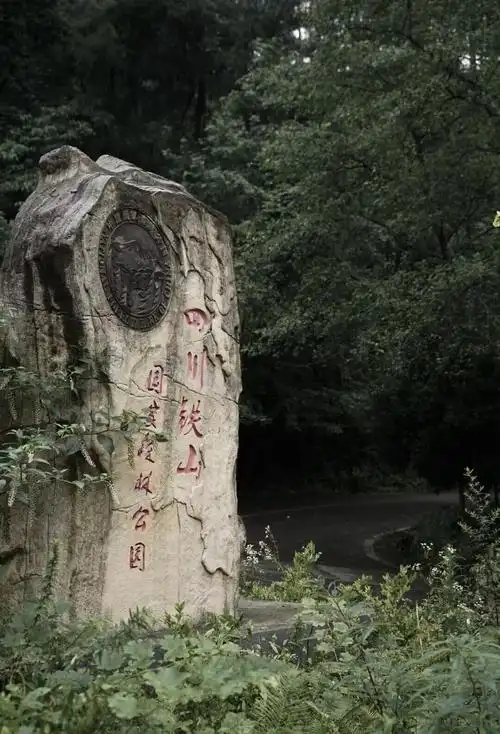 The Tie Mountain cliff inscriptions were carved in 579 CE during the Northern Zhou dynasty, an era when China was reunifying after centuries of division while Europe was navigating its own early medieval transformation following the collapse of Roman authority in the West. The work was commissioned by the monk An Dao Yi, whose calligraphy—blending clerical and emerging regular scripts—sprawls across a vast natural rock face. At 66 meters tall and 1,085 square meters in area, the inscription rivals in scale the great Buddhist cave complexes of India's Ajanta or Afghanistan's now-lost Bamiyan Buddhas, standing as one of the best-preserved monumental Buddhist scriptures from this period of religious fervor.
The calligraphy itself is the architecture: enormous Chinese characters follow the natural contours of the southern rock face, appearing to flow across the stone like a frozen waterfall. The brushwork balances the angular precision of early regular script with the sweeping strokes of traditional clerical writing, creating a visual rhythm that many visitors compare to a colossal illuminated manuscript carved directly into bedrock. Surrounding this centerpiece, the park layers manicured Chinese landscaping with four themed gardens—peony, cherry, crabapple, and plum—each blooming in seasonal succession throughout the year.
Beyond Buddhism, the park carries a distinctly Confucian character through its Mencius Academy, with its whitewashed walls and grey-tiled roofs echoing traditional Shandong scholarly architecture. Zoucheng proudly claims Mencius (372–289 BCE) as its native son—the philosopher whom later tradition crowned "Second Sage" of Confucianism, much as Plato stands second to Socrates in the Western philosophical canon. This pairing of Buddhist scripture with Confucian scholarship makes the park a rare meeting point of China's two great intellectual traditions, inviting contemplation of how stone, ink, and ideas have shaped East Asian civilization across more than two millennia.
Tieshan Park sits at 1498 Gangshan North Road in Zoucheng, approximately 50 kilometers from central Jining—roughly an hour's drive or a comfortable day trip by high-speed rail. Trains arrive at Zoucheng East Station, where Bus 19 connects directly to the park entrance. The grounds are free and open daily from 7:30 a.m. to 6:30 p.m., with no advance reservation required. Signage is predominantly in Chinese, so visitors without language skills may wish to download a translation app or join a local guide. Comfortable walking shoes, sun protection, and a refillable water bottle are recommended.
Plan for 1.5 to 2 hours, entering through the south gate and walking the loop trail clockwise. Begin at the cliff inscriptions to appreciate them in soft morning or late-afternoon light—flash photography is prohibited to protect the stone—then climb toward the summit for sweeping views over Zoucheng's rooftops and surrounding hills before descending through the Mencius Academy. Early risers are rewarded with golden light on the carvings and cooler walking temperatures, while late afternoons offer dramatic shadows and a quieter atmosphere. The combination of monumental ancient art, seasonal blooms, and Confucian heritage gives this unassuming Shandong park a depth rarely found in urban green spaces.
The Tie Mountain cliff inscriptions were carved in 579 CE during the Northern Zhou dynasty, an era when China was reunifying after centuries of division while Europe was navigating its own early medieval transformation following the collapse of Roman authority in the West. The work was commissioned by the monk An Dao Yi, whose calligraphy—blending clerical and emerging regular scripts—sprawls across a vast natural rock face. At 66 meters tall and 1,085 square meters in area, the inscription rivals in scale the great Buddhist cave complexes of India's Ajanta or Afghanistan's now-lost Bamiyan Buddhas, standing as one of the best-preserved monumental Buddhist scriptures from this period of religious fervor.
The calligraphy itself is the architecture: enormous Chinese characters follow the natural contours of the southern rock face, appearing to flow across the stone like a frozen waterfall. The brushwork balances the angular precision of early regular script with the sweeping strokes of traditional clerical writing, creating a visual rhythm that many visitors compare to a colossal illuminated manuscript carved directly into bedrock. Surrounding this centerpiece, the park layers manicured Chinese landscaping with four themed gardens—peony, cherry, crabapple, and plum—each blooming in seasonal succession throughout the year.
Beyond Buddhism, the park carries a distinctly Confucian character through its Mencius Academy, with its whitewashed walls and grey-tiled roofs echoing traditional Shandong scholarly architecture. Zoucheng proudly claims Mencius (372–289 BCE) as its native son—the philosopher whom later tradition crowned "Second Sage" of Confucianism, much as Plato stands second to Socrates in the Western philosophical canon. This pairing of Buddhist scripture with Confucian scholarship makes the park a rare meeting point of China's two great intellectual traditions, inviting contemplation of how stone, ink, and ideas have shaped East Asian civilization across more than two millennia.
Tieshan Park sits at 1498 Gangshan North Road in Zoucheng, approximately 50 kilometers from central Jining—roughly an hour's drive or a comfortable day trip by high-speed rail. Trains arrive at Zoucheng East Station, where Bus 19 connects directly to the park entrance. The grounds are free and open daily from 7:30 a.m. to 6:30 p.m., with no advance reservation required. Signage is predominantly in Chinese, so visitors without language skills may wish to download a translation app or join a local guide. Comfortable walking shoes, sun protection, and a refillable water bottle are recommended.
Plan for 1.5 to 2 hours, entering through the south gate and walking the loop trail clockwise. Begin at the cliff inscriptions to appreciate them in soft morning or late-afternoon light—flash photography is prohibited to protect the stone—then climb toward the summit for sweeping views over Zoucheng's rooftops and surrounding hills before descending through the Mencius Academy. Early risers are rewarded with golden light on the carvings and cooler walking temperatures, while late afternoons offer dramatic shadows and a quieter atmosphere. The combination of monumental ancient art, seasonal blooms, and Confucian heritage gives this unassuming Shandong park a depth rarely found in urban green spaces.