Longtan Park
⭐ 4.60
Longtan Park, Yufeng District, Liuzhou City, Guangxi Zhuang Autonomous Region, China
 The park's historical treasures span more than three millennia. Its Neolithic shell-mound sites—where ancient inhabitants discarded mollusk shells in great heaps—parallel the kitchen middens of Scandinavia's Ertebølle culture (roughly 5400–3900 BCE), offering tangible links to early human settlement. The Tang Dynasty stele commemorating writer Liu Zongyuan's "Rain Prayer at Thunder Pool" dates from the same era as Charlemagne's coronation in 800 CE, when Europe was emerging from its early medieval period. A Ming Dynasty cliff inscription by the official Zhang Chong further enriches this layered chronology, transforming the park into a walk through more than a thousand years of Chinese civilization.
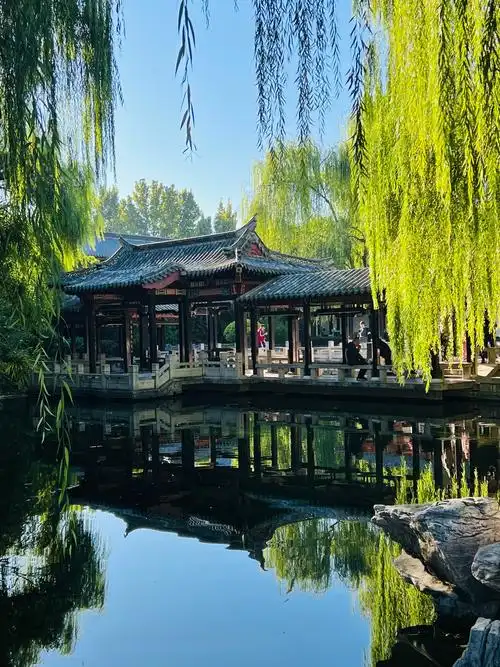
The architectural centerpiece is a striking replica of the Chengyang Wind-and-Rain Bridge, a covered wooden span whose upturned eaves and lacquered beams recall the painted trusses of Kyoto's temple halls or, more loosely, Switzerland's medieval Chapel Bridge in Lucerne. Nearby, the clustered Dong drum towers—tall, pagoda-like structures crowned with tiered roofs—rise like watchtowers of a Tuscan hill town, their silhouettes amplified by intricate painted decoration. Surrounding villages showcase traditional stilt houses of the Zhuang, Miao, and Yao peoples, constructed much like Alpine chalets adapted to tropical humidity, with airy upper floors for daily life and shaded verandas for gathering.
More than an open-air museum, the park functions as a living stage for Guangxi's ethnic traditions. Visitors arriving at the right moment may encounter impromptu performances of antiphonal love songs (duige) and lusheng reed-pipe dances, customs shared across Southeast Asia's upland communities and reminiscent of Scottish Gaelic psalm singing in their call-and-response structure. Travelers can rent traditional costumes for photographs, sample regional specialties like pounded oil tea, bamboo-tube rice, and sour fish, and watch artisans demonstrate intangible heritage crafts. The combination of song, costume, cuisine, and architecture makes this one of the most accessible windows into southern China's minority cultures.
The park welcomes visitors year-round at no charge. Summer hours run 6:00 AM to 10:30 PM; winter hours shift to 6:30 AM to 10:00 PM, with illuminated nightscapes offering a second, dramatically different visual experience. Reach the north gate by Bus 19, or the east gate via Buses 48, 69, or 70. To escape Guangxi's fierce summer heat, plan your arrival before 8:30 AM or after 4:00 PM; the surrounding karst peaks create surprisingly cool microclimates near the water. Two looped walking trails—a 2 km short loop and a 3 km full circuit—let visitors tailor the visit to their stamina, with children's play areas, boat rentals, and picnic lawns along the way.
Longtan Park earns its nickname as the "city's ecological living room" by compressing multiple experiences into a single green space: misty karst scenery comparable to Vietnam's Ha Long Bay, ethnic architecture echoing the wooden churches of Eastern Europe, and historical depth reaching back to the Neolithic era. Whether you come for a leisurely morning stroll, an evening boat ride on jade-green water, or a half-day cultural immersion, the park delivers an unusually rich, walkable introduction to Guangxi's landscapes and people—without ever leaving Liuzhou's urban footprint.
The park's historical treasures span more than three millennia. Its Neolithic shell-mound sites—where ancient inhabitants discarded mollusk shells in great heaps—parallel the kitchen middens of Scandinavia's Ertebølle culture (roughly 5400–3900 BCE), offering tangible links to early human settlement. The Tang Dynasty stele commemorating writer Liu Zongyuan's "Rain Prayer at Thunder Pool" dates from the same era as Charlemagne's coronation in 800 CE, when Europe was emerging from its early medieval period. A Ming Dynasty cliff inscription by the official Zhang Chong further enriches this layered chronology, transforming the park into a walk through more than a thousand years of Chinese civilization.
The architectural centerpiece is a striking replica of the Chengyang Wind-and-Rain Bridge, a covered wooden span whose upturned eaves and lacquered beams recall the painted trusses of Kyoto's temple halls or, more loosely, Switzerland's medieval Chapel Bridge in Lucerne. Nearby, the clustered Dong drum towers—tall, pagoda-like structures crowned with tiered roofs—rise like watchtowers of a Tuscan hill town, their silhouettes amplified by intricate painted decoration. Surrounding villages showcase traditional stilt houses of the Zhuang, Miao, and Yao peoples, constructed much like Alpine chalets adapted to tropical humidity, with airy upper floors for daily life and shaded verandas for gathering.
More than an open-air museum, the park functions as a living stage for Guangxi's ethnic traditions. Visitors arriving at the right moment may encounter impromptu performances of antiphonal love songs (duige) and lusheng reed-pipe dances, customs shared across Southeast Asia's upland communities and reminiscent of Scottish Gaelic psalm singing in their call-and-response structure. Travelers can rent traditional costumes for photographs, sample regional specialties like pounded oil tea, bamboo-tube rice, and sour fish, and watch artisans demonstrate intangible heritage crafts. The combination of song, costume, cuisine, and architecture makes this one of the most accessible windows into southern China's minority cultures.
The park welcomes visitors year-round at no charge. Summer hours run 6:00 AM to 10:30 PM; winter hours shift to 6:30 AM to 10:00 PM, with illuminated nightscapes offering a second, dramatically different visual experience. Reach the north gate by Bus 19, or the east gate via Buses 48, 69, or 70. To escape Guangxi's fierce summer heat, plan your arrival before 8:30 AM or after 4:00 PM; the surrounding karst peaks create surprisingly cool microclimates near the water. Two looped walking trails—a 2 km short loop and a 3 km full circuit—let visitors tailor the visit to their stamina, with children's play areas, boat rentals, and picnic lawns along the way.
Longtan Park earns its nickname as the "city's ecological living room" by compressing multiple experiences into a single green space: misty karst scenery comparable to Vietnam's Ha Long Bay, ethnic architecture echoing the wooden churches of Eastern Europe, and historical depth reaching back to the Neolithic era. Whether you come for a leisurely morning stroll, an evening boat ride on jade-green water, or a half-day cultural immersion, the park delivers an unusually rich, walkable introduction to Guangxi's landscapes and people—without ever leaving Liuzhou's urban footprint.