Three Rivers Confluence
⭐ 3.80
Sanjiangkou Town, Sanjiang Dong Autonomous County, Liuzhou City, Guangxi Zhuang Autonomous Region, China
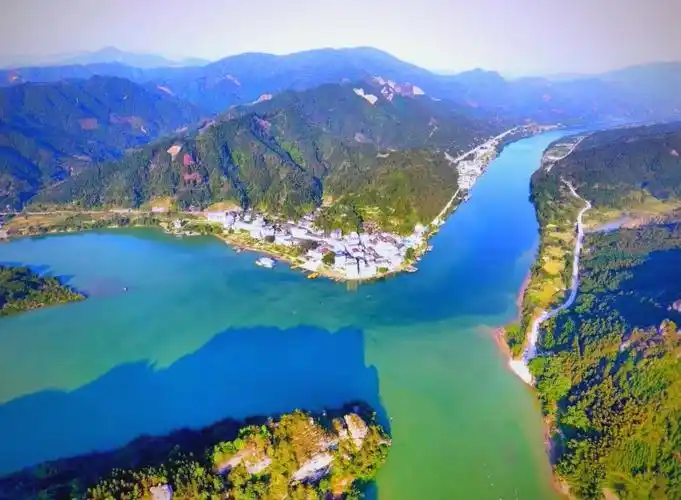 Set at the meeting point of Guangxi, Hunan, and Guizhou provinces, Sanjiaokou lies about 30 kilometers from Sanjiang county town, roughly a 40-minute drive through karst-studded hill country. The site's name literally means "Three River Mouth," and it occupies a hydrological position reminiscent of Europe's great river confluences—think of how the Rhine, Main, and Moselle meet at Koblenz. Here, the three tributaries bring different sediment loads, creating clearly visible color boundaries where they merge, a phenomenon that has drawn poets and travelers for centuries.
The centerpiece is Chankou Shimenxia Lake, where sheer canyon walls rise on either side of a broad, glassy waterway flanked by lush subtropical forest. Locals proudly call it "Not the Three Gorges, yet surpassing the Three Gorges," an audacious claim that, in many visitors' eyes, holds up. Boat rides thread between towering limestone cliffs, echoing the dramatic scenery of Norway's fjords or the Danube's Iron Gates, but with the added drama of watching three distinct currents weave into one.
Cultural depth comes from the Dong people, one of China's most architecturally gifted minorities, whose settlements in this region are threaded with covered wind-and-rain bridges and soaring drum towers. Within the park, a massive banyan tree more than 13 centuries old spreads its canopy like a living cathedral, worshipped as a spirit guardian. According to local belief, washing your hands with the waters of all three rivers brings blessings of fortune, longevity, and joy—a ritual many travelers quietly attempt.
Visitors can join hands-on activities such as pounding sticky rice cakes with wooden mallets, brewing fragrant oil tea, sipping拦路酒 blocking-road welcome wine, and sitting down to a long-table banquet laden with sour fish, cured pork, and sticky rice. These experiences echo the communal feasting traditions found across rural Europe, from Italian harvest festivals to Bavarian beer-hall gatherings, but with a distinctly Dong flavor. Nearby, Chengyang Eight Villages showcases UNESCO-worthy bridges, while Danzhou Ancient Town is a walled Ming-era settlement set on an island in the Liu River.
Practical planning is straightforward: the park itself charges no main entrance fee, though boat trips and cultural experiences cost extra. High-speed trains run to Sanjiang South Station, from which taxis or rental cars cover the final stretch—public buses in this mountainous area are infrequent. Spring and autumn bring the most pleasant weather, summer offers cool relief from the lowland heat despite occasional rain, and winter sees fewest crowds. Festival seasons in July and August, plus major Chinese holidays, deliver the richest program of Dong music, dance, and parades.
Set at the meeting point of Guangxi, Hunan, and Guizhou provinces, Sanjiaokou lies about 30 kilometers from Sanjiang county town, roughly a 40-minute drive through karst-studded hill country. The site's name literally means "Three River Mouth," and it occupies a hydrological position reminiscent of Europe's great river confluences—think of how the Rhine, Main, and Moselle meet at Koblenz. Here, the three tributaries bring different sediment loads, creating clearly visible color boundaries where they merge, a phenomenon that has drawn poets and travelers for centuries.
The centerpiece is Chankou Shimenxia Lake, where sheer canyon walls rise on either side of a broad, glassy waterway flanked by lush subtropical forest. Locals proudly call it "Not the Three Gorges, yet surpassing the Three Gorges," an audacious claim that, in many visitors' eyes, holds up. Boat rides thread between towering limestone cliffs, echoing the dramatic scenery of Norway's fjords or the Danube's Iron Gates, but with the added drama of watching three distinct currents weave into one.
Cultural depth comes from the Dong people, one of China's most architecturally gifted minorities, whose settlements in this region are threaded with covered wind-and-rain bridges and soaring drum towers. Within the park, a massive banyan tree more than 13 centuries old spreads its canopy like a living cathedral, worshipped as a spirit guardian. According to local belief, washing your hands with the waters of all three rivers brings blessings of fortune, longevity, and joy—a ritual many travelers quietly attempt.
Visitors can join hands-on activities such as pounding sticky rice cakes with wooden mallets, brewing fragrant oil tea, sipping拦路酒 blocking-road welcome wine, and sitting down to a long-table banquet laden with sour fish, cured pork, and sticky rice. These experiences echo the communal feasting traditions found across rural Europe, from Italian harvest festivals to Bavarian beer-hall gatherings, but with a distinctly Dong flavor. Nearby, Chengyang Eight Villages showcases UNESCO-worthy bridges, while Danzhou Ancient Town is a walled Ming-era settlement set on an island in the Liu River.
Practical planning is straightforward: the park itself charges no main entrance fee, though boat trips and cultural experiences cost extra. High-speed trains run to Sanjiang South Station, from which taxis or rental cars cover the final stretch—public buses in this mountainous area are infrequent. Spring and autumn bring the most pleasant weather, summer offers cool relief from the lowland heat despite occasional rain, and winter sees fewest crowds. Festival seasons in July and August, plus major Chinese holidays, deliver the richest program of Dong music, dance, and parades.