Leifeng Pagoda
⭐ 4.20
Leifeng Pagoda Scenic Area, Hangzhou, Zhejiang Province, China
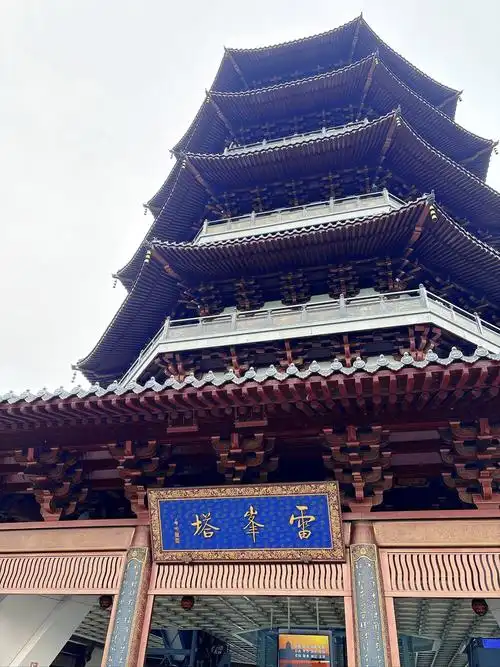 Rising 71.68 meters above Sunset Hill (夕照山) on West Lake's southern flank, Leifeng Pagoda occupies a place in Chinese culture rivaling the romantic pull of Heidelberg Castle or the literary fame of Spain's Alhambra. First raised in 977 AD by Qian Chu, the last king of the short-lived Wuyue Kingdom—a regional power contemporary with Saxon England—its original purpose was to honor his consort Sun. Over the following millennium, the pagoda became a treasured Buddhist site until 1924, when its bricks were literally stolen out from under it by superstitious locals seeking rumored treasures inside. The 2002 reconstruction resurrected its Song-era silhouette, and the archaeological excavation of its underground palace yielded a stunning bronze Ashoka stupa, now displayed alongside foundation remnants beneath the new structure.
The pagoda's architecture represents a fascinating hybrid: China's first steel-framed heritage tower, sheathed in colored copper tiles that blaze amber in the setting sun. Modeled on an eight-sided, five-tier wooden-pavilion style recorded in the Southern Song capital's official gazette, its flying eaves and intricate dougong bracketing echo the wooden temple traditions of Kyoto, while its sheer copper-clad mass feels distinctly modern. The ground floor deliberately exposes the crumbling brick core of the original pagoda through glass flooring—an architectural time machine reminiscent of Rome's layered ruins beneath modern churches.
Leifeng's cultural resonance stems largely from "Legend of the White Snake," China's equivalent of Tristan and Isolde or Romeo and Juliet. The tale of a serpent spirit imprisoned beneath the pagoda by the monk Fahai has inspired opera, film, and literature for centuries. Inside, a breathtaking 60-meter Dongyang wood-carving panorama unfurls the saga's iconic scenes—"Meeting on Broken Bridge" and "Flooding Jinshan Temple"—across entire walls, while upper floors showcase Wuyue-era Buddhist art and classical poetry about the tower.
Visiting is straightforward: located at 15 Nanshan Road, West Lake District, entry costs 40 yuan with discounts for students and seniors. The site stays open until 8 PM in high season (May–October), making late-afternoon arrival ideal. Allow 90 minutes to descend to the foundation level for archaeological viewing, ascend by elevator to the top-floor observation deck for panoramic views spanning Su Causeway, Three Pools Mirroring the Moon, Baochu Pagoda, and Jingci Temple, then drift downward examining the wood carvings. The 4:30 PM entry strategy captures daytime vistas, golden-hour photography, and illuminated evening reflections in a single visit.
Beyond the pagoda itself, the surrounding area rewards exploration. Cross the road to Jingci Temple for its 10-yuan ticket and the famous Nanping Evening Bell, or stroll westward to Long Bridge Park for postcard-perfect reflections of Leifeng mirrored in the lake. Public transport via Longxiangqiao metro station followed by bus or bike is recommended—driving into the West Lake scenic area means navigating Hangzhou's strict license-plate restrictions on weekends. Whether you come for the legend, the sunset, or the view, Leifeng Pagoda offers one of China's most poetically charged experiences.
Rising 71.68 meters above Sunset Hill (夕照山) on West Lake's southern flank, Leifeng Pagoda occupies a place in Chinese culture rivaling the romantic pull of Heidelberg Castle or the literary fame of Spain's Alhambra. First raised in 977 AD by Qian Chu, the last king of the short-lived Wuyue Kingdom—a regional power contemporary with Saxon England—its original purpose was to honor his consort Sun. Over the following millennium, the pagoda became a treasured Buddhist site until 1924, when its bricks were literally stolen out from under it by superstitious locals seeking rumored treasures inside. The 2002 reconstruction resurrected its Song-era silhouette, and the archaeological excavation of its underground palace yielded a stunning bronze Ashoka stupa, now displayed alongside foundation remnants beneath the new structure.
The pagoda's architecture represents a fascinating hybrid: China's first steel-framed heritage tower, sheathed in colored copper tiles that blaze amber in the setting sun. Modeled on an eight-sided, five-tier wooden-pavilion style recorded in the Southern Song capital's official gazette, its flying eaves and intricate dougong bracketing echo the wooden temple traditions of Kyoto, while its sheer copper-clad mass feels distinctly modern. The ground floor deliberately exposes the crumbling brick core of the original pagoda through glass flooring—an architectural time machine reminiscent of Rome's layered ruins beneath modern churches.
Leifeng's cultural resonance stems largely from "Legend of the White Snake," China's equivalent of Tristan and Isolde or Romeo and Juliet. The tale of a serpent spirit imprisoned beneath the pagoda by the monk Fahai has inspired opera, film, and literature for centuries. Inside, a breathtaking 60-meter Dongyang wood-carving panorama unfurls the saga's iconic scenes—"Meeting on Broken Bridge" and "Flooding Jinshan Temple"—across entire walls, while upper floors showcase Wuyue-era Buddhist art and classical poetry about the tower.
Visiting is straightforward: located at 15 Nanshan Road, West Lake District, entry costs 40 yuan with discounts for students and seniors. The site stays open until 8 PM in high season (May–October), making late-afternoon arrival ideal. Allow 90 minutes to descend to the foundation level for archaeological viewing, ascend by elevator to the top-floor observation deck for panoramic views spanning Su Causeway, Three Pools Mirroring the Moon, Baochu Pagoda, and Jingci Temple, then drift downward examining the wood carvings. The 4:30 PM entry strategy captures daytime vistas, golden-hour photography, and illuminated evening reflections in a single visit.
Beyond the pagoda itself, the surrounding area rewards exploration. Cross the road to Jingci Temple for its 10-yuan ticket and the famous Nanping Evening Bell, or stroll westward to Long Bridge Park for postcard-perfect reflections of Leifeng mirrored in the lake. Public transport via Longxiangqiao metro station followed by bus or bike is recommended—driving into the West Lake scenic area means navigating Hangzhou's strict license-plate restrictions on weekends. Whether you come for the legend, the sunset, or the view, Leifeng Pagoda offers one of China's most poetically charged experiences.