Tianchi Lake Scenic Area
⭐ 4.60
Tianchi Lake Scenic Area, Fukang City, Changji Hui Autonomous Prefecture, Xinjiang Uyghur Autonomous Region, China
 **Mythology and Historical Significance**
Tianchi's cultural roots stretch back more than two millennia, when it was known as the "Jade Pool," the legendary residence of Xiwangmu, the Queen Mother of the West, who hosted the famous Peach Banquet of immortals. For Daoist tradition, it functions much like Mount Olympus did for the ancient Greeks—a sacred threshold where mortals and deities meet. The Qing Dynasty bestowed its current name, "Heavenly Lake," and the site earned National Scenic Area status in 1982 before becoming part of the UNESCO World Natural Heritage listing for the Xinjiang Tian Shan range. Today it carries both geological and cultural weight, drawing pilgrims of landscape and legend alike.
**Geological Marvel**
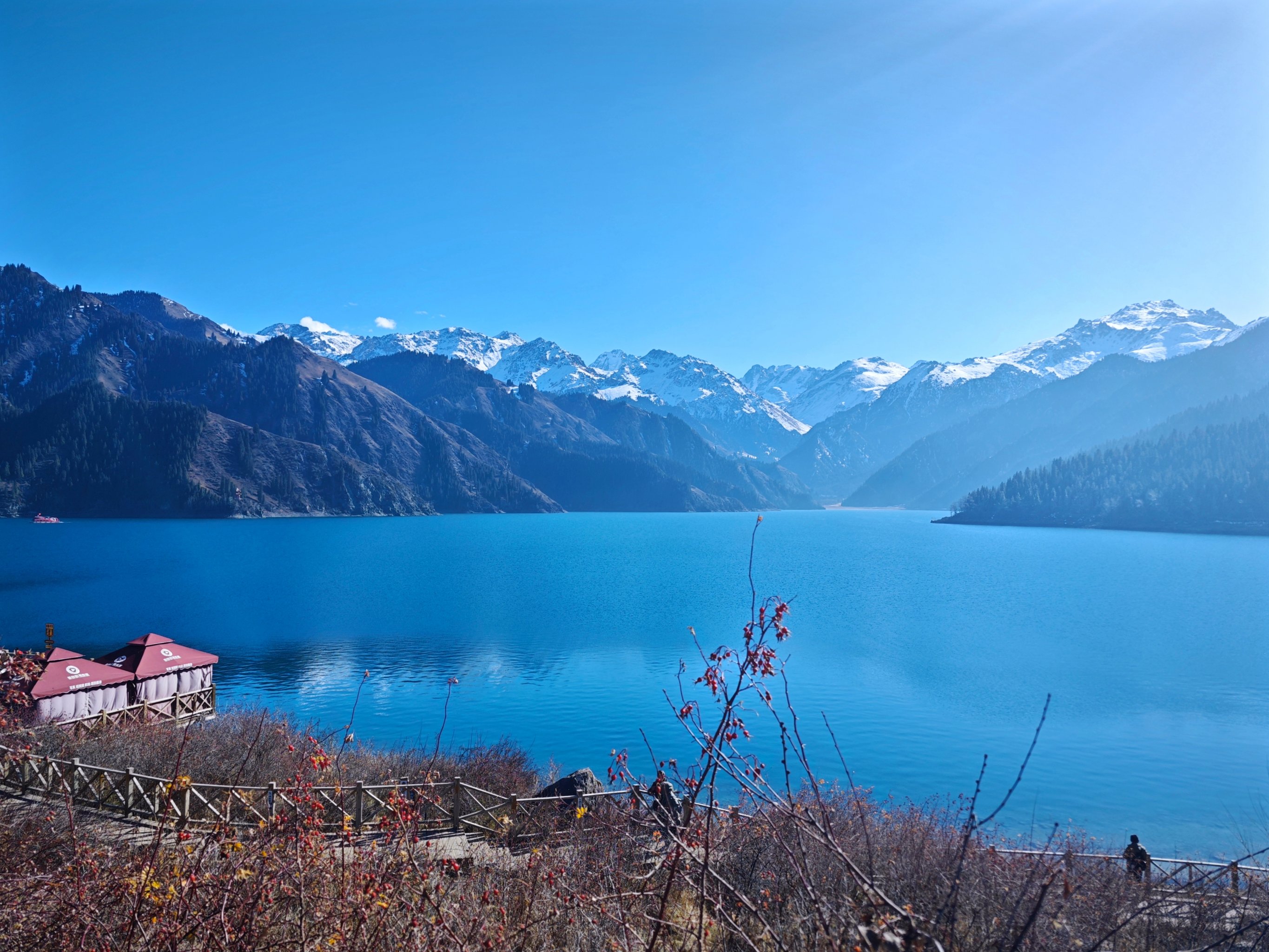
The lake itself is a textbook example of glacial sculpting: a half-moon basin carved by ancient ice and dammed by a moraine wall, plunging to 105 meters at its deepest point. Its mineral-rich waters shimmer in a vivid cobalt-turquoise that rivals Alpine lakes such as Switzerland's Oeschinensee. Surrounding the shoreline, groves of snow spruce (Tianshan fir) climb toward the perpetual snows of Bogeda Peak, forming the classic "snow mountain–forest–lake" trinity beloved of Chinese landscape painters. The eerie "Sea-Calming Needle," a gnarled ancient elm said to be a hairpin of the Queen Mother herself, stands as the lake's most photographed curiosity.
**Canyons, Waterfalls, and Cultural Architecture**
Visitors enter the park through the dramatic Stone Gate canyon, where sheer cliffs squeeze the road—a passage that evokes the narrow defiles of Norway's fjords or Switzerland's Lauterbrunnen Valley. Two smaller satellite lakes complement the main basin: the tranquil West Small Lake and East Small Lake, the latter cascading in a rushing waterfall. Along the eastern shore sits the Queen Mother Ancestral Temple, a hillside complex whose tiered pavilions recall the mountain monasteries of Meteora in Greece. Built in harmony with the terrain and framed by cypress and prayer flags, the temple anchors Tianchi's mythological legacy in tangible stone.
**Viewpoints and Cable Car Experience**
For panoramic rewards, the Maya Mountain cable car climbs to a 3,056-meter observation deck—the only vantage point where the full sweep of Bogeda's glaciers and Tianchi's crescent appear in a single frame. Rising through alternating zones of dense spruce, alpine meadow, and bare granite, the ride parallels the vertical "four-seasons-in-one-day" ecological transitions that draw comparison to Peru's Sacred Valley or the Himalayas' mid-altitude belts. Photography enthusiasts will find the upper platform unmatched for capturing the contrast of icy summit and liquid turquoise below. Round-trip tickets cost roughly 220 yuan and require separate purchase.
**Practical Visiting Information**
The scenic area is open daily from 08:00 to 19:00 between April 1 and October 31. Entry costs 155 yuan per person, combining a 95-yuan admission fee with a mandatory 60-yuan shuttle bus that all visitors must take; private cars are parked at the visitor center, with a 40-minute ride to the lake. The ticket remains valid for two consecutive days, allowing leisurely exploration. Recommended routing runs from the visitor center through West Small Lake, around the main lake, past the Queen Mother Temple, to East Small Lake, and finally up the Maya Mountain cable car—a circuit taking three to four hours.
**Seasonal Tips and Why Visit**
August is unquestionably the prime month, when snowmelt fills the lake to its most luminous blue and the surrounding meadows turn gold. Expect daytime temperatures of 26 °C at lake level but up to 38 °C in the valley below, with intense UV and sharp temperature swings after sunset—pack a windproof jacket, sunscreen, sunglasses, and a hat. Arriving before 8 a.m. beats the tour-bus rush and secures the clearest mirror-like reflections of Bogeda Peak. For Western travelers, Tianchi offers a rare combination of high-altitude wilderness, living mythology, and Silk Road heritage found nowhere else on Earth.
**Mythology and Historical Significance**
Tianchi's cultural roots stretch back more than two millennia, when it was known as the "Jade Pool," the legendary residence of Xiwangmu, the Queen Mother of the West, who hosted the famous Peach Banquet of immortals. For Daoist tradition, it functions much like Mount Olympus did for the ancient Greeks—a sacred threshold where mortals and deities meet. The Qing Dynasty bestowed its current name, "Heavenly Lake," and the site earned National Scenic Area status in 1982 before becoming part of the UNESCO World Natural Heritage listing for the Xinjiang Tian Shan range. Today it carries both geological and cultural weight, drawing pilgrims of landscape and legend alike.
**Geological Marvel**
The lake itself is a textbook example of glacial sculpting: a half-moon basin carved by ancient ice and dammed by a moraine wall, plunging to 105 meters at its deepest point. Its mineral-rich waters shimmer in a vivid cobalt-turquoise that rivals Alpine lakes such as Switzerland's Oeschinensee. Surrounding the shoreline, groves of snow spruce (Tianshan fir) climb toward the perpetual snows of Bogeda Peak, forming the classic "snow mountain–forest–lake" trinity beloved of Chinese landscape painters. The eerie "Sea-Calming Needle," a gnarled ancient elm said to be a hairpin of the Queen Mother herself, stands as the lake's most photographed curiosity.
**Canyons, Waterfalls, and Cultural Architecture**
Visitors enter the park through the dramatic Stone Gate canyon, where sheer cliffs squeeze the road—a passage that evokes the narrow defiles of Norway's fjords or Switzerland's Lauterbrunnen Valley. Two smaller satellite lakes complement the main basin: the tranquil West Small Lake and East Small Lake, the latter cascading in a rushing waterfall. Along the eastern shore sits the Queen Mother Ancestral Temple, a hillside complex whose tiered pavilions recall the mountain monasteries of Meteora in Greece. Built in harmony with the terrain and framed by cypress and prayer flags, the temple anchors Tianchi's mythological legacy in tangible stone.
**Viewpoints and Cable Car Experience**
For panoramic rewards, the Maya Mountain cable car climbs to a 3,056-meter observation deck—the only vantage point where the full sweep of Bogeda's glaciers and Tianchi's crescent appear in a single frame. Rising through alternating zones of dense spruce, alpine meadow, and bare granite, the ride parallels the vertical "four-seasons-in-one-day" ecological transitions that draw comparison to Peru's Sacred Valley or the Himalayas' mid-altitude belts. Photography enthusiasts will find the upper platform unmatched for capturing the contrast of icy summit and liquid turquoise below. Round-trip tickets cost roughly 220 yuan and require separate purchase.
**Practical Visiting Information**
The scenic area is open daily from 08:00 to 19:00 between April 1 and October 31. Entry costs 155 yuan per person, combining a 95-yuan admission fee with a mandatory 60-yuan shuttle bus that all visitors must take; private cars are parked at the visitor center, with a 40-minute ride to the lake. The ticket remains valid for two consecutive days, allowing leisurely exploration. Recommended routing runs from the visitor center through West Small Lake, around the main lake, past the Queen Mother Temple, to East Small Lake, and finally up the Maya Mountain cable car—a circuit taking three to four hours.
**Seasonal Tips and Why Visit**
August is unquestionably the prime month, when snowmelt fills the lake to its most luminous blue and the surrounding meadows turn gold. Expect daytime temperatures of 26 °C at lake level but up to 38 °C in the valley below, with intense UV and sharp temperature swings after sunset—pack a windproof jacket, sunscreen, sunglasses, and a hat. Arriving before 8 a.m. beats the tour-bus rush and secures the clearest mirror-like reflections of Bogeda Peak. For Western travelers, Tianchi offers a rare combination of high-altitude wilderness, living mythology, and Silk Road heritage found nowhere else on Earth.