Beijing-Hangzhou Grand Canal · Hangzhou

⭐ 4.40

Beijing-Hangzhou Grand Canal Hangzhou Scenic Area, Hangzhou, Zhejiang Province, China
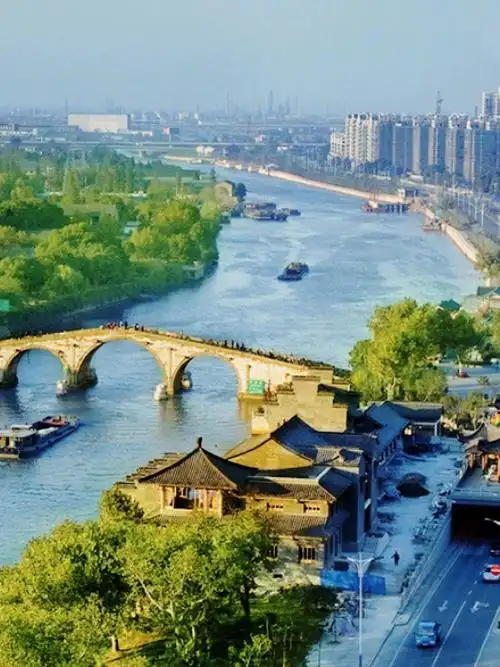
Beijing-Hangzhou Grand Canal · Hangzhou
The Grand Canal is one of humanity's most ambitious pre-industrial engineering feats—comparable in ambition to Rome's road network or Venice's lagoon commerce. First excavated during the Spring and Autumn period, fully connected under the Sui dynasty around 610 AD, and rerouted by the Mongols in the Yuan era to its present form, its total length approaches 1,800 km. That makes it roughly six times longer than France's Canal du Midi (a UNESCO sibling since 1996) and the longest artificial waterway on Earth. Hangzhou marks its southern terminus, and unlike many historic canals that exist only as museum pieces, this stretch remains a living artery where cargo barges, tour boats, and water buses share the same current—a working waterway much as the Rhine or Danube were in medieval Europe. The section's architectural centerpiece is Gongchen Bridge, a triple-arched stone span built in the Ming era and traditionally understood as marking the canal's southern gateway. Its carved balustrades reflect beautifully at dusk, evoking the elegance of a Venetian footbridge. From here, a 2–3 hour walking loop threads through the three distinct historic quarters: Qiaoxi, a cluster of restored warehouses now housing intangible heritage museums; Dadou Road, dominated by the Buddhist serenity of Xiangji Temple; and Xiaohe Straight Street, where Republican-era shopfronts and narrow lanes preserve the gritty texture of 1920s Hangzhou. The cultural significance here lies in a rare fusion the rest of the world can rarely match—an unbroken chain of craft traditions still practiced in situ. Four national-level museums form China's only intangible-heritage museum cluster: the Grand Canal Museum, the China Knives, Scissors and Swords Museum, the Umbrella Museum, and the Fan Museum. Nearby, the Living Heritage Hall invites visitors to watch oil-paper umbrellas being stretched and scissors being forged, much as one might observe Murano glassblowers near Venice. Meanwhile, former fuel depots reborn as Xiaohe Park and the timeworn Fuyi Warehouse converted into creative studios show how a nation can adapt industrial relics the way Liverpool's Albert Dock or Hamburg's Speicherstadt have done in Europe. Practical information is refreshingly straightforward. The riverside walkways, bridges, and main canal embankments are open 24 hours and free of charge, with no reservation required. The museum cluster requires free online booking via official WeChat accounts; opening hours are Tuesday to Sunday, 9:00–16:30, closed Mondays. The cleanest route is by metro—Line 5 to Grand Canal Station or Line 3 to Xiangji Temple Station—since parking is tight on weekends and holidays. A water bus (Line 1) departs from Wulinmen Wharf for just ¥3 (about 40 US cents) northbound to Gongchen Bridge, while evening sightseeing cruises start at ¥68. The best strategy is to arrive after 4 pm. Take the water bus north, climb Gongchen Bridge at golden hour, then walk back south through the three historic lanes, finishing at Dadou Road as dusk deepens. Locals nickname the illuminated scene a "floating Along the River During the Qingming Festival"—the famous 12th-century scroll that depicted this very waterway at its commercial peak. For travelers who have already ticked off the West Lake, this is the Hangzhou experience that rewards a second evening, delivering both sunset panoramas and a lantern-lit riverscape that no European canal city quite replicates.

Traveler reviews

Hangzhou's section of the Grand Canal is famous for its unique waterway scenery and historical-cultural value. Wi...
⭐ 5 · Casey Expand
Taking a cruise on the Grand Canal feels like a water journey穿越 a thousand years. The boat glides through green waters, with ancient architecture and modern cityscapes on both banks — there's a real sense of history mixed with everyday life. Passing under Gongchen Bridge, you can almost hear t...
⭐ 5 · Rowan Expand