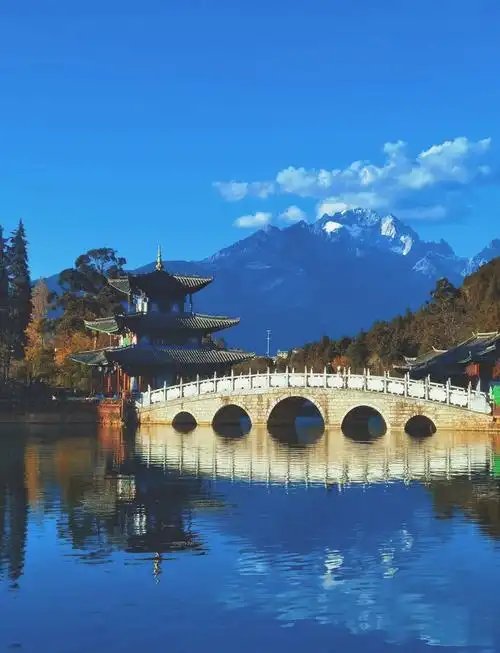
With origins stretching back over two millennia to the Western Han dynasty's "Black Water Shrine," Black Dragon Pool is often called "Yunnan's Oldest Ancient Shrine." For context, it predates the fall of Rome and has functioned continuously through every Chinese dynasty since—surviving the same turbulent centuries that shaped medieval Europe. This remarkable continuity makes it an invaluable living archive of southwestern religious culture, offering visitors a tangible connection to the ancient world that few Chinese sites can match.
The park's architectural heart is a layered Taoist complex divided into the Lower Abbey (Black Dragon Palace) and the Upper Abbey (Longquan Temple), arranged in a five-courtyard configuration climbing the mountainside. Comparable in ambition to a hillside monastery like Montserrat in Spain, the ensemble features ornate painted beams, intricately carved brackets, and the striking seven-story octagonal Wind-Settling Pagoda, whose summit rewards climbers with sweeping views of Longquan Mountain blending seamlessly into the surrounding forest.
The park's most treasured features are its "Four Wonders"—living trees planted during four consecutive dynasties: a Tang-dynasty plum, Song-era cypress, Yuan-era fir, and Ming-era camellia. Spanning over a millennium, these botanical treasures function as living monuments, much like the ancient oaks of European royal estates. The Plum Blossom Stele Pavilion houses centuries of inscribed poetry celebrating plum culture, preserving literary heritage that complements the natural wonders and makes the site a pilgrimage destination for scholars of Chinese arts.
The legendary "Twin Pools of Clarity and Turbidity" remain the park's most mesmerizing mystery: two adjacent ponds divided by a bridge, sharing an underground connection yet maintaining completely different water clarity, with fish from one pool never venturing into the other. Geologists have proposed explanations involving underground springs and temperature differentials, yet no consensus exists. Visually striking and intellectually puzzling, this natural phenomenon rivals the geological curiosities that draw visitors to sites like Scotland's Loch Ness or Iceland's tectonic fissures.
Practically, the park lies at No. 1 Lan'e Road beneath the Five Elders Peak, accessible via buses 9, 79, 128, and 249 to the "Black Dragon Pool" stop, or by transferring from Metro Line 2 at Longtoujie Station. Admission is free except during special plum blossom exhibitions, with opening hours typically 8:00 to 18:00. Photography is prohibited inside the temple halls—please observe Taoist etiquette and maintain silence in sacred spaces. Sturdy non-slip shoes are essential for the mossy stone steps, along with sun protection and insect repellent.
For the optimal experience, arrive between 8:00 and 11:00 when soft morning light illuminates the pools and ancient architecture while crowds remain thin. During August, focus on the Twin Pools, Longquan Temple, and the ancient trees—plan two to three hours for a thorough visit. However, the truly magical season runs January through February, when the legendary "Dragon Pool Plum Hunt" fills the gardens with ten thousand blooming plum trees in a celebration recognized as intangible cultural heritage—a floral spectacle every bit as breathtaking as Japan's cherry blossom season or the Netherlands' tulip displays.