Yunnan University
⭐ 4.20
Yunnan University, Wuhua District, Kunming City, Yunnan Province, China
 Yunnan University was founded in 1922, just four years after the end of the First World War and during the same wave of educational reform that modernized many of Europe's universities. As one of southwest China's earliest modern institutions of higher learning, it emerged from the Republican-era spirit of intellectual renewal. Notable scholars including mathematician Xiong Qinglai, often compared in influence to his contemporary David Hilbert, and sociologist Fei Xiaotong, China's answer to Britain's Bronisław Malinowski, once taught here. Today the university remains a "211 Project" and "Double First-Class" institution—China's equivalent of a top-tier research university—and continues to shape the intellectual life of the region.
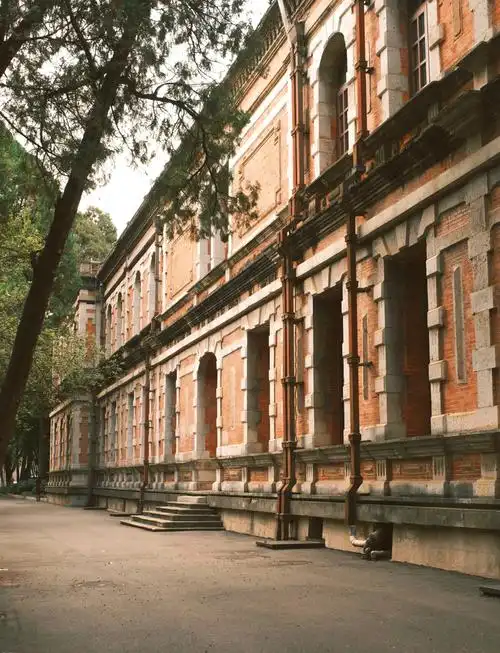
The Donglu Campus showcases a striking fusion of French Beaux-Arts planning and Chinese ornamentation—a style reminiscent of French Indochina's colonial campuses in Hanoi or Saigon. The centerpiece is Huize Hall, with red-brick walls, green-glazed roof tiles, and a symmetrical façade that evokes the academic gravitas of a European faculty building while honoring Chinese heritage. Nearby stands Zhigong Tang, a sober wooden hall that once housed the local imperial examination complex—China's centuries-old counterpart to Europe's medieval scholastic traditions—before being absorbed into the modern campus. Together they chart China's transition from imperial testing to modern scholarship.
A canopy of mature trees softens the campus's architectural formality. The famed Ginkgo Avenue turns brilliant gold each November—a spectacle that draws photographers from across the province and rivals the autumn displays of Beijing's Beihai Park or Kyoto's tree-covered temple approaches. Adjacent to it, a camphor-lined lane near Wenlin Street creates a quieter, more contemplative corner for visitors who prefer off-peak exploration. Together these green corridors link the campus to neighboring Cui Hu Park, forming one of Kunming's most pleasant walking circuits and earning the area its informal nickname of the "Twin Rings."
The university's motto, "Huize Baijia, Zhigong Tianxia" ("Broad learning from a hundred schools; impartial service to all under heaven"), is inscribed at the top of the 95-step granite staircase—an ascent that recalls the ceremonial steps of grand European academies. The on-site History Museum, open Friday afternoons, traces the institution's evolution through photographs and artifacts, while a small cottage once belonging to Xiong Qinglai and the surviving examination hall fragments reward curious visitors. These spaces preserve an unbroken thread linking imperial scholarship, the Republican intellectual awakening, and today's research universities.
Entry to the campus is free, but foreign visitors must reserve in advance through the "Ping'an Yunda" WeChat mini-program, selecting the Donglu Campus and presenting a passport on arrival. Visiting hours run from 08:30 to 17:00 daily. Classrooms, laboratories, and other restricted zones are off-limits, noise is discouraged, and commercial filming requires special permission. There are no on-site cafés or shops, so plan refreshments around a visit to the surrounding neighborhood.
For the best experience, plan a half-day visit in autumn, booking two to three days ahead to secure a reservation. Avoid exam weeks and rainy weather; comfortable walking shoes are essential for the cobbled lanes. Begin in the morning when soft light flatters Huize Hall's red-brick façade, then wander down Ginkgo Avenue to Zhigong Tang, and finish with tea or a meal by Cui Hu Park to absorb the local rhythm. Few Chinese universities offer such an open, atmospheric blend of heritage architecture, mature landscape, and living scholarship within walking distance of a city lake.
Yunnan University was founded in 1922, just four years after the end of the First World War and during the same wave of educational reform that modernized many of Europe's universities. As one of southwest China's earliest modern institutions of higher learning, it emerged from the Republican-era spirit of intellectual renewal. Notable scholars including mathematician Xiong Qinglai, often compared in influence to his contemporary David Hilbert, and sociologist Fei Xiaotong, China's answer to Britain's Bronisław Malinowski, once taught here. Today the university remains a "211 Project" and "Double First-Class" institution—China's equivalent of a top-tier research university—and continues to shape the intellectual life of the region.
The Donglu Campus showcases a striking fusion of French Beaux-Arts planning and Chinese ornamentation—a style reminiscent of French Indochina's colonial campuses in Hanoi or Saigon. The centerpiece is Huize Hall, with red-brick walls, green-glazed roof tiles, and a symmetrical façade that evokes the academic gravitas of a European faculty building while honoring Chinese heritage. Nearby stands Zhigong Tang, a sober wooden hall that once housed the local imperial examination complex—China's centuries-old counterpart to Europe's medieval scholastic traditions—before being absorbed into the modern campus. Together they chart China's transition from imperial testing to modern scholarship.
A canopy of mature trees softens the campus's architectural formality. The famed Ginkgo Avenue turns brilliant gold each November—a spectacle that draws photographers from across the province and rivals the autumn displays of Beijing's Beihai Park or Kyoto's tree-covered temple approaches. Adjacent to it, a camphor-lined lane near Wenlin Street creates a quieter, more contemplative corner for visitors who prefer off-peak exploration. Together these green corridors link the campus to neighboring Cui Hu Park, forming one of Kunming's most pleasant walking circuits and earning the area its informal nickname of the "Twin Rings."
The university's motto, "Huize Baijia, Zhigong Tianxia" ("Broad learning from a hundred schools; impartial service to all under heaven"), is inscribed at the top of the 95-step granite staircase—an ascent that recalls the ceremonial steps of grand European academies. The on-site History Museum, open Friday afternoons, traces the institution's evolution through photographs and artifacts, while a small cottage once belonging to Xiong Qinglai and the surviving examination hall fragments reward curious visitors. These spaces preserve an unbroken thread linking imperial scholarship, the Republican intellectual awakening, and today's research universities.
Entry to the campus is free, but foreign visitors must reserve in advance through the "Ping'an Yunda" WeChat mini-program, selecting the Donglu Campus and presenting a passport on arrival. Visiting hours run from 08:30 to 17:00 daily. Classrooms, laboratories, and other restricted zones are off-limits, noise is discouraged, and commercial filming requires special permission. There are no on-site cafés or shops, so plan refreshments around a visit to the surrounding neighborhood.
For the best experience, plan a half-day visit in autumn, booking two to three days ahead to secure a reservation. Avoid exam weeks and rainy weather; comfortable walking shoes are essential for the cobbled lanes. Begin in the morning when soft light flatters Huize Hall's red-brick façade, then wander down Ginkgo Avenue to Zhigong Tang, and finish with tea or a meal by Cui Hu Park to absorb the local rhythm. Few Chinese universities offer such an open, atmospheric blend of heritage architecture, mature landscape, and living scholarship within walking distance of a city lake.