Cuihu Park
⭐ 4.20
Cuihu Park, Cuihu Street, Wuhua District, Kunming City, Yunnan Province, China
 Cuihu Park's origins stretch back to the Yuan Dynasty (1271–1368), a period in European history marked by Marco Polo's journeys across Asia. Originally a scenic pond, it evolved through the Ming and Qing dynasties into one of Yunnan's most celebrated landscapes before becoming a public park in the Republican era. The phrase "a pool of emerald water holds half of Kunming's history" reflects how the lake has witnessed the city's transformation from an ancient Dian Kingdom outpost to a modern southwestern metropolis. Today, nearly forty protected heritage sites encircle its shores, including the former Yunnan Examination Hall.
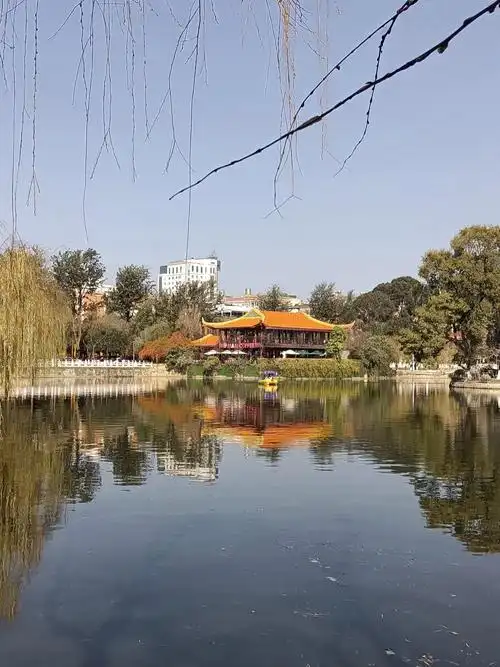
Spanning roughly 0.21 square kilometers—about the size of London's St. James's Park—the grounds are dominated by water, with an oval lake cradled against the western slopes of Wuhua Hill. Traditional Chinese garden architecture, including the central Lake Heart Pavilion, the Nine-Turn Bridge, and Sea Heart Pavilion, dots the surface in classic Jiangnan style reminiscent of Suzhou's celebrated classical gardens. Weeping willows, ornamental plantings, and tiered viewing platforms create a layered composition that rewards slow exploration, with every bridge offering a new vantage point across the placid water.
The park functions as the cultural anchor of Kunming's old town, encircled by landmarks such as the Yunnan Military Academy (where future leaders of twentieth-century China received their training) and the preserved sites of the imperial examination halls. For centuries, scholars, poets, and ordinary citizens have gathered along its shores, leaving verses in local memory and a tradition of unhurried contemplation. Locals practice tai chi at dawn, gather for choral singing, and sip tea beside the lotus beds, embodying the easy rhythm that gives Kunming its "Spring City" reputation.
Cuihu rewards visitors in every season. From late July through August, lotus flowers reach peak bloom, including rare varieties such as "Taikong Lotus" and "Dasa Jin," their pink petals rising above vast carpets of green leaves that recall the water gardens of Monet's Giverny. Spring brings fresh willow foliage; autumn displays golden chrysanthemums; and from November through March, the lake hosts thousands of migratory black-headed gulls—an annual phenomenon since the 1980s that transforms the park into a living tableau, with locals and tourists alike tossing breadcrumbs to the wheeling flocks.
The park is open daily and free of charge, with no reservation required. It is easily reached via Metro Lines 3 and 5, multiple bus routes, taxi, or bicycle from anywhere in central Kunming. Allow one to one-and-a-half hours for the park alone, or three to four hours if combining it with nearby attractions. The Yunnan Military Academy, Yunnan University's historic Old Campus, Wenlin Street's cafés and bookshops, and Qianwang Street all lie within easy walking distance. During August heat, visit between 8:00 and 10:30 a.m. or after 5:00 p.m. and bring sun protection; in winter, dress in layers for cool mornings.
Cuihu offers something rare in modern China: an unscripted glimpse into a city where daily life still unfolds at human pace around a historic green heart. Unlike the imperial grandeur of Beijing's Summer Palace or the manicured formality of Suzhou's gardens, Cuihu feels lived-in and loved—a working community space rather than a museum piece. For travelers seeking both natural beauty and authentic local atmosphere, it provides an ideal introduction to Kunming's gentle climate, layered history, and the unhurried culture of southwest China, where mountains, ethnic traditions, and modern ambitions meet beneath a temperate sky.
Cuihu Park's origins stretch back to the Yuan Dynasty (1271–1368), a period in European history marked by Marco Polo's journeys across Asia. Originally a scenic pond, it evolved through the Ming and Qing dynasties into one of Yunnan's most celebrated landscapes before becoming a public park in the Republican era. The phrase "a pool of emerald water holds half of Kunming's history" reflects how the lake has witnessed the city's transformation from an ancient Dian Kingdom outpost to a modern southwestern metropolis. Today, nearly forty protected heritage sites encircle its shores, including the former Yunnan Examination Hall.
Spanning roughly 0.21 square kilometers—about the size of London's St. James's Park—the grounds are dominated by water, with an oval lake cradled against the western slopes of Wuhua Hill. Traditional Chinese garden architecture, including the central Lake Heart Pavilion, the Nine-Turn Bridge, and Sea Heart Pavilion, dots the surface in classic Jiangnan style reminiscent of Suzhou's celebrated classical gardens. Weeping willows, ornamental plantings, and tiered viewing platforms create a layered composition that rewards slow exploration, with every bridge offering a new vantage point across the placid water.
The park functions as the cultural anchor of Kunming's old town, encircled by landmarks such as the Yunnan Military Academy (where future leaders of twentieth-century China received their training) and the preserved sites of the imperial examination halls. For centuries, scholars, poets, and ordinary citizens have gathered along its shores, leaving verses in local memory and a tradition of unhurried contemplation. Locals practice tai chi at dawn, gather for choral singing, and sip tea beside the lotus beds, embodying the easy rhythm that gives Kunming its "Spring City" reputation.
Cuihu rewards visitors in every season. From late July through August, lotus flowers reach peak bloom, including rare varieties such as "Taikong Lotus" and "Dasa Jin," their pink petals rising above vast carpets of green leaves that recall the water gardens of Monet's Giverny. Spring brings fresh willow foliage; autumn displays golden chrysanthemums; and from November through March, the lake hosts thousands of migratory black-headed gulls—an annual phenomenon since the 1980s that transforms the park into a living tableau, with locals and tourists alike tossing breadcrumbs to the wheeling flocks.
The park is open daily and free of charge, with no reservation required. It is easily reached via Metro Lines 3 and 5, multiple bus routes, taxi, or bicycle from anywhere in central Kunming. Allow one to one-and-a-half hours for the park alone, or three to four hours if combining it with nearby attractions. The Yunnan Military Academy, Yunnan University's historic Old Campus, Wenlin Street's cafés and bookshops, and Qianwang Street all lie within easy walking distance. During August heat, visit between 8:00 and 10:30 a.m. or after 5:00 p.m. and bring sun protection; in winter, dress in layers for cool mornings.
Cuihu offers something rare in modern China: an unscripted glimpse into a city where daily life still unfolds at human pace around a historic green heart. Unlike the imperial grandeur of Beijing's Summer Palace or the manicured formality of Suzhou's gardens, Cuihu feels lived-in and loved—a working community space rather than a museum piece. For travelers seeking both natural beauty and authentic local atmosphere, it provides an ideal introduction to Kunming's gentle climate, layered history, and the unhurried culture of southwest China, where mountains, ethnic traditions, and modern ambitions meet beneath a temperate sky.