Bi Gan Temple
⭐ 3.20
Bi Gan Temple Scenic Area, Xinxiang City, Henan Province, China
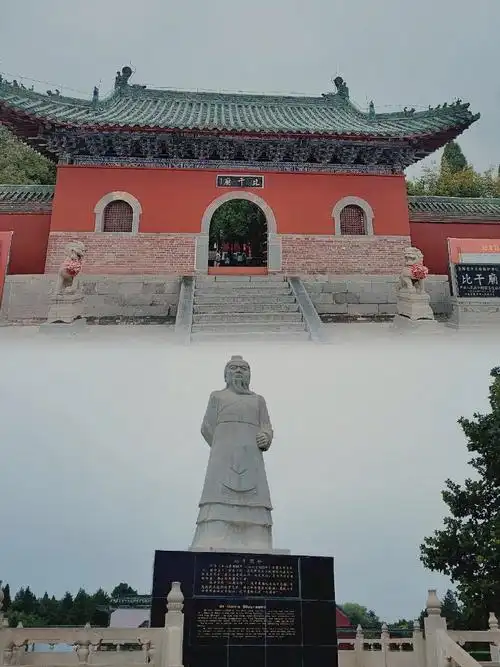 The temple honors Bi Gan, the uncle of the last Shang king, whose tragic story echoes that of classical loyalty figures like the Roman Seneca or the Danish prince Hamlet. When the cruel King Zhou ignored his counsel, Bi Gan dared to remonstrate and was famously disemboweled—a sacrifice that crowned him as "the most loyal minister of all time." Pilgrims still come to honor him, and the philosopher Confucius reportedly visited the tomb himself, leaving the four carved characters "殷比干莫" (Yin Bi Gan Mo) on a weathered stele now venerated as the "First Stele Under Heaven."
The architecture follows a strict axial symmetry reminiscent of European monastic complexes, with a glazed tile screen wall from the Ming Dynasty serving as a dazzling prelude. Comparable to the finest Italian maiolica or Byzantine mosaics, its centerpiece—a peony-and-vase motif rendered in twenty-four colored琉璃 bricks—symbolizes the unity of the Lin clan, descendants of Bi Gan. Walking the central axis leads visitors through ornate gateways, an atmospheric stele corridor, and finally to the sacred mound itself.
The tomb is considered China's earliest surviving tumulus-style burial, predating many European medieval graves by centuries. Curiously ancient cypresses surround the site, including the famous "Heart-Opened Cypress," whose trunk naturally splits in two—a living echo of the legend that Bi Gan walked the earth with no heart. Eighty-six stone inscriptions line the grounds, showcasing calligraphy in every script style and offering a chronological survey of Chinese literary art from the Northern Wei through the Qing.
As a National 4A-rated attraction and protected cultural site, the temple charges a modest 40 yuan entry fee, with free admission for visitors surnamed Lin and ID proof. Summer hours run 8:00 to 19:00, while winter visitors should arrive between 8:30 and 17:30. Allow between one and one-and-a-half hours, and strongly consider booking a guided interpretation in advance—the steles' stories and architectural symbolism are easily missed by the casual eye.
Though a brisk visitor can walk the central axis in forty minutes, the depth of history rewards slower contemplation. Travelers may also time their visit to the lively Bi Gan Birthday Cultural Festival on the fourth day of the fourth lunar month. The temple pairs well with nearby Weihui ancient town, the canyon scenery of Baoquan, and the cliffside village of Guoliang, making it an ideal anchor for a full-day cultural excursion through northern Henan.
The temple honors Bi Gan, the uncle of the last Shang king, whose tragic story echoes that of classical loyalty figures like the Roman Seneca or the Danish prince Hamlet. When the cruel King Zhou ignored his counsel, Bi Gan dared to remonstrate and was famously disemboweled—a sacrifice that crowned him as "the most loyal minister of all time." Pilgrims still come to honor him, and the philosopher Confucius reportedly visited the tomb himself, leaving the four carved characters "殷比干莫" (Yin Bi Gan Mo) on a weathered stele now venerated as the "First Stele Under Heaven."
The architecture follows a strict axial symmetry reminiscent of European monastic complexes, with a glazed tile screen wall from the Ming Dynasty serving as a dazzling prelude. Comparable to the finest Italian maiolica or Byzantine mosaics, its centerpiece—a peony-and-vase motif rendered in twenty-four colored琉璃 bricks—symbolizes the unity of the Lin clan, descendants of Bi Gan. Walking the central axis leads visitors through ornate gateways, an atmospheric stele corridor, and finally to the sacred mound itself.
The tomb is considered China's earliest surviving tumulus-style burial, predating many European medieval graves by centuries. Curiously ancient cypresses surround the site, including the famous "Heart-Opened Cypress," whose trunk naturally splits in two—a living echo of the legend that Bi Gan walked the earth with no heart. Eighty-six stone inscriptions line the grounds, showcasing calligraphy in every script style and offering a chronological survey of Chinese literary art from the Northern Wei through the Qing.
As a National 4A-rated attraction and protected cultural site, the temple charges a modest 40 yuan entry fee, with free admission for visitors surnamed Lin and ID proof. Summer hours run 8:00 to 19:00, while winter visitors should arrive between 8:30 and 17:30. Allow between one and one-and-a-half hours, and strongly consider booking a guided interpretation in advance—the steles' stories and architectural symbolism are easily missed by the casual eye.
Though a brisk visitor can walk the central axis in forty minutes, the depth of history rewards slower contemplation. Travelers may also time their visit to the lively Bi Gan Birthday Cultural Festival on the fourth day of the fourth lunar month. The temple pairs well with nearby Weihui ancient town, the canyon scenery of Baoquan, and the cliffside village of Guoliang, making it an ideal anchor for a full-day cultural excursion through northern Henan.