Jin Taihang Mountain Scenic Area
⭐ 4.20
Jin Taihang Mountain Scenic Area, Huixian City, Xinxiang City, Henan Province, China
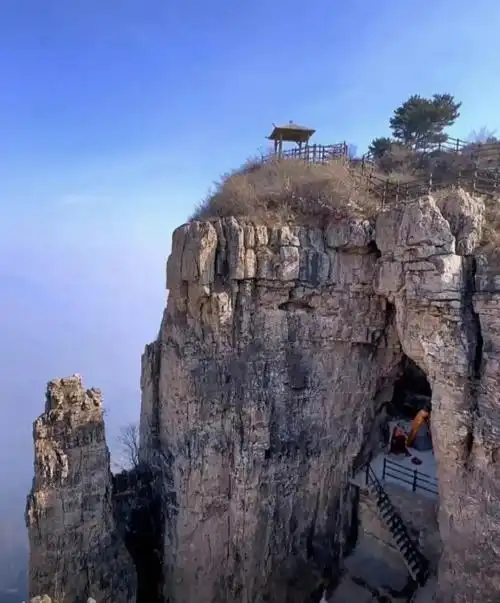 Stretching along the eastern foothills of the Taihang Range, the South Taihang Mountains showcase some of China's most dramatic geology—layered red quartzite cliffs and fault-formed canyons sculpted over hundreds of millions of years. Geologists liken these "zhangshiyan" formations to a living textbook of Taihang topography, rivaling in scale the red rock canyons of the American Southwest or Spain's Montserrat. The combination of soaring escarpments, forested valleys, and tumbling waterfalls creates a landscape that feels both primordial and grand, making it an exceptional classroom for nature enthusiasts and a visual feast for photographers.
The undisputed highlight is the Guoliang Cliff Road in Wanxian Mountain—a 1.25-kilometer tunnel hand-chiseled into a vertical rock face by villagers over five years in the 1970s. Often hailed as the "Ninth Wonder of the World," it parallels the audacity of Norway's Trollstigen or Peru's Inca road engineering, yet was built using nothing but hammers and chisels by thirteen local farmers. Driving its narrow ledges, with sheer drops and rough-hewn windows revealing misty valleys below, delivers one of China's most pulse-pounding motoring experiences, drawing road-trip pilgrims from across the country.
The resort's four scenic cores each carry their own character. Bali Gou is the spiritual heart, home to Tianhe Waterfall—the "Soul of Taihang"—which thunders through a walk-through cave resembling a scene from Tolkien's Middle-earth. Guanshan National Geopark features a geology museum ideal for families, while Baoquan offers cliff elevators, cable cars, and high-altitude glass walkways that whisk visitors above roaring cascades. Adventurers can tackle the 15-kilometer Wangmangling ridge traverse, drift through canyon rivers, or speed down mountain luge tracks.
Beyond scenery, the region pulses with living culture. Guoliang Village, dubbed "China's Cinema Village," has hosted productions from over 40 films and still preserves traditional stone-slab houses and timeless village rhythms. Autumn brings the photogenic "shai qiu" harvest tradition—corn, chili peppers, and persimmons drying across sun-drenched stone courtyards. Local cuisine is hearty and unpretentious: try *hutou noodles* (a savory wheat-and-paste stew), clay-pot chicken slow-cooked over firewood, and steamed flower-shaped cornbread—dishes reminiscent of rural European farmhouse cooking.
Practical planning is straightforward. Self-driving from Xinxiang takes about 1.5 hours; the area is also accessible from Zhengzhou. July and August deliver refreshing temperatures around 25°C—rare for this part of China—while October ignites the hillsides in crimson and gold. Tickets across the parks offer solid value, and cliff-side boutique homestays let you fall asleep gazing at moonlit canyon walls. Hikers should prepare for steep ascents on certain trails, and during July–August rains, always check road conditions before departing, as temporary closures can occur in mountain passes.
Stretching along the eastern foothills of the Taihang Range, the South Taihang Mountains showcase some of China's most dramatic geology—layered red quartzite cliffs and fault-formed canyons sculpted over hundreds of millions of years. Geologists liken these "zhangshiyan" formations to a living textbook of Taihang topography, rivaling in scale the red rock canyons of the American Southwest or Spain's Montserrat. The combination of soaring escarpments, forested valleys, and tumbling waterfalls creates a landscape that feels both primordial and grand, making it an exceptional classroom for nature enthusiasts and a visual feast for photographers.
The undisputed highlight is the Guoliang Cliff Road in Wanxian Mountain—a 1.25-kilometer tunnel hand-chiseled into a vertical rock face by villagers over five years in the 1970s. Often hailed as the "Ninth Wonder of the World," it parallels the audacity of Norway's Trollstigen or Peru's Inca road engineering, yet was built using nothing but hammers and chisels by thirteen local farmers. Driving its narrow ledges, with sheer drops and rough-hewn windows revealing misty valleys below, delivers one of China's most pulse-pounding motoring experiences, drawing road-trip pilgrims from across the country.
The resort's four scenic cores each carry their own character. Bali Gou is the spiritual heart, home to Tianhe Waterfall—the "Soul of Taihang"—which thunders through a walk-through cave resembling a scene from Tolkien's Middle-earth. Guanshan National Geopark features a geology museum ideal for families, while Baoquan offers cliff elevators, cable cars, and high-altitude glass walkways that whisk visitors above roaring cascades. Adventurers can tackle the 15-kilometer Wangmangling ridge traverse, drift through canyon rivers, or speed down mountain luge tracks.
Beyond scenery, the region pulses with living culture. Guoliang Village, dubbed "China's Cinema Village," has hosted productions from over 40 films and still preserves traditional stone-slab houses and timeless village rhythms. Autumn brings the photogenic "shai qiu" harvest tradition—corn, chili peppers, and persimmons drying across sun-drenched stone courtyards. Local cuisine is hearty and unpretentious: try *hutou noodles* (a savory wheat-and-paste stew), clay-pot chicken slow-cooked over firewood, and steamed flower-shaped cornbread—dishes reminiscent of rural European farmhouse cooking.
Practical planning is straightforward. Self-driving from Xinxiang takes about 1.5 hours; the area is also accessible from Zhengzhou. July and August deliver refreshing temperatures around 25°C—rare for this part of China—while October ignites the hillsides in crimson and gold. Tickets across the parks offer solid value, and cliff-side boutique homestays let you fall asleep gazing at moonlit canyon walls. Hikers should prepare for steep ascents on certain trails, and during July–August rains, always check road conditions before departing, as temporary closures can occur in mountain passes.