Sanwan Canal Park
⭐ 4.60
Sanwan Canal Park, Hanjiang District, Yangzhou City, Jiangsu Province, China
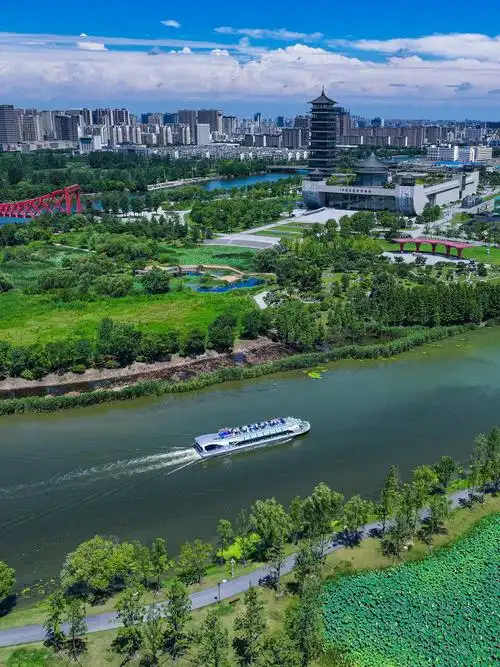 The Sanwan bend embodies a masterpiece of Ming dynasty hydraulic engineering. When engineers in the 16th century rerouted the canal here, they used the ingenious "three bends replacing one dam" principle to slow water flow and protect riverbanks—an approach comparable to the Dutch tradition of working with water rather than against it, as seen in the polders and waterboards of the Netherlands. Designated a key node in the Grand Canal's successful UNESCO World Heritage inscription, this section echoes the spirit of Europe's great engineering waterways, from Bruges' canals to Amsterdam's grachten, while telling a distinctly Chinese story of water management wisdom.
The park's signature skyline, "Three Towers Reflecting Three Bends," unites the historic Wenfeng Pagoda with the modern Dayun Pagoda and Tianzhong Tower, creating a silhouette reminiscent of Italy's hilltop campanile clusters. Three pedestrian bridges add distinct artistic flair: the Jianying (Paper-cut) Bridge incorporates Chinese red papercut motifs with flowing Art Nouveau curves; the Lingbo Bridge evokes rippling water; and the Qinse Bridge draws inspiration from the guzheng zither. Each structure marries functional engineering with Instagram-worthy aesthetics, making the park a magnet for design enthusiasts and photographers.
The Yangzhou China Grand Canal Museum, a national first-class institution, houses over 10,000 artifacts and immersive galleries that chronicle the canal's 2,500-year evolution and the vital role of grain transport (caoyun) in imperial China. Comparable in ambition to London's V&A or Amsterdam's Rijksmuseum in scope and presentation, the museum offers a comprehensive narrative of how the Grand Canal—longer than the Suez and Panama Canals combined—shaped commerce, culture, and daily life along its 1,700 kilometers. The surrounding park itself is a designated World Heritage buffer zone and National Water Conservancy Scenic Area, embodying the living heritage of canal civilization.
The park is open daily and free of charge, but museum entry requires advance booking through official channels with a real-name reservation; the museum closes on Mondays. Located in Guangling District along Xingyang Road, the park is easily reachable via bus routes 56 and Tour Bus 2 from central Yangzhou, with ample parking available at the South Gate lot for private vehicles and taxis. Core exhibition halls typically operate 09:00–18:00. Visitors should bring comfortable walking shoes for the 5.5-kilometer waterside trail and pack sunscreen in summer or warm layers in winter for the exposed riverside paths.
Allow half a day to a full day to fully appreciate this multifaceted site. Begin with an in-depth museum visit, then follow the recommended clockwise loop along the waterside promenade, crossing the Jianying, Lingbo, and Qinse bridges, with detours to the birdwatching hides in the wetland sections. As evening falls, position yourself near the Dayun Pagoda for the magical moment when all three towers illuminate, casting luminous reflections across the canal bends. Spring brings cherry blossoms, while autumn transforms the reeds into a golden tapestry—each season painting a fresh ecological portrait of this remarkable landscape.
The Sanwan bend embodies a masterpiece of Ming dynasty hydraulic engineering. When engineers in the 16th century rerouted the canal here, they used the ingenious "three bends replacing one dam" principle to slow water flow and protect riverbanks—an approach comparable to the Dutch tradition of working with water rather than against it, as seen in the polders and waterboards of the Netherlands. Designated a key node in the Grand Canal's successful UNESCO World Heritage inscription, this section echoes the spirit of Europe's great engineering waterways, from Bruges' canals to Amsterdam's grachten, while telling a distinctly Chinese story of water management wisdom.
The park's signature skyline, "Three Towers Reflecting Three Bends," unites the historic Wenfeng Pagoda with the modern Dayun Pagoda and Tianzhong Tower, creating a silhouette reminiscent of Italy's hilltop campanile clusters. Three pedestrian bridges add distinct artistic flair: the Jianying (Paper-cut) Bridge incorporates Chinese red papercut motifs with flowing Art Nouveau curves; the Lingbo Bridge evokes rippling water; and the Qinse Bridge draws inspiration from the guzheng zither. Each structure marries functional engineering with Instagram-worthy aesthetics, making the park a magnet for design enthusiasts and photographers.
The Yangzhou China Grand Canal Museum, a national first-class institution, houses over 10,000 artifacts and immersive galleries that chronicle the canal's 2,500-year evolution and the vital role of grain transport (caoyun) in imperial China. Comparable in ambition to London's V&A or Amsterdam's Rijksmuseum in scope and presentation, the museum offers a comprehensive narrative of how the Grand Canal—longer than the Suez and Panama Canals combined—shaped commerce, culture, and daily life along its 1,700 kilometers. The surrounding park itself is a designated World Heritage buffer zone and National Water Conservancy Scenic Area, embodying the living heritage of canal civilization.
The park is open daily and free of charge, but museum entry requires advance booking through official channels with a real-name reservation; the museum closes on Mondays. Located in Guangling District along Xingyang Road, the park is easily reachable via bus routes 56 and Tour Bus 2 from central Yangzhou, with ample parking available at the South Gate lot for private vehicles and taxis. Core exhibition halls typically operate 09:00–18:00. Visitors should bring comfortable walking shoes for the 5.5-kilometer waterside trail and pack sunscreen in summer or warm layers in winter for the exposed riverside paths.
Allow half a day to a full day to fully appreciate this multifaceted site. Begin with an in-depth museum visit, then follow the recommended clockwise loop along the waterside promenade, crossing the Jianying, Lingbo, and Qinse bridges, with detours to the birdwatching hides in the wetland sections. As evening falls, position yourself near the Dayun Pagoda for the magical moment when all three towers illuminate, casting luminous reflections across the canal bends. Spring brings cherry blossoms, while autumn transforms the reeds into a golden tapestry—each season painting a fresh ecological portrait of this remarkable landscape.