Wenfeng Temple
⭐ 3.80
Wenfeng Temple, Guangling District, Yangzhou City, Jiangsu Province, China
 Founded in 1582 during the Ming Wanli era, Wenfeng Temple carries the weight of centuries along the Grand Canal—a waterway whose earliest sections were completed in the seventh century, predating Europe's Age of Discovery. Its position at Baota Bay made it a strategic node where cargo, monks, and emperors converged. The site is intimately tied to one of East Asia's most poignant religious sagas: the monk Jianzhen, who lost his eyesight during repeated failed attempts to reach Japan, succeeding only on his sixth departure in 754 CE. Like Europe's medieval pilgrimage routes, his journey embodies enduring cross-cultural devotion.
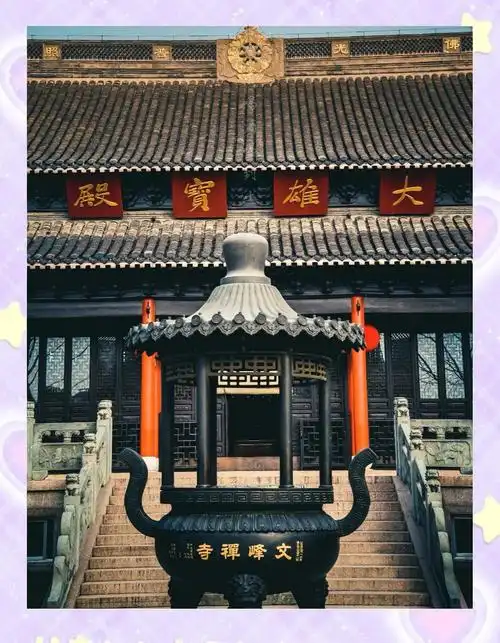
The crowning glory is the Wenfeng Pagoda itself—a seven-tiered, eight-sided brick-and-wood tower standing 44.75 meters, crowned in traditional grey tile. Its tiered silhouette evokes the stepped steeples of European Gothic cathedrals, while its proportions reflect the classical restraint of Ming design. The temple complex follows a traditional courtyard layout, with a relocated Ming-era Great Hall preserving authentic architectural details. From certain angles, the pagoda's reflection in the canal creates the legendary "brush dipping into an inkstone" image—an iconic motif that has inspired Chinese landscape painting for centuries.
Beyond its religious function, Wenfeng Temple served as a ceremonial waypoint for the Kangxi and Qianlong emperors during their celebrated Southern Tours in the 17th and 18th centuries—a tradition comparable to European royal progresses that displayed imperial authority through landscape and architecture. The grounds commemorate Jianzhen's voyages through a memorial square and ancient stelae inscribed "Ancient Grand Canal." Today the site functions as both a working Buddhist sanctuary and a living monument to Sino-Japanese cultural exchange, embodying the spiritual and commercial currents that once surged along this UNESCO-listed waterway.
The temple welcomes visitors free of charge, with no reservation required, between 08:30 and 17:00 (last entry at 16:30). It lies at 16 Baota Road in Guangling District, easily reached by bus routes 3 or 11 to the Wenfeng Temple stop. A complimentary parking area sits just outside the gates. Plan for one to one-and-a-half hours—enough time for a climb up the pagoda (permitted at management's discretion), a contemplative stroll through the courtyards, and a quiet pause along the water's edge.
Early morning and late afternoon offer the gentlest light and fewest crowds, with canal sunsets particularly memorable. Avoid the 1st and 15th of each lunar month, when local worshippers gather in numbers, and the early-June gaokao exam season, when students flock here to pray for success. Maintain quiet reverence as a courtesy to practicing monks. Pair your visit with the nearby China Grand Canal Museum and Sanwan Wetland Park—both within easy reach—for a comprehensive immersion in the canal culture that shaped China's economic heartbeat for over a millennium.
Founded in 1582 during the Ming Wanli era, Wenfeng Temple carries the weight of centuries along the Grand Canal—a waterway whose earliest sections were completed in the seventh century, predating Europe's Age of Discovery. Its position at Baota Bay made it a strategic node where cargo, monks, and emperors converged. The site is intimately tied to one of East Asia's most poignant religious sagas: the monk Jianzhen, who lost his eyesight during repeated failed attempts to reach Japan, succeeding only on his sixth departure in 754 CE. Like Europe's medieval pilgrimage routes, his journey embodies enduring cross-cultural devotion.
The crowning glory is the Wenfeng Pagoda itself—a seven-tiered, eight-sided brick-and-wood tower standing 44.75 meters, crowned in traditional grey tile. Its tiered silhouette evokes the stepped steeples of European Gothic cathedrals, while its proportions reflect the classical restraint of Ming design. The temple complex follows a traditional courtyard layout, with a relocated Ming-era Great Hall preserving authentic architectural details. From certain angles, the pagoda's reflection in the canal creates the legendary "brush dipping into an inkstone" image—an iconic motif that has inspired Chinese landscape painting for centuries.
Beyond its religious function, Wenfeng Temple served as a ceremonial waypoint for the Kangxi and Qianlong emperors during their celebrated Southern Tours in the 17th and 18th centuries—a tradition comparable to European royal progresses that displayed imperial authority through landscape and architecture. The grounds commemorate Jianzhen's voyages through a memorial square and ancient stelae inscribed "Ancient Grand Canal." Today the site functions as both a working Buddhist sanctuary and a living monument to Sino-Japanese cultural exchange, embodying the spiritual and commercial currents that once surged along this UNESCO-listed waterway.
The temple welcomes visitors free of charge, with no reservation required, between 08:30 and 17:00 (last entry at 16:30). It lies at 16 Baota Road in Guangling District, easily reached by bus routes 3 or 11 to the Wenfeng Temple stop. A complimentary parking area sits just outside the gates. Plan for one to one-and-a-half hours—enough time for a climb up the pagoda (permitted at management's discretion), a contemplative stroll through the courtyards, and a quiet pause along the water's edge.
Early morning and late afternoon offer the gentlest light and fewest crowds, with canal sunsets particularly memorable. Avoid the 1st and 15th of each lunar month, when local worshippers gather in numbers, and the early-June gaokao exam season, when students flock here to pray for success. Maintain quiet reverence as a courtesy to practicing monks. Pair your visit with the nearby China Grand Canal Museum and Sanwan Wetland Park—both within easy reach—for a comprehensive immersion in the canal culture that shaped China's economic heartbeat for over a millennium.