Pingshan Hall
⭐ 3.80
Pingshan Hall, Hanjiang District, Yangzhou City, Jiangsu Province, China
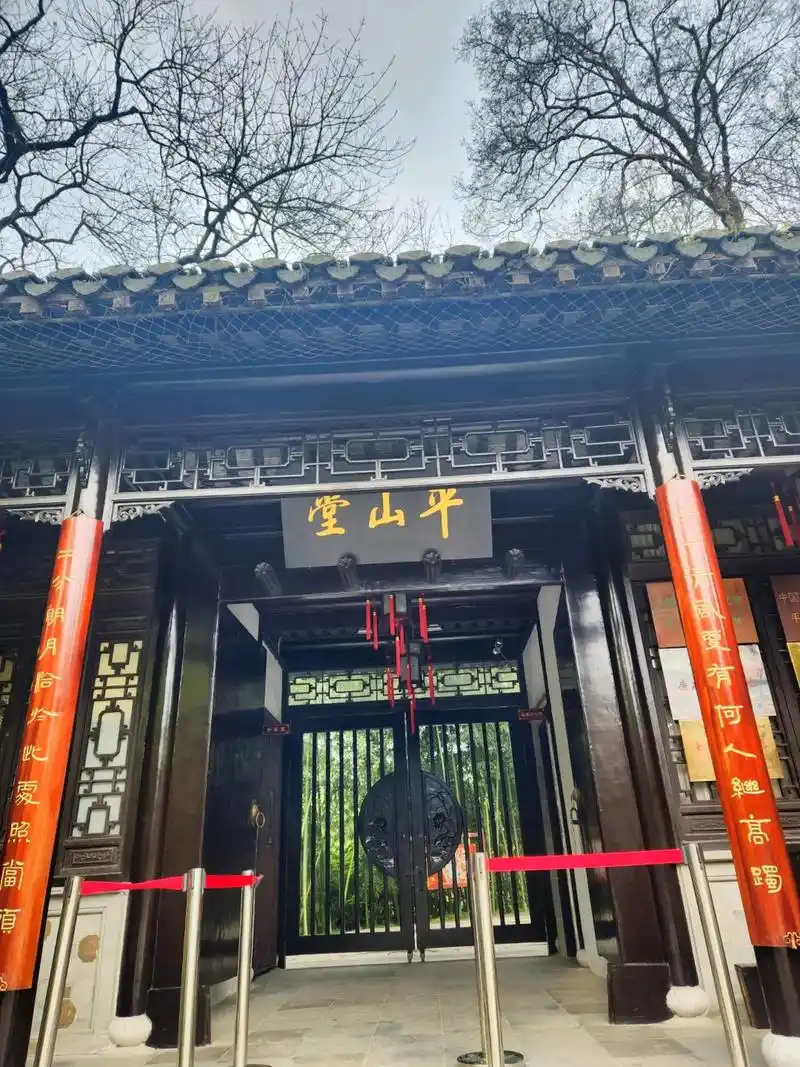 When Ouyang Xiu raised Ping Shan Hall in 1048, Europe was consolidating Norman England and raising its first Romanesque cathedrals. In China, however, the Northern Song dynasty had already produced one of history's most extraordinary cultural renaissances, and Ouyang Xiu stood among its literary giants. As prefect of Yangzhou, he hosted celebrated poetry gatherings here, entertaining guests with wine, music, and verse in a tradition as refined as any Italian Renaissance salon three centuries later. Three decades on, his protégé Su Shi—perhaps China's most beloved poet—returned three times to mourn his teacher, immortalizing the site in his lyrical "Moon Over Ping Shan Hall."
The present buildings date to a careful Qing restoration in the 1870s, executed in dignified Jiangnan style: gray brick, sweeping tiled roofs, and carved wooden brackets as restrained as an English Georgian manor. The central hall is airy and luminous, its hanging plaques rewarding close reading. Look for the celebrated "Elegance Lives On" inscription—subtly altered so the character for "flow" lacks a stroke while "exists" gains one, a visual pun on the poets' fates. The flanking Memorial Hall to Ouyang and Gulin Hall honoring Su Shi complete a literary sequence unmatched in China.
Behind the halls lies the West Garden, a Qianlong-era Jiangnan landscape masterpiece. At its heart flows the legendary "Fifth Spring Under Heaven"—so designated by the emperor himself after sampling its waters, ranking just behind sacred springs in Beijing and Jinan. Yellow rockeries, a moon-shaped boat pavilion, and wisteria-draped trellises create the quintessential Chinese garden effect of "great within small," a principle Western visitors may recognize in compact Parisian courtyards or hidden Roman cloisters. While mature trees now obscure the original mountain-meets-eaves view, the contemplative atmosphere has only deepened.
Ping Shan Hall lies within the Daming Temple complex, requiring a combined ticket (about 45 yuan peak season, 30 yuan off-peak; separate fee for the nine-story Qiling Pagoda's panoramic views). The site opens daily from 8:00 AM to 5:00 PM, last entry at 4:30 PM, year-round. Buses 1, 2 (sightseeing loops), and 25 stop at Daming Temple Station; drivers can navigate directly to the temple's parking lot. Allow 1 to 1.5 hours for a relaxed visit, and use the official WeChat account to reserve during Chinese holidays.
Few Chinese sites so vividly capture the dialogue between two great literary minds while offering such a complete package: ancient hall, fragrant garden, sacred spring, and views toward a lake district that has charmed painters for centuries. For travelers who have traced Byron's footsteps along Lake Geneva or visited Shakespeare's Stratford, this is Yangzhou's equivalent—a pilgrimage site for those who love poetry and place. Visit in autumn when golden light slants across the gray tiles, then walk ten minutes from the western gate directly to Slender West Lake's eastern entrance.
When Ouyang Xiu raised Ping Shan Hall in 1048, Europe was consolidating Norman England and raising its first Romanesque cathedrals. In China, however, the Northern Song dynasty had already produced one of history's most extraordinary cultural renaissances, and Ouyang Xiu stood among its literary giants. As prefect of Yangzhou, he hosted celebrated poetry gatherings here, entertaining guests with wine, music, and verse in a tradition as refined as any Italian Renaissance salon three centuries later. Three decades on, his protégé Su Shi—perhaps China's most beloved poet—returned three times to mourn his teacher, immortalizing the site in his lyrical "Moon Over Ping Shan Hall."
The present buildings date to a careful Qing restoration in the 1870s, executed in dignified Jiangnan style: gray brick, sweeping tiled roofs, and carved wooden brackets as restrained as an English Georgian manor. The central hall is airy and luminous, its hanging plaques rewarding close reading. Look for the celebrated "Elegance Lives On" inscription—subtly altered so the character for "flow" lacks a stroke while "exists" gains one, a visual pun on the poets' fates. The flanking Memorial Hall to Ouyang and Gulin Hall honoring Su Shi complete a literary sequence unmatched in China.
Behind the halls lies the West Garden, a Qianlong-era Jiangnan landscape masterpiece. At its heart flows the legendary "Fifth Spring Under Heaven"—so designated by the emperor himself after sampling its waters, ranking just behind sacred springs in Beijing and Jinan. Yellow rockeries, a moon-shaped boat pavilion, and wisteria-draped trellises create the quintessential Chinese garden effect of "great within small," a principle Western visitors may recognize in compact Parisian courtyards or hidden Roman cloisters. While mature trees now obscure the original mountain-meets-eaves view, the contemplative atmosphere has only deepened.
Ping Shan Hall lies within the Daming Temple complex, requiring a combined ticket (about 45 yuan peak season, 30 yuan off-peak; separate fee for the nine-story Qiling Pagoda's panoramic views). The site opens daily from 8:00 AM to 5:00 PM, last entry at 4:30 PM, year-round. Buses 1, 2 (sightseeing loops), and 25 stop at Daming Temple Station; drivers can navigate directly to the temple's parking lot. Allow 1 to 1.5 hours for a relaxed visit, and use the official WeChat account to reserve during Chinese holidays.
Few Chinese sites so vividly capture the dialogue between two great literary minds while offering such a complete package: ancient hall, fragrant garden, sacred spring, and views toward a lake district that has charmed painters for centuries. For travelers who have traced Byron's footsteps along Lake Geneva or visited Shakespeare's Stratford, this is Yangzhou's equivalent—a pilgrimage site for those who love poetry and place. Visit in autumn when golden light slants across the gray tiles, then walk ten minutes from the western gate directly to Slender West Lake's eastern entrance.