Zhuyu Bay Park
⭐ 4.60
Zhuyu Bay Park, Hanjiang District, Yangzhou City, Jiangsu Province, China
 Zhuyu Bay Park sits on the eastern bank of the Grand Canal, the world’s longest artificial waterway and a UNESCO World Heritage Site since 2014. Begun in the 5th century BC and completed under the Sui dynasty (581‑618 AD), the canal rivals the Roman aqueducts in scale and ambition, linking the Yellow River to the Yangtze and fostering trade along the Silk Road. When the Tang‑dynasty monk Jianzhen (Ganjin) set out from Yangzhou in the 8th century to bring Buddhist teachings to Japan, he paused at this very stretch of canal, inspiring the park’s “Stone‑Seat‑Watching‑Lotus” legend. The site’s strategic position made it a hub for merchants and pilgrims, a heritage the park preserves through restored navigation markers and interpretive plaques.
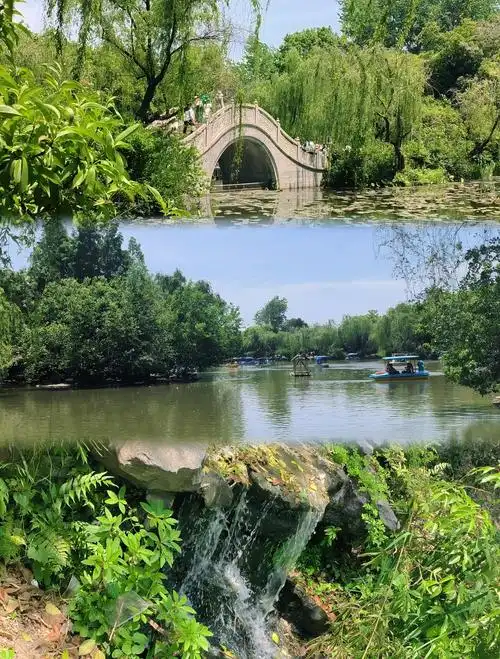
The park’s layout marries classical Chinese garden principles with subtle European influences. A central water feature, Crane‑Singing Lake, is ringed by gently curving “Lotus‑Wind Curved Bridges” whose stone arches echo the elegance of Venice’s Rialto Bridge on a miniature scale. Meandering paths lead past pavilions, bamboo groves and a “Plum Blossom Hill” that mirrors the romantic English landscape garden’s emphasis on naturalistic vistas. Ancient navigation beacons, once used to guide barges along the canal, have been repurposed as decorative landmarks, while modern signage blends discreetly with the lush foliage. This fusion creates a tranquil, photogenic environment that invites leisurely strolls and quiet contemplation.
In Chinese tradition the dogwood shrub (zhuyu) is associated with protection and renewal; planting 1,500 specimens here turns the park into a living talisman for the New Year, a practice familiar to Europeans who hang mistletoe for similar reasons. The legend of the Tang monk Jianzhen adds a Buddhist layer: his “Stone‑Seat‑Watching‑Lotus” site is marked by a modest stone bench, inviting visitors to reflect on the trans‑cultural journey of religious teachings across East Asia. Seasonal festivals, such as the May peony celebration that rivals the Dutch tulip mania, showcase China’s horticultural artistry. Together these elements weave a tapestry of nature, spirituality and folk custom.
The animal collection spans five continents, featuring star attractions like the giant panda – a conservation icon comparable to the European brown bear – and golden monkeys whose antics delight children. Interactive zones allow guests to purchase special feed and hand‑feed peacocks, miniature giraffes and capybaras, a South‑American rodent that has become a social‑media
Zhuyu Bay Park sits on the eastern bank of the Grand Canal, the world’s longest artificial waterway and a UNESCO World Heritage Site since 2014. Begun in the 5th century BC and completed under the Sui dynasty (581‑618 AD), the canal rivals the Roman aqueducts in scale and ambition, linking the Yellow River to the Yangtze and fostering trade along the Silk Road. When the Tang‑dynasty monk Jianzhen (Ganjin) set out from Yangzhou in the 8th century to bring Buddhist teachings to Japan, he paused at this very stretch of canal, inspiring the park’s “Stone‑Seat‑Watching‑Lotus” legend. The site’s strategic position made it a hub for merchants and pilgrims, a heritage the park preserves through restored navigation markers and interpretive plaques.
The park’s layout marries classical Chinese garden principles with subtle European influences. A central water feature, Crane‑Singing Lake, is ringed by gently curving “Lotus‑Wind Curved Bridges” whose stone arches echo the elegance of Venice’s Rialto Bridge on a miniature scale. Meandering paths lead past pavilions, bamboo groves and a “Plum Blossom Hill” that mirrors the romantic English landscape garden’s emphasis on naturalistic vistas. Ancient navigation beacons, once used to guide barges along the canal, have been repurposed as decorative landmarks, while modern signage blends discreetly with the lush foliage. This fusion creates a tranquil, photogenic environment that invites leisurely strolls and quiet contemplation.
In Chinese tradition the dogwood shrub (zhuyu) is associated with protection and renewal; planting 1,500 specimens here turns the park into a living talisman for the New Year, a practice familiar to Europeans who hang mistletoe for similar reasons. The legend of the Tang monk Jianzhen adds a Buddhist layer: his “Stone‑Seat‑Watching‑Lotus” site is marked by a modest stone bench, inviting visitors to reflect on the trans‑cultural journey of religious teachings across East Asia. Seasonal festivals, such as the May peony celebration that rivals the Dutch tulip mania, showcase China’s horticultural artistry. Together these elements weave a tapestry of nature, spirituality and folk custom.
The animal collection spans five continents, featuring star attractions like the giant panda – a conservation icon comparable to the European brown bear – and golden monkeys whose antics delight children. Interactive zones allow guests to purchase special feed and hand‑feed peacocks, miniature giraffes and capybaras, a South‑American rodent that has become a social‑media