Dongguan Street
⭐ 4.20
Dongguan Street, Guangling District, Yangzhou City, Jiangsu Province, China
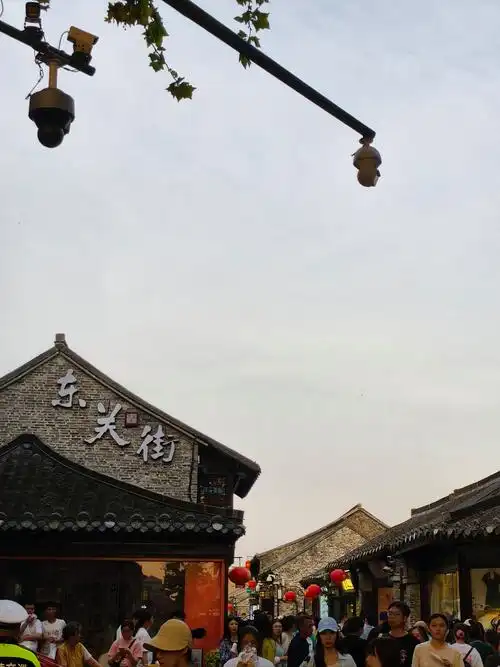 Stretching 1.1 kilometers along the eastern flank of old Yangzhou, Dongguan Street owes its existence to the Grand Canal—often compared to Europe's Rhine or the waterways of Bruges and Venice. Built up during the Sui and Tang dynasties and flourishing under the Ming and Qing, it controlled the strategic junction where the canal met the Yangtze, funneling tax grain and salt fortunes into the city. The saying "One Dongguan Street, half of Yangzhou's history" reflects its central role, recognized in 2010 as one of China's Top Ten Historic Streets and in 2023 with a UNESCO Asia-Pacific Award for Cultural Heritage Conservation.
The street's layout is a textbook example of traditional Chinese urban planning: a main spine with a "fishbone" lattice of perpendicular alleys such as Yang Xiang and Anjia Xiang. Bluestone slabs worn smooth by centuries of foot traffic lead past buildings that marry the ornamental brickwork of Anhui merchants with the refined garden architecture native to Yangzhou. Climbing the East Gate tower rewards visitors with sweeping canal views and a glass-floor window revealing Tang and Song dynasty city wall strata beneath—a rare archaeological window into the past.
Dongguan Street functions as an open-air theater for Huaiyang intangible heritage. Yangzhou pinghua storytelling, Yangju opera, and guqin performances echo from doorways, while workshops inside heritage brands keep alive crafts like duck-egg powder perfume and traditional pickled vegetables. For international visitors, an on-site tax-refund counter simplifies purchases of local specialties—fragrant cosmetics, fermented sauces, and扬州 paper umbrellas.
Food is the main event. Beyond the polished main-street restaurants serving Yangzhou fried rice, lion's head meatballs, crab-roe soup dumplings, and silken tofu shreds, the real rewards lie down the side alleys: Zhao family's glutinous rice balls and Huangqiao sesame biscuits from family stalls where locals actually eat. Skip the homogenized souvenir shops near the main entrance and head deeper for genuine flavors and everyday Jiangnan life.
Entry to the street itself is free; individual sites like Ge Garden require separate tickets. Begin at the East Gate Ancient Ferry archway, work westward past the historic shopfronts and side-alley residences, and end at Ge Garden. Evening visits are magical, when lantern light gilds the old facades and reflects off the canal. Parking is limited, so arrive by bus or bike, and consider extending your walk into neighboring Caiyi and Pishi streets for a fuller taste of Yangzhou's preserved old quarter.
Stretching 1.1 kilometers along the eastern flank of old Yangzhou, Dongguan Street owes its existence to the Grand Canal—often compared to Europe's Rhine or the waterways of Bruges and Venice. Built up during the Sui and Tang dynasties and flourishing under the Ming and Qing, it controlled the strategic junction where the canal met the Yangtze, funneling tax grain and salt fortunes into the city. The saying "One Dongguan Street, half of Yangzhou's history" reflects its central role, recognized in 2010 as one of China's Top Ten Historic Streets and in 2023 with a UNESCO Asia-Pacific Award for Cultural Heritage Conservation.
The street's layout is a textbook example of traditional Chinese urban planning: a main spine with a "fishbone" lattice of perpendicular alleys such as Yang Xiang and Anjia Xiang. Bluestone slabs worn smooth by centuries of foot traffic lead past buildings that marry the ornamental brickwork of Anhui merchants with the refined garden architecture native to Yangzhou. Climbing the East Gate tower rewards visitors with sweeping canal views and a glass-floor window revealing Tang and Song dynasty city wall strata beneath—a rare archaeological window into the past.
Dongguan Street functions as an open-air theater for Huaiyang intangible heritage. Yangzhou pinghua storytelling, Yangju opera, and guqin performances echo from doorways, while workshops inside heritage brands keep alive crafts like duck-egg powder perfume and traditional pickled vegetables. For international visitors, an on-site tax-refund counter simplifies purchases of local specialties—fragrant cosmetics, fermented sauces, and扬州 paper umbrellas.
Food is the main event. Beyond the polished main-street restaurants serving Yangzhou fried rice, lion's head meatballs, crab-roe soup dumplings, and silken tofu shreds, the real rewards lie down the side alleys: Zhao family's glutinous rice balls and Huangqiao sesame biscuits from family stalls where locals actually eat. Skip the homogenized souvenir shops near the main entrance and head deeper for genuine flavors and everyday Jiangnan life.
Entry to the street itself is free; individual sites like Ge Garden require separate tickets. Begin at the East Gate Ancient Ferry archway, work westward past the historic shopfronts and side-alley residences, and end at Ge Garden. Evening visits are magical, when lantern light gilds the old facades and reflects off the canal. Parking is limited, so arrive by bus or bike, and consider extending your walk into neighboring Caiyi and Pishi streets for a fuller taste of Yangzhou's preserved old quarter.