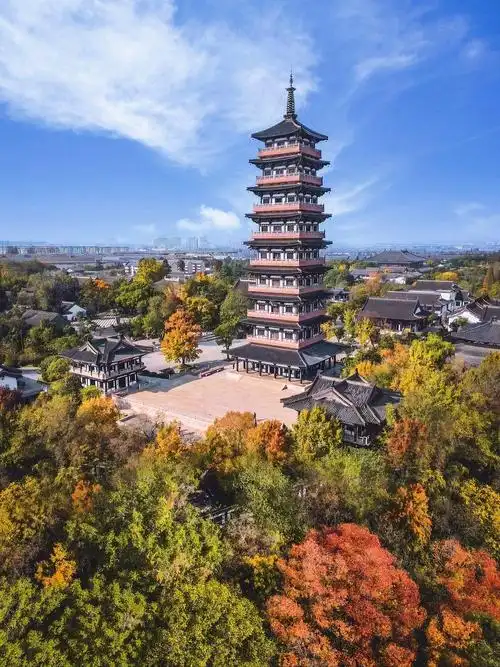
Daming Temple traces its origins to the Liu Song dynasty of the Southern Dynasties, around 458 AD, placing its founding in the twilight of the Western Roman world and the age of the Byzantine emperor Leo I. Over the centuries, the complex rose, fell, and was reborn through successive dynasties, absorbing layers of architectural and devotional history. Its pivotal moment came in the 8th century, when the Tang monk Jianzhen—seated here as abbot—finally succeeded on his sixth attempt to cross the East China Sea to Japan. His arrival in Nara in 754 AD carried the full transmission of Tang Buddhism, medicine, and craftsmanship to the Japanese court, an exchange as transformative for Heian Japan as the Carolingian Renaissance was for medieval Europe.
The Jianzhen Memorial Hall stands as the temple's most architecturally significant structure, designed under the supervision of Liang Sicheng, the 20th-century scholar often called the father of modern Chinese architectural conservation. Modeled faithfully on the Golden Hall of Toshodai-ji Temple in Nara—the very monastery Jianzhen founded in Japan—the hall creates a tangible dialogue between two nations separated by a thousand years and a stormy sea. Inside, visitors encounter a sandalwood statue of the monk, while stone lanterns and Tang-era proportions evoke the elegance of Chang'an, the imperial capital whose cosmopolitanism rivaled that of Constantinople or Baghdad in its day.
No visit is complete without ascending the Qiling Pagoda, a nine-story Tang-style tower rising 70 meters above the temple grounds. Comparable in ambition to the campanile of St. Mark's in Venice, though rooted in Buddhist tradition, the pagoda offers an elevator ride to a glass-walled observation deck on the seventh floor. From here, the gaze sweeps across misty Slender West Lake, the rooftops of old Yangzhou, and the layered silhouettes of distant hills—an experience that recalls the panoramic vistas from Sacré-Cœur in Paris, but anchored in a far older landscape. The pagoda's stately silhouette also echoes the wooden towers of historic Japan, itself a distant echo of Jianzhen's transmission.
Literary pilgrims will be drawn to the twin pavilions of Pingshan Hall and Gulin Hall, where the voices of two Song-dynasty giants intersect. Ouyang Xiu, one of the era's greatest essayists and a contemporary of the troubadours of Languedoc, built Pingshan Hall during his tenure as governor of Yangzhou, naming it for the poetic illusion that distant mountains rise to meet the hall's level. Centuries later, his protégé Su Shi—perhaps the most beloved poet of the Song era—erected Gulin Hall next door to honor his mentor. The adjacent Western Garden adds further refinement, with a Qianlong-era imperial stele pavilion and the spring that Lu Yu, China's patron saint of tea, ranked as the "Fifth Spring Under Heaven."
Plan to arrive in the morning to beat both crowds and summer heat. Admission runs 45 yuan in peak season and 30 yuan in the off-season, with an additional charge of roughly 26 yuan to ascend the Qiling Pagoda. Allow two to three hours for a thorough visit, and consider combining the temple with a stroll through Slender West Lake directly below—forming a seamless "temple, pagoda, garden, and lake" circuit that captures the essence of Yangzhou culture. Within the grounds, purchase incense only through official channels, refrain from flash photography inside the halls, and dress modestly to respect the active Buddhist community.
In a country studded with celebrated temples, Daming Temple offers something rare: a single hilltop where 1,500 years of religious devotion, diplomatic history, literary genius, and garden art converge. Few sites so vividly illustrate how the Tang court's cosmopolitan reach shaped the civilization of East Asia, or how Chinese literati transformed a provincial city into a cultural capital. For travelers tracing the Silk Road's maritime extension, exploring the legacy of cross-cultural exchange, or simply seeking a quieter alternative to the crowded temples of Beijing and Xi'an, Daming Temple rewards both the curious generalist and the specialist alike.