Sichuan Science and Technology Museum
⭐ 4.60
No. 529, Hangfei Avenue, Lichun Town, Pengzhou City, Sichuan, China
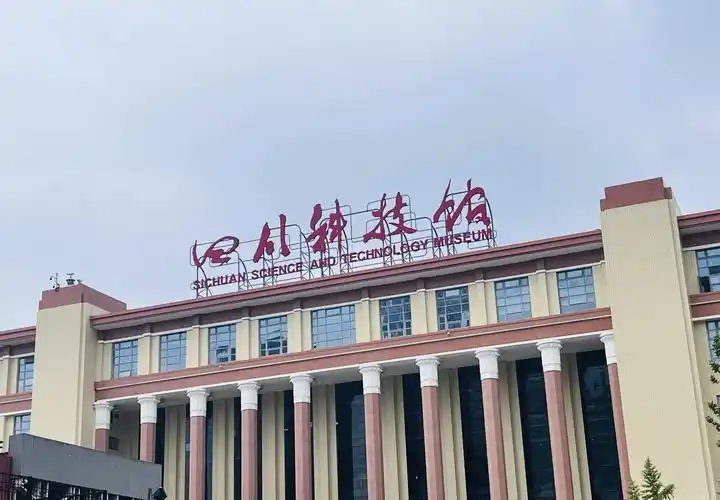 Opened in the early 2000s, the museum was conceived as part of Chengdu's bold push to fuse science education with public culture, mirroring the ambition of London's Science Museum or Paris's Cité des Sciences. Spanning roughly 42,000 square metres across four floors, its glass-and-steel façade echoes the modernist transparency of these European counterparts while reflecting the city's confident embrace of the future. Standing shoulder to shoulder with the neighbouring Chengdu Museum, the two institutions form a cultural-technological axis reminiscent of Berlin's Museum Island paired with the Deutsches Technikmuseum.
The first floor is an aviation enthusiast's dream, displaying a genuine Shenyang J-7 fighter alongside a 1:1 replica of China's Tiangong space station. A dynamic working model of the ancient Dujiangyan irrigation system, a UNESCO World Heritage marvel dating to 256 BC, offers a brilliant bridge between historical ingenuity and modern engineering. Visitors can also simulate a rocket launch, experiencing the same thrill felt at Kennedy Space Centre.
Ascending to the second floor, guests enter a robotics wonderland where a robot band strikes up tunes, a Rubik's cube-solving automaton defeats challengers in seconds, and a chess-playing AI offers games of skill. VR and AR installations transport visitors into immersive virtual realms, while a "time tunnel" corridor enchants younger audiences. This level captures the playful spirit of a science centre blended with a modern art installation, much like Barcelona's CosmoCaixa.
The third floor shifts to the wonders of physics and the human body. A "Mysteries of the Human Body" exhibit demystifies conception and development with respectful scientific clarity, while an earthquake simulation room and tornado chamber deliver adrenaline-pumping lessons in disaster preparedness, an increasingly relevant topic in a seismically active region. The top floor is reserved for budding inventors, featuring a youth maker space and a showcase of cutting-edge artificial intelligence applications.
Admission is entirely free, but foreign visitors must reserve in advance via the museum's WeChat account or the Tianfu Science & Technology Cloud app, presenting a passport at entry. The museum operates Tuesday through Sunday from 9:20 a.m. to 5:00 p.m., with last entry at 4:30 p.m., and remains closed on Mondays. Reaching it is effortless: take Metro Lines 1 or 2 to Tianfu Square Station, exit through Gate H, and walk three minutes north. Set aside at least half a day to explore from the ground floor upward, note that some high-thrill attractions enforce a 150 cm height minimum, and avoid weekend crowds by visiting on a Tuesday or Wednesday morning.
For a perfectly curated half-day itinerary, combine your visit with the adjacent Chengdu Museum, where Sichuan's 3,000-year history provides the cultural counterweight to this temple of technology, creating an experience that rivals a full afternoon at any major European science-and-culture complex.
Opened in the early 2000s, the museum was conceived as part of Chengdu's bold push to fuse science education with public culture, mirroring the ambition of London's Science Museum or Paris's Cité des Sciences. Spanning roughly 42,000 square metres across four floors, its glass-and-steel façade echoes the modernist transparency of these European counterparts while reflecting the city's confident embrace of the future. Standing shoulder to shoulder with the neighbouring Chengdu Museum, the two institutions form a cultural-technological axis reminiscent of Berlin's Museum Island paired with the Deutsches Technikmuseum.
The first floor is an aviation enthusiast's dream, displaying a genuine Shenyang J-7 fighter alongside a 1:1 replica of China's Tiangong space station. A dynamic working model of the ancient Dujiangyan irrigation system, a UNESCO World Heritage marvel dating to 256 BC, offers a brilliant bridge between historical ingenuity and modern engineering. Visitors can also simulate a rocket launch, experiencing the same thrill felt at Kennedy Space Centre.
Ascending to the second floor, guests enter a robotics wonderland where a robot band strikes up tunes, a Rubik's cube-solving automaton defeats challengers in seconds, and a chess-playing AI offers games of skill. VR and AR installations transport visitors into immersive virtual realms, while a "time tunnel" corridor enchants younger audiences. This level captures the playful spirit of a science centre blended with a modern art installation, much like Barcelona's CosmoCaixa.
The third floor shifts to the wonders of physics and the human body. A "Mysteries of the Human Body" exhibit demystifies conception and development with respectful scientific clarity, while an earthquake simulation room and tornado chamber deliver adrenaline-pumping lessons in disaster preparedness, an increasingly relevant topic in a seismically active region. The top floor is reserved for budding inventors, featuring a youth maker space and a showcase of cutting-edge artificial intelligence applications.
Admission is entirely free, but foreign visitors must reserve in advance via the museum's WeChat account or the Tianfu Science & Technology Cloud app, presenting a passport at entry. The museum operates Tuesday through Sunday from 9:20 a.m. to 5:00 p.m., with last entry at 4:30 p.m., and remains closed on Mondays. Reaching it is effortless: take Metro Lines 1 or 2 to Tianfu Square Station, exit through Gate H, and walk three minutes north. Set aside at least half a day to explore from the ground floor upward, note that some high-thrill attractions enforce a 150 cm height minimum, and avoid weekend crowds by visiting on a Tuesday or Wednesday morning.
For a perfectly curated half-day itinerary, combine your visit with the adjacent Chengdu Museum, where Sichuan's 3,000-year history provides the cultural counterweight to this temple of technology, creating an experience that rivals a full afternoon at any major European science-and-culture complex.