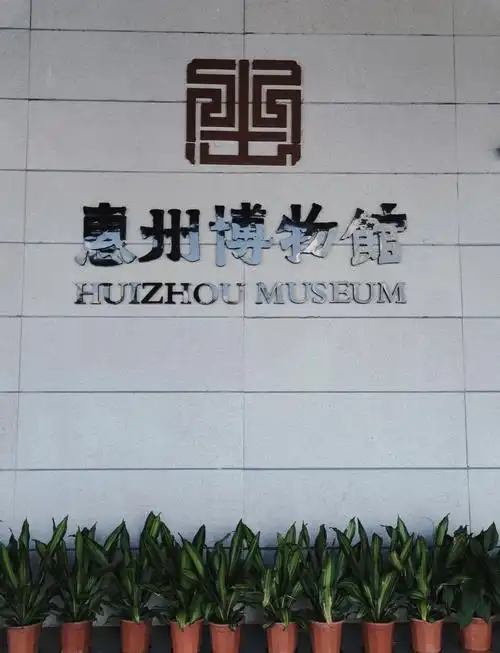
Huizhou Museum chronicles more than two millennia of civilization along the East River, from the pre-Qin kingdom of Fuluo—predating Rome's founding—through the imperial dynasties and into the revolutionary twentieth century. Permanent galleries trace a chronological arc familiar to visitors of the British Museum: stone tools and bronze ritual vessels give way to Tang and Song ceramics, the period when Huizhou earned its reputation as a place of imperial exile. The cultural parallels are striking: while Ovid composed his Tristia on the Black Sea, the great Song poet Su Shi (1037–1101), often ranked alongside Shakespeare for his lyrical genius, was twice demoted to this southern outpost, where he wrote beloved verses and shaped local identity.
The building itself is a meditation on memory, conceived as a "seal of history"—a massive rectangular block sheathed in glass that evokes an imperial jade seal pressed into wax. Opened in its current form in 2009, it spans over 10,000 square meters across four floors, blending traditional gravitas with modern transparency. Interiors are bright and contemplative, with circulation as clearly defined as in Berlin's Neues Museum. The first floor hosts special exhibitions alongside family-friendly interactive stations; the second offers ancient-text reading rooms; the third and fourth floors contain the chronological history gallery and the celebrated Hall of Historical Figures.
The Hall of Historical Figures ranks among the museum's most memorable experiences: 48 life-sized sculptures bring the city's luminaries to vivid presence. They range from Qin general Ren Xiao and founding emperor Zhao Tuo—who established Nanyue, a kingdom contemporary with the late Roman Republic—to Tang military hero Li Jing, the beloved Su Shi, and on through Ming and Qing Hakka migrants to modern patriots Liao Zhongkai and Deng Yanda. Together these figures form a human tapestry that compares in ambition to a national portrait hall while feeling distinctly local. The museum also administers five affiliated sites, including the nearby Su Shi Memorial Hall.
The museum sits at 3 Jiangbei Citizen Park West Road in Huicheng District, adjacent to Citizen Square and a lively commercial center with abundant dining and shopping. Admission is free. Opening hours run Tuesday through Sunday, 9 a.m. to 5 p.m., with special exhibitions occasionally extending to 6 p.m.; the museum closes Mondays. International visitors should bring passports for registration and book the "Tang Dynasty Treasures" exhibition via the Huizhou Cultural Tourism mini-program or the official WeChat public account, as time slots fill quickly during the August 2026 run.
Allow roughly half a day and follow the recommended route: third-floor chronological gallery first, then the Hall of Historical Figures, finishing with the temporary exhibition—a sequence that builds from broad context to intimate character studies before delivering the visual fireworks of national treasures. Stamp-collecting interactive zones and touch-screen query walls delight families. For a complete cultural day, pair the museum with a stroll to the Su Shi Memorial Hall and West Lake, whose lotus-dotted shores inspired some of the poet's finest verses. August is the optimal window to catch the Tang exhibition while avoiding peak holiday crowds.