Mount Luofu
⭐ 3.80
Sangzao Town, Anzhou District, Mianyang City, Sichuan Province, China
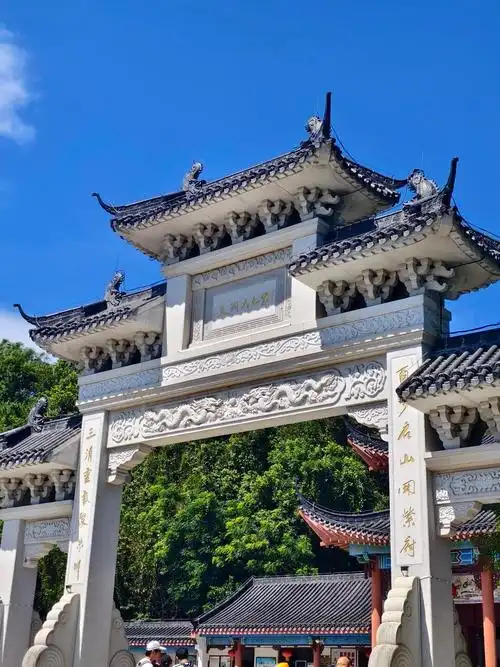 Rising from the central Longmen Mountains—the same tectonic belt that produced the Sichuan basin's dramatic 2008 seismic activity—Luofu Mountain's twelve peaks arc into a rare horseshoe formation sculpted over millions of years. The bedrock cradles 280-million-year-old Permian sponge reefs, ancient marine organisms that flourished when this region lay beneath a warm tropical sea. The on-site Geological Museum interprets these fossils with scientific rigor comparable to natural history halls across Europe, making the site an engaging classroom for curious families and amateur geologists alike.
Halfway up the slopes stands Feiming Chan Temple, founded during the Tang Dynasty (618–907 CE) when Sichuan served as a Buddhist stronghold rivaling the great monasteries of Dunhuang. Unlike purely Buddhist sites, this temple embodies a rare fusion of Chan Buddhism and Taoist practice, with weathered wooden halls and stone pagodas that recall the contemplative atmosphere of Mount Emei or Japan's ancient Koya-san. Pilgrims have climbed these trails for over a millennium, seeking both spiritual merit and the mountain's celebrated restorative powers.
At the mountain's base lie the atmospheric ruins of Ming-era Qiang King City, complete with remnant ramparts and beacon towers that once guarded the frontier between Han Chinese settlements and Qiang highland communities. The fortress later doubled as a filming location for the sequel to the beloved 1980s television adaptation of Journey to the West, lending it unexpected pop-culture resonance. Visitors wander these stones while learning about Qiang stone-tower architecture, embroidered textiles, and harvest festivals—traditions that parallel those of Tibetan and Yi neighbors across the highlands.
The undisputed highlight is the geothermal experience: spring water drawn from 1,500 to 2,000 meters below the surface emerges at 48°C, infused with more than twenty trace minerals including boric acid. This has earned the resort the official "World-Class Therapeutic Hot Spring" designation, comparable in prestige to Hungary's celebrated Hévíz baths or Japan's Kusatsu onsen. Resorts cluster around the valley floor, offering the signature Sichuanese rhythm of "climb by day, soak by night"—a formula especially popular with mature travelers seeking joint relief and urban escape.
Luofu Mountain lies roughly 40 kilometers southeast of Mianyang city, easily reached via the Chengdu-Mianyang Expressway followed by a short county road to Sangzao Town. Spring and autumn offer the most comfortable hiking temperatures, with chrysanthemum and maple displays lighting up the slopes from October onward. A focused day trip covers the main peaks, Feiming Temple, and the geological museum, while a two-day, one-night itinerary allows a leisurely soak session under the stars. Travelers should note this Luofu should not be confused with the more famous Luofu Mountain near Huizhou in Guangdong Province—the Sichuan version trades crowds for contemplative quiet.
Rising from the central Longmen Mountains—the same tectonic belt that produced the Sichuan basin's dramatic 2008 seismic activity—Luofu Mountain's twelve peaks arc into a rare horseshoe formation sculpted over millions of years. The bedrock cradles 280-million-year-old Permian sponge reefs, ancient marine organisms that flourished when this region lay beneath a warm tropical sea. The on-site Geological Museum interprets these fossils with scientific rigor comparable to natural history halls across Europe, making the site an engaging classroom for curious families and amateur geologists alike.
Halfway up the slopes stands Feiming Chan Temple, founded during the Tang Dynasty (618–907 CE) when Sichuan served as a Buddhist stronghold rivaling the great monasteries of Dunhuang. Unlike purely Buddhist sites, this temple embodies a rare fusion of Chan Buddhism and Taoist practice, with weathered wooden halls and stone pagodas that recall the contemplative atmosphere of Mount Emei or Japan's ancient Koya-san. Pilgrims have climbed these trails for over a millennium, seeking both spiritual merit and the mountain's celebrated restorative powers.
At the mountain's base lie the atmospheric ruins of Ming-era Qiang King City, complete with remnant ramparts and beacon towers that once guarded the frontier between Han Chinese settlements and Qiang highland communities. The fortress later doubled as a filming location for the sequel to the beloved 1980s television adaptation of Journey to the West, lending it unexpected pop-culture resonance. Visitors wander these stones while learning about Qiang stone-tower architecture, embroidered textiles, and harvest festivals—traditions that parallel those of Tibetan and Yi neighbors across the highlands.
The undisputed highlight is the geothermal experience: spring water drawn from 1,500 to 2,000 meters below the surface emerges at 48°C, infused with more than twenty trace minerals including boric acid. This has earned the resort the official "World-Class Therapeutic Hot Spring" designation, comparable in prestige to Hungary's celebrated Hévíz baths or Japan's Kusatsu onsen. Resorts cluster around the valley floor, offering the signature Sichuanese rhythm of "climb by day, soak by night"—a formula especially popular with mature travelers seeking joint relief and urban escape.
Luofu Mountain lies roughly 40 kilometers southeast of Mianyang city, easily reached via the Chengdu-Mianyang Expressway followed by a short county road to Sangzao Town. Spring and autumn offer the most comfortable hiking temperatures, with chrysanthemum and maple displays lighting up the slopes from October onward. A focused day trip covers the main peaks, Feiming Temple, and the geological museum, while a two-day, one-night itinerary allows a leisurely soak session under the stars. Travelers should note this Luofu should not be confused with the more famous Luofu Mountain near Huizhou in Guangdong Province—the Sichuan version trades crowds for contemplative quiet.