Huizhou West Lake
⭐ 4.60
Huizhou West Lake Scenic Area, Huicheng District, Huizhou City, Guangdong Province, China
 Dating back to the Tang dynasty and reaching its cultural zenith under the Northern Song—roughly contemporaneous with the Norman conquest of England—Huizhou West Lake has shaped its city's identity for more than a millennium. The park's most celebrated chapter unfolded between 1094 and 1097, when Su Shi, often called China's Shakespeare for his poetry, calligraphy, and political daring, was exiled here. Comparable to Ovid's banishment to the Black Sea or Dante's Florentine years, Su's enforced residence produced some of his finest verses, and his Causeway, Bridge, and remembrances still define the lakeside experience today.
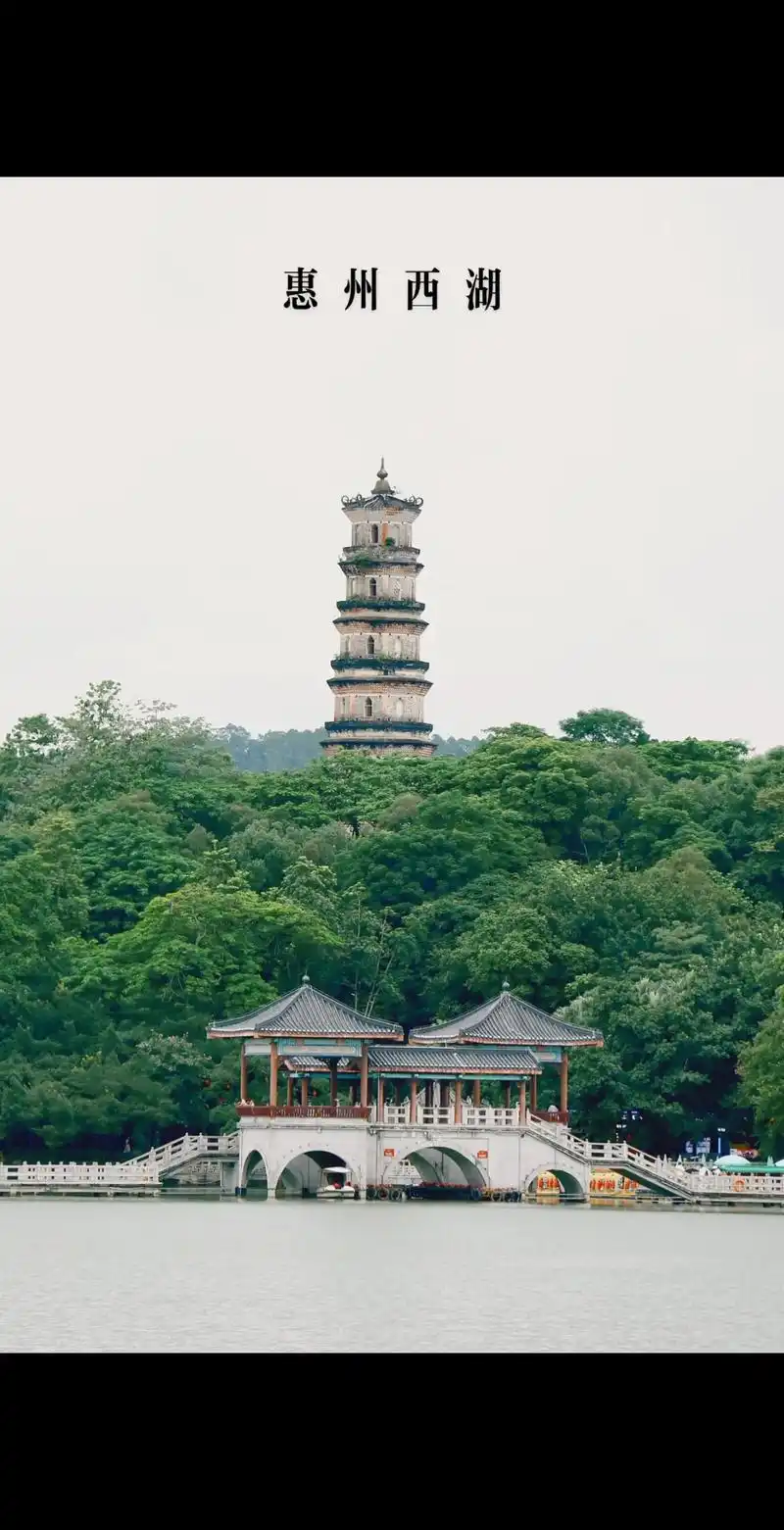
The skyline belongs to the Tang-era Sizhou Pagoda, a seven-story brick-and-wood tower that rises from West Hill like a Chinese answer to Italy's medieval bell towers. Climb it for a panoramic sweep of the entire lake system, then linger after dark for the celebrated "Jade Pagoda in Ripples" lighting effect. Nearby, the 110-meter Nine-Turn Bridge snakes gracefully between Gu Hill and Diancui Isle, recalling Venice's quieter canals, while the park's classical Lingnan pavilions, moon gates, and curling rooflines echo the courtyard traditions of Suzhou.
Beyond its scenery, Huizhou West Lake functions as an open-air museum. The Su Dongpo Memorial on Gu Hill traces the poet's daily routines and literary output during exile, alongside the tomb of his beloved concubine Zhaoyun and a pavilion where he once sampled lychees. The thousand-year-old Fenghu Academy, whose stone courtyards evoke Oxford or the Sorbonne's monastic origins, preserves Huizhou's scholarly lineage, while Yuanmiao Taoist Temple keeps Lingnan Daoist rituals alive. Together these sites transform a pleasant park into a layered historical narrative.
Entry is entirely free—an increasingly rare distinction for a 5A attraction. The main Pinghu Gate is reached by city bus or metro, and the park stays open daily from 8 a.m. to 9 p.m. Allow half a day for the recommended circuit: Pinghu Gate → Su Causeway → Sizhou Pagoda → Su Dongpo Memorial → Nine-Turn Bridge → Diancui Isle → Fengzhu Garden. The full lakeside loop takes three to four hours on foot, or rent rowing boats and electric cruisers from several jetties. Friday and Saturday evenings feature lantern shows and Cantonese opera performances.
Late spring through autumn offers the most rewarding weather, with June through August bringing spectacular lotus blooms across the water. Summer mornings and evenings are best for avoiding both heat and mosquitoes, so pack repellent, sunscreen, and water. Beware touts near the gate selling "paid boat tours" of the free park, and combine your visit with nearby Shuishang Street food alley or Zhuwu Lane creative quarter for Hakka cuisine and local snacks. Huizhou West Lake rewards travelers willing to stray from the Guangzhou–Shenzhen circuit with something increasingly precious: tranquility, history, and beauty without crowds or ticket prices.
Dating back to the Tang dynasty and reaching its cultural zenith under the Northern Song—roughly contemporaneous with the Norman conquest of England—Huizhou West Lake has shaped its city's identity for more than a millennium. The park's most celebrated chapter unfolded between 1094 and 1097, when Su Shi, often called China's Shakespeare for his poetry, calligraphy, and political daring, was exiled here. Comparable to Ovid's banishment to the Black Sea or Dante's Florentine years, Su's enforced residence produced some of his finest verses, and his Causeway, Bridge, and remembrances still define the lakeside experience today.
The skyline belongs to the Tang-era Sizhou Pagoda, a seven-story brick-and-wood tower that rises from West Hill like a Chinese answer to Italy's medieval bell towers. Climb it for a panoramic sweep of the entire lake system, then linger after dark for the celebrated "Jade Pagoda in Ripples" lighting effect. Nearby, the 110-meter Nine-Turn Bridge snakes gracefully between Gu Hill and Diancui Isle, recalling Venice's quieter canals, while the park's classical Lingnan pavilions, moon gates, and curling rooflines echo the courtyard traditions of Suzhou.
Beyond its scenery, Huizhou West Lake functions as an open-air museum. The Su Dongpo Memorial on Gu Hill traces the poet's daily routines and literary output during exile, alongside the tomb of his beloved concubine Zhaoyun and a pavilion where he once sampled lychees. The thousand-year-old Fenghu Academy, whose stone courtyards evoke Oxford or the Sorbonne's monastic origins, preserves Huizhou's scholarly lineage, while Yuanmiao Taoist Temple keeps Lingnan Daoist rituals alive. Together these sites transform a pleasant park into a layered historical narrative.
Entry is entirely free—an increasingly rare distinction for a 5A attraction. The main Pinghu Gate is reached by city bus or metro, and the park stays open daily from 8 a.m. to 9 p.m. Allow half a day for the recommended circuit: Pinghu Gate → Su Causeway → Sizhou Pagoda → Su Dongpo Memorial → Nine-Turn Bridge → Diancui Isle → Fengzhu Garden. The full lakeside loop takes three to four hours on foot, or rent rowing boats and electric cruisers from several jetties. Friday and Saturday evenings feature lantern shows and Cantonese opera performances.
Late spring through autumn offers the most rewarding weather, with June through August bringing spectacular lotus blooms across the water. Summer mornings and evenings are best for avoiding both heat and mosquitoes, so pack repellent, sunscreen, and water. Beware touts near the gate selling "paid boat tours" of the free park, and combine your visit with nearby Shuishang Street food alley or Zhuwu Lane creative quarter for Hakka cuisine and local snacks. Huizhou West Lake rewards travelers willing to stray from the Guangzhou–Shenzhen circuit with something increasingly precious: tranquility, history, and beauty without crowds or ticket prices.