Langfang Science and Technology Museum
⭐ 4.20
Northwest corner of the intersection of Aimin East Avenue and Guangyang Avenue, Guangyang District, Langfang City, Hebei Province, China
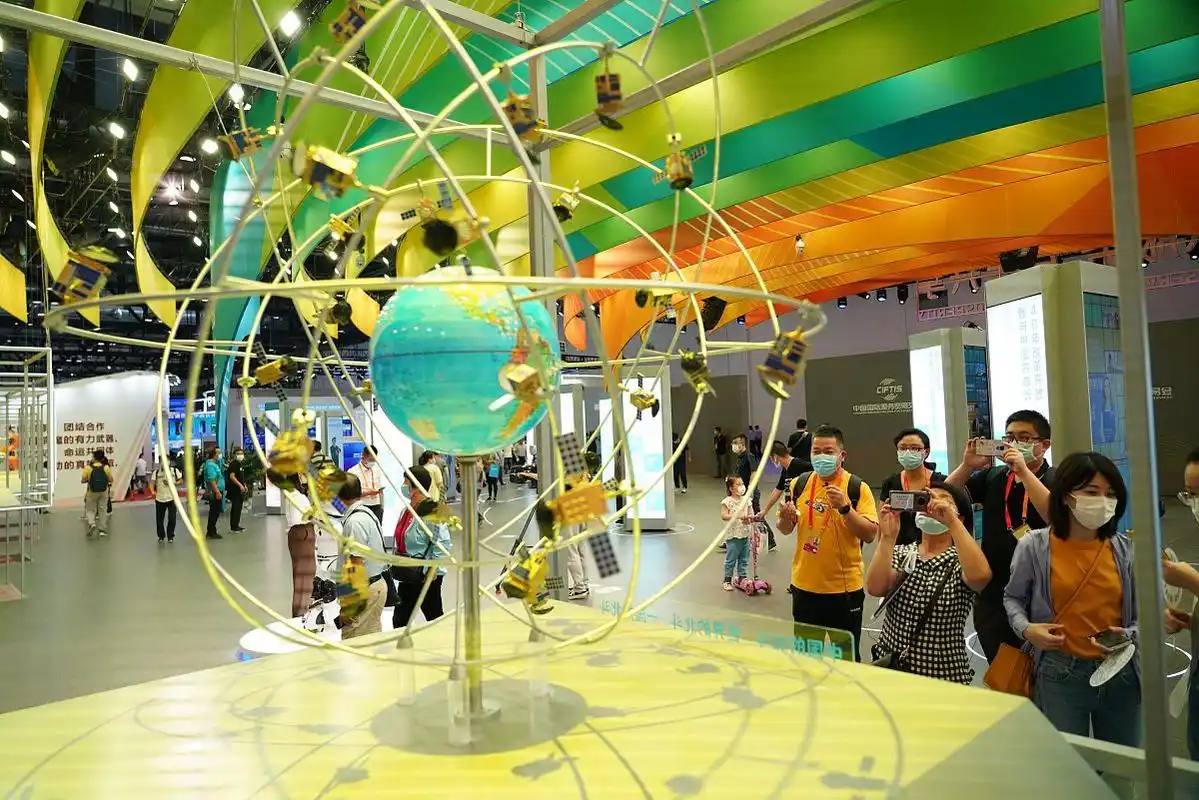 The museum's narrative arc echoes humanity's long quest to mechanize thought—from Leibniz's 17th-century calculating wheel and Babbage's Difference Engine on display at London's Science Museum, to Alan Turing's wartime code-breaking at Bletchley Park. Where those landmarks honor the pioneers of mechanical and analog computing, Langfang's new institution zooms forward into the deep-learning era, presenting today's AI breakthroughs as the latest chapter in a story that began when our ancestors tied the first informational knots. A sweeping timeline in the AI Prologue Hall anchors each visitor in this continuum before they descend into the technical heart of the building.
Housed inside the repurposed 100 Cultural Commercial Complex, the 33,000-square-meter venue divides into six distinct zones and nine interconnected galleries, each with its own visual identity. The Technology Principles Hall anchors the experience with a towering replica of a microchip and live data streams illustrating the trinity of compute, algorithms, and datasets. Nearby, the Applications Zone translates abstract concepts into tangible scenarios: visitors steer autonomous vehicles through a recreated road course, operate surgical robots on a smart-medicine sand table, and pilot drones through an aerial obstacle track. The layout deliberately funnels guests from theory to practice within a single, walkable circuit.
Interaction drives every corner. In the Super Maker Workshop, families assemble a simplified chip package and take the finished product home as a souvenir—an echo of the workshop benches at Munich's Deutsches Museum. Outside, robot dogs perform traditional Chinese lion dances while humanoid robots pour coffee and challenge visitors to a game of Go. The museum reports these living exhibits consistently draw the longest queues, with the drone-flying course and human-versus-robot chess matches topping the popularity charts. A separate children's area keeps younger visitors engaged without overwhelming the more technical halls.
What distinguishes Langfang's venue from older, gadget-focused science centers is its dedicated Ethics and Reflection Zone, where interactive walls like "The Bias Laboratory" and "Privacy Defense" invite guests to debate how algorithms shape society. This dual narrative—technology plus values—mirrors a wider global conversation unfolding at institutions from London's Victoria and Albert Museum to the Computer History Museum in Mountain View. By weaving humanities into hard science, Langfang positions itself not just as an entertainment venue but as a civic forum, signaling the city's ambition to help shape, rather than merely consume, the coming AI century.
The museum sits inside the 100 Cultural Commercial Complex on Guangming West Road, with ample parking and easy navigation access—roughly 60 kilometers southeast of central Beijing and 70 kilometers west of Tianjin, making it a natural stop on a regional circuit. Standard hours run Tuesday through Sunday, 9:30 a.m. to 5:30 p.m., with Mondays reserved for maintenance. General admission to the permanent galleries is free or nominally priced, though advanced workshops and themed courses require separate reservations. Arrive before 10 a.m. on weekdays or right at opening on weekends to beat the crowds, and prioritize the chip-making and drone experiences first—those fill up fastest.
For travelers curious about where China is investing its next generation of public engagement, this museum offers a revealing snapshot. It trades the encyclopedic sweep of a classic science center—think Boston's Museum of Science or Paris's Cité des Sciences—for depth and focus, making it ideal for AI enthusiasts, school groups, and curious families. Visitors seeking traditional exhibits on astronomy, geology, or classical physics may find the theme too narrow; everyone else should allow two to three hours for a satisfying visit. The result is a confident, forward-looking cultural landmark that complements, rather than competes with, the great science museums of Europe and North America.
The museum's narrative arc echoes humanity's long quest to mechanize thought—from Leibniz's 17th-century calculating wheel and Babbage's Difference Engine on display at London's Science Museum, to Alan Turing's wartime code-breaking at Bletchley Park. Where those landmarks honor the pioneers of mechanical and analog computing, Langfang's new institution zooms forward into the deep-learning era, presenting today's AI breakthroughs as the latest chapter in a story that began when our ancestors tied the first informational knots. A sweeping timeline in the AI Prologue Hall anchors each visitor in this continuum before they descend into the technical heart of the building.
Housed inside the repurposed 100 Cultural Commercial Complex, the 33,000-square-meter venue divides into six distinct zones and nine interconnected galleries, each with its own visual identity. The Technology Principles Hall anchors the experience with a towering replica of a microchip and live data streams illustrating the trinity of compute, algorithms, and datasets. Nearby, the Applications Zone translates abstract concepts into tangible scenarios: visitors steer autonomous vehicles through a recreated road course, operate surgical robots on a smart-medicine sand table, and pilot drones through an aerial obstacle track. The layout deliberately funnels guests from theory to practice within a single, walkable circuit.
Interaction drives every corner. In the Super Maker Workshop, families assemble a simplified chip package and take the finished product home as a souvenir—an echo of the workshop benches at Munich's Deutsches Museum. Outside, robot dogs perform traditional Chinese lion dances while humanoid robots pour coffee and challenge visitors to a game of Go. The museum reports these living exhibits consistently draw the longest queues, with the drone-flying course and human-versus-robot chess matches topping the popularity charts. A separate children's area keeps younger visitors engaged without overwhelming the more technical halls.
What distinguishes Langfang's venue from older, gadget-focused science centers is its dedicated Ethics and Reflection Zone, where interactive walls like "The Bias Laboratory" and "Privacy Defense" invite guests to debate how algorithms shape society. This dual narrative—technology plus values—mirrors a wider global conversation unfolding at institutions from London's Victoria and Albert Museum to the Computer History Museum in Mountain View. By weaving humanities into hard science, Langfang positions itself not just as an entertainment venue but as a civic forum, signaling the city's ambition to help shape, rather than merely consume, the coming AI century.
The museum sits inside the 100 Cultural Commercial Complex on Guangming West Road, with ample parking and easy navigation access—roughly 60 kilometers southeast of central Beijing and 70 kilometers west of Tianjin, making it a natural stop on a regional circuit. Standard hours run Tuesday through Sunday, 9:30 a.m. to 5:30 p.m., with Mondays reserved for maintenance. General admission to the permanent galleries is free or nominally priced, though advanced workshops and themed courses require separate reservations. Arrive before 10 a.m. on weekdays or right at opening on weekends to beat the crowds, and prioritize the chip-making and drone experiences first—those fill up fastest.
For travelers curious about where China is investing its next generation of public engagement, this museum offers a revealing snapshot. It trades the encyclopedic sweep of a classic science center—think Boston's Museum of Science or Paris's Cité des Sciences—for depth and focus, making it ideal for AI enthusiasts, school groups, and curious families. Visitors seeking traditional exhibits on astronomy, geology, or classical physics may find the theme too narrow; everyone else should allow two to three hours for a satisfying visit. The result is a confident, forward-looking cultural landmark that complements, rather than competes with, the great science museums of Europe and North America.