Langfang Film and Television Base
⭐ 3.50
Langfang Film and Television Base, Guangyang District, Langfang City, Hebei Province, China
 Langfang's film tourism sector began in the early 2000s, when Guohua Cultural Film City broke ground in 2007 on a vast site in Xianghe County—one of North China's earliest large-scale filming locations. Its younger sibling, Daguang Film Town, opened in 2016 along the Chaobai River in Dachang Hui Autonomous County, riding the wave of China's television and streaming boom. Together the venues reflect two distinct eras of Chinese cinema: Guohua rooted in the nostalgic period-drama tradition, Daguang embracing the digital, special-effects-driven productions of today's market.
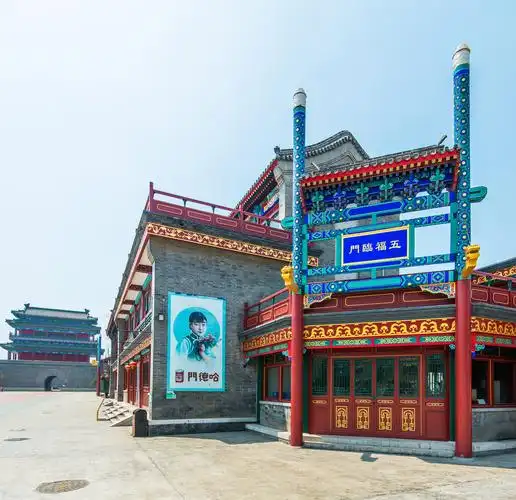
Guohua Cultural Film City is the more visually spectacular of the two. Its Ming-Qing Street recreates traditional Chinese urban architecture with grey brick walls, upturned eaves, and intricate timber bracket sets (dougong) that echo the imperial courtyards of Beijing's Forbidden City and Datong's ancient walls. The Republican-era lane conjures 1930s Shanghai, recalling the glamour of the Bund and the old European concessions, while the European district—complete with a Gothic chapel and pastel villas—feels plucked from a Tuscan hilltop or a Bavarian storybook. The striking juxtapositions make the complex irresistible to photographers and wedding parties.
By contrast, Daguang Film Town is all about the future of filmmaking. The park houses six world-class sound stages, a 4K broadcast studio, and professional motion-capture and visual-effects equipment. Visitors can watch variety-show tapings, try green-screen acting, interact with life-sized animatronic dinosaurs, and experiment with foley sound effects in a dedicated studio. Costume rentals let guests star in their own short films—an experience comparable to the Warner Bros. Studio Tour in London or Universal Studios in Hollywood, but with a distinctly Chinese twist.
Beyond entertainment, the two parks illustrate how China has transformed a once-closed industry into accessible cultural tourism. Hundreds of television series and variety programmes have been produced on these grounds, allowing visitors to trace the evolution of Chinese storytelling from traditional costume dramas to today's streaming-era blockbusters. The elaborate period sets also reveal how heritage architecture is being preserved—not in museums, but through living reconstructions actively used by contemporary artists.
Both parks require advance booking, ideally one to three days ahead, through the official WeChat mini-program or by phone, to confirm opening status and guided-tour availability. From central Beijing, take a high-speed train to Langfang Station in about twenty minutes, then a taxi for the forty-to-sixty-minute ride to the parks, or arrange a direct car. Surrounding restaurants and hotels are plentiful. Summer visitors should pack sunscreen, hats, and rain gear, and wear comfortable walking shoes—the grounds feature extensive stone-paved pathways.
For travellers seeking Instagram-worthy period costumes and architecture, Guohua Cultural Film City is the obvious choice, rivaling Hengdian World Studios but with a more intimate, less crowded feel. Those drawn to cutting-edge production technology and interactive experiences will find Daguang Film Town more compelling. Ideally, devote a full day to each, or combine them into a long weekend that captures both the storied past and the high-tech future of Chinese cinema.
Langfang's film tourism sector began in the early 2000s, when Guohua Cultural Film City broke ground in 2007 on a vast site in Xianghe County—one of North China's earliest large-scale filming locations. Its younger sibling, Daguang Film Town, opened in 2016 along the Chaobai River in Dachang Hui Autonomous County, riding the wave of China's television and streaming boom. Together the venues reflect two distinct eras of Chinese cinema: Guohua rooted in the nostalgic period-drama tradition, Daguang embracing the digital, special-effects-driven productions of today's market.
Guohua Cultural Film City is the more visually spectacular of the two. Its Ming-Qing Street recreates traditional Chinese urban architecture with grey brick walls, upturned eaves, and intricate timber bracket sets (dougong) that echo the imperial courtyards of Beijing's Forbidden City and Datong's ancient walls. The Republican-era lane conjures 1930s Shanghai, recalling the glamour of the Bund and the old European concessions, while the European district—complete with a Gothic chapel and pastel villas—feels plucked from a Tuscan hilltop or a Bavarian storybook. The striking juxtapositions make the complex irresistible to photographers and wedding parties.
By contrast, Daguang Film Town is all about the future of filmmaking. The park houses six world-class sound stages, a 4K broadcast studio, and professional motion-capture and visual-effects equipment. Visitors can watch variety-show tapings, try green-screen acting, interact with life-sized animatronic dinosaurs, and experiment with foley sound effects in a dedicated studio. Costume rentals let guests star in their own short films—an experience comparable to the Warner Bros. Studio Tour in London or Universal Studios in Hollywood, but with a distinctly Chinese twist.
Beyond entertainment, the two parks illustrate how China has transformed a once-closed industry into accessible cultural tourism. Hundreds of television series and variety programmes have been produced on these grounds, allowing visitors to trace the evolution of Chinese storytelling from traditional costume dramas to today's streaming-era blockbusters. The elaborate period sets also reveal how heritage architecture is being preserved—not in museums, but through living reconstructions actively used by contemporary artists.
Both parks require advance booking, ideally one to three days ahead, through the official WeChat mini-program or by phone, to confirm opening status and guided-tour availability. From central Beijing, take a high-speed train to Langfang Station in about twenty minutes, then a taxi for the forty-to-sixty-minute ride to the parks, or arrange a direct car. Surrounding restaurants and hotels are plentiful. Summer visitors should pack sunscreen, hats, and rain gear, and wear comfortable walking shoes—the grounds feature extensive stone-paved pathways.
For travellers seeking Instagram-worthy period costumes and architecture, Guohua Cultural Film City is the obvious choice, rivaling Hengdian World Studios but with a more intimate, less crowded feel. Those drawn to cutting-edge production technology and interactive experiences will find Daguang Film Town more compelling. Ideally, devote a full day to each, or combine them into a long weekend that captures both the storied past and the high-tech future of Chinese cinema.