Langfang Mosque
⭐ 3.50
Northwest side of the intersection of Aimin East Avenue and Guangyang Avenue, Guangyang District, Langfang City, Hebei Province, China
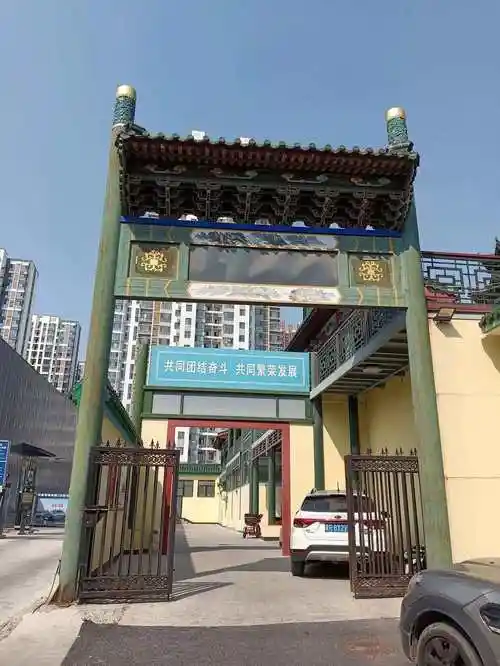 Langfang Mosque traces its origins to 1933, when local Hui Muslims established a modest place of worship on what is now Nanxiaojie. The mosque's near-century of evolution mirrors the broader trajectory of Islam in modern China, where Muslim communities have navigated cycles of integration, upheaval, and renewal since the religion's arrival via the Silk Road in the seventh century. A first major renovation came in 1988–1990, and in 1998 the entire complex was relocated and enlarged to make way for the Yinhe elevated bridge. Today it occupies roughly 1,650 square meters, a small but resilient outpost of faith.
The two-story structure is a confident exercise in Sino-Arabian fusion, with crisp modern lines draped in unmistakable Islamic symbolism. A vivid emerald-green dome, ringed by bulbous finials and crescent markers, rises above the prayer hall like a miniature echo of the great mosque of Córdoba or the domed silhouettes crowning Istanbul's skyline. The ground floor houses reception rooms, ablution facilities, and a separate women's prayer space, all sheltered by a wraparound colonnade. Above, the main prayer hall accommodates up to 600 worshippers in a restrained yet warm palette that conveys solemnity without austerity.
As the seat of the Langfang Islamic Association, the mosque functions as the spiritual heart of the local Hui community. Beyond its role in daily prayers and the Friday Jumu'ah gathering, it hosts festivals, religious instruction, and community events that knit the congregation together across generations. For foreign visitors, the complex offers a candid introduction to the everyday rhythms of Chinese Muslim life, an often-overlooked thread in the country's cultural fabric. To step inside is to glimpse the gentle coexistence of Han and Hui traditions that has shaped Langfang's identity for more than a century.
The mosque sits on Nanxiaojie in Anda District, close to Yinhe Bridge and Yuehua Road. Bus 2 stops directly nearby; alternatively, take routes 4-branch, 29, or 32 and alight at Anda District Hospital or Minxin Bridge East, from where it is a short walk. The site is generally open to visitors daily from 08:00 to 17:00, though hours may vary, so check on arrival. Women should bring a headscarf, modest clothing is appreciated, and shoes must be removed before entering the prayer hall. Photography of the exterior and courtyard is welcome; ask before photographing the prayer hall interior, and never photograph worshippers at close range.
Most travelers racing between Beijing and Tianjin overlook Langfang entirely, which makes a stop here all the more rewarding. The mosque's green dome offers one of the few distinctive silhouettes on the city's otherwise utilitarian skyline, and the surrounding streets are dotted with halal eateries serving steaming bowls of mutton soup and hand-pulled beef noodles, perfect for an unhurried lunch. Pair your visit with a wander through the neighboring old lanes to absorb the everyday atmosphere. In less than an hour, you leave with a richer sense of the multicultural currents quietly flowing through this unassuming gateway city.
Langfang Mosque traces its origins to 1933, when local Hui Muslims established a modest place of worship on what is now Nanxiaojie. The mosque's near-century of evolution mirrors the broader trajectory of Islam in modern China, where Muslim communities have navigated cycles of integration, upheaval, and renewal since the religion's arrival via the Silk Road in the seventh century. A first major renovation came in 1988–1990, and in 1998 the entire complex was relocated and enlarged to make way for the Yinhe elevated bridge. Today it occupies roughly 1,650 square meters, a small but resilient outpost of faith.
The two-story structure is a confident exercise in Sino-Arabian fusion, with crisp modern lines draped in unmistakable Islamic symbolism. A vivid emerald-green dome, ringed by bulbous finials and crescent markers, rises above the prayer hall like a miniature echo of the great mosque of Córdoba or the domed silhouettes crowning Istanbul's skyline. The ground floor houses reception rooms, ablution facilities, and a separate women's prayer space, all sheltered by a wraparound colonnade. Above, the main prayer hall accommodates up to 600 worshippers in a restrained yet warm palette that conveys solemnity without austerity.
As the seat of the Langfang Islamic Association, the mosque functions as the spiritual heart of the local Hui community. Beyond its role in daily prayers and the Friday Jumu'ah gathering, it hosts festivals, religious instruction, and community events that knit the congregation together across generations. For foreign visitors, the complex offers a candid introduction to the everyday rhythms of Chinese Muslim life, an often-overlooked thread in the country's cultural fabric. To step inside is to glimpse the gentle coexistence of Han and Hui traditions that has shaped Langfang's identity for more than a century.
The mosque sits on Nanxiaojie in Anda District, close to Yinhe Bridge and Yuehua Road. Bus 2 stops directly nearby; alternatively, take routes 4-branch, 29, or 32 and alight at Anda District Hospital or Minxin Bridge East, from where it is a short walk. The site is generally open to visitors daily from 08:00 to 17:00, though hours may vary, so check on arrival. Women should bring a headscarf, modest clothing is appreciated, and shoes must be removed before entering the prayer hall. Photography of the exterior and courtyard is welcome; ask before photographing the prayer hall interior, and never photograph worshippers at close range.
Most travelers racing between Beijing and Tianjin overlook Langfang entirely, which makes a stop here all the more rewarding. The mosque's green dome offers one of the few distinctive silhouettes on the city's otherwise utilitarian skyline, and the surrounding streets are dotted with halal eateries serving steaming bowls of mutton soup and hand-pulled beef noodles, perfect for an unhurried lunch. Pair your visit with a wander through the neighboring old lanes to absorb the everyday atmosphere. In less than an hour, you leave with a richer sense of the multicultural currents quietly flowing through this unassuming gateway city.