Nanjian Pagoda
⭐ 2.50
Nanjianta Village, Nanjianta Town, Guangyang District, Langfang City, Hebei Province, China
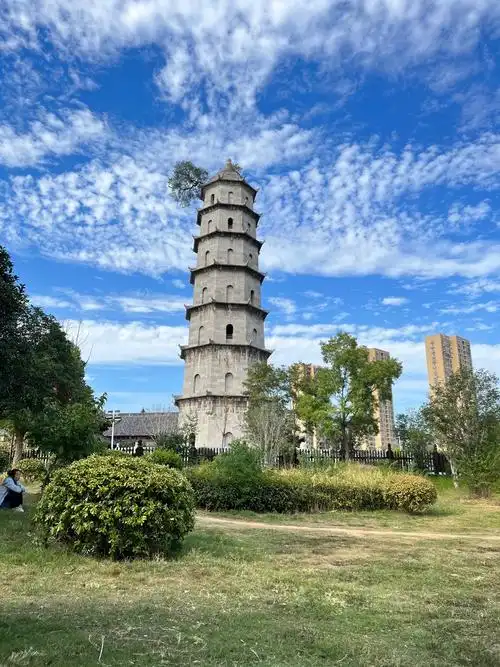 The name South Spire Pagoda reaches back to the Tang Dynasty (618–907 CE), an era contemporaries in the West would recognize as the age of Charlemagne. According to local records, the celebrated Tang general Yuchi Gong—revered rather like a medieval knight-errant—oversaw construction of the Thousand Buddha Pagoda Temple here, creating a Buddhist center whose incense smoke reportedly drifted across the region for centuries. Much as the vanished Temple of Solomon shaped Jerusalem's spiritual geography, this lost pagoda imprinted itself on Langfang's identity. Though both the temple and tower eventually eroded into history, their name survived as one of the city's oldest place markers, still whispered daily by commuters and shopkeepers.
The original pagoda was a six-sided brick structure typical of Buddhist architecture in Tang-era northern China—roughly contemporary with the Carolingian chapels of early medieval Europe. Such hexagonal designs were favored for their structural stability and symbolic resonance with Buddhist cosmology. Sadly, no physical trace remains of the tower itself; visitors searching for stone or brickwork will find only a busy urban crossroads. What endures is the geographical anchor: locals still navigate by "South Spire Pagoda" the way Parisians once oriented themselves by vanished medieval landmarks. Climbing is strictly prohibited—not that there's anything left to climb—and the experience is one of standing in a vanished shadow.
For scholars of religion, urban history, and toponymy, this unassuming intersection offers a remarkably rich case study. South Spire Pagoda witnessed Langfang's transformation from a Tang-era village into a modern city serving the Beijing-Tianjin corridor—much as the name "Temple Bar" in Dublin preserves a medieval heritage within a contemporary urban setting. The surviving toponym reminds passersby that beneath the asphalt once rose pagoda spires alive with sutras and chanting. It is a quiet reminder that cities layer centuries upon centuries, and that some of the most durable monuments are simply the names we keep calling places.
Entry is completely free, with no ticket required—the only "admission" is your imagination. The optimal visiting window is late afternoon, roughly 4 to 8 PM, when golden-hour light flatters the surroundings and the neighborhood's night market swings into action. From Langfang High-Speed Rail Station, a taxi to the site costs around 10–15 RMB and takes about ten minutes; alternatively, city buses 18 and 25 both stop at "Nanjianta." Plan for 30 to 60 minutes on-site, since the attraction itself is a location rather than a structure. Bring a camera and comfortable shoes for wandering the surrounding streets.
South Spire Pagoda pairs beautifully with a low-key half-day of local Langfang leisure. As evening falls, the Guangyang Road night market beckons with jianbing (savory crepes), fried skewers, and bubbling bowls of malatang—the kind of unpretentious Chinese street food that has largely vanished from more polished tourist cities. For deeper relaxation, drive 15–20 minutes to the Yi'er Holiday Hot Spring for a Korean-style jjimjilbang and buffet. Families may prefer the Changzheng Modern Agricultural Creative Park for seasonal fruit picking. The overall vibe is gentle, affordable, and authentic—ideal for travelers already exploring the Beijing-Tianjin corridor rather than those making a special pilgrimage.
The name South Spire Pagoda reaches back to the Tang Dynasty (618–907 CE), an era contemporaries in the West would recognize as the age of Charlemagne. According to local records, the celebrated Tang general Yuchi Gong—revered rather like a medieval knight-errant—oversaw construction of the Thousand Buddha Pagoda Temple here, creating a Buddhist center whose incense smoke reportedly drifted across the region for centuries. Much as the vanished Temple of Solomon shaped Jerusalem's spiritual geography, this lost pagoda imprinted itself on Langfang's identity. Though both the temple and tower eventually eroded into history, their name survived as one of the city's oldest place markers, still whispered daily by commuters and shopkeepers.
The original pagoda was a six-sided brick structure typical of Buddhist architecture in Tang-era northern China—roughly contemporary with the Carolingian chapels of early medieval Europe. Such hexagonal designs were favored for their structural stability and symbolic resonance with Buddhist cosmology. Sadly, no physical trace remains of the tower itself; visitors searching for stone or brickwork will find only a busy urban crossroads. What endures is the geographical anchor: locals still navigate by "South Spire Pagoda" the way Parisians once oriented themselves by vanished medieval landmarks. Climbing is strictly prohibited—not that there's anything left to climb—and the experience is one of standing in a vanished shadow.
For scholars of religion, urban history, and toponymy, this unassuming intersection offers a remarkably rich case study. South Spire Pagoda witnessed Langfang's transformation from a Tang-era village into a modern city serving the Beijing-Tianjin corridor—much as the name "Temple Bar" in Dublin preserves a medieval heritage within a contemporary urban setting. The surviving toponym reminds passersby that beneath the asphalt once rose pagoda spires alive with sutras and chanting. It is a quiet reminder that cities layer centuries upon centuries, and that some of the most durable monuments are simply the names we keep calling places.
Entry is completely free, with no ticket required—the only "admission" is your imagination. The optimal visiting window is late afternoon, roughly 4 to 8 PM, when golden-hour light flatters the surroundings and the neighborhood's night market swings into action. From Langfang High-Speed Rail Station, a taxi to the site costs around 10–15 RMB and takes about ten minutes; alternatively, city buses 18 and 25 both stop at "Nanjianta." Plan for 30 to 60 minutes on-site, since the attraction itself is a location rather than a structure. Bring a camera and comfortable shoes for wandering the surrounding streets.
South Spire Pagoda pairs beautifully with a low-key half-day of local Langfang leisure. As evening falls, the Guangyang Road night market beckons with jianbing (savory crepes), fried skewers, and bubbling bowls of malatang—the kind of unpretentious Chinese street food that has largely vanished from more polished tourist cities. For deeper relaxation, drive 15–20 minutes to the Yi'er Holiday Hot Spring for a Korean-style jjimjilbang and buffet. Families may prefer the Changzheng Modern Agricultural Creative Park for seasonal fruit picking. The overall vibe is gentle, affordable, and authentic—ideal for travelers already exploring the Beijing-Tianjin corridor rather than those making a special pilgrimage.