Shuilian Cave Scenic Area
⭐ 3.80
Shuilian Cave Scenic Area, Dongcheng District, Dongguan City, Guangdong Province, China
 **A Cascade Carved in Stone**
The name "Water Curtain Cave" evokes the fantastical grottoes of Chinese mythology, yet this Dongguan landmark is firmly rooted in geology rather than legend. The cliff-side inscription "Pengdong Water Curtain," carved during the Ming dynasty (1368–1644), commemorates the same silvery cascade that draws visitors today—roughly contemporary with Shakespeare's London. The site belongs to the Lingnan tradition of scholar-poet landscapes, where waterfalls were revered as places where heaven's moisture met the earth, much as the Romantic poets would later celebrate waterfalls in the Alps two centuries afterward.
**Echoes of a Song-Era Sanctuary**
Cloaked in subtropical forest, the partially restored Xishan Temple traces its origins to the Song dynasty (960–1279), an era when Marco Polo's forebears were still trading along the Silk Road. Its crimson walls, grey-tiled roofs, and restrained ornamentation reflect the austere elegance typical of southern Chinese Buddhist architecture, offering a contemplative counterpoint to the bolder, gilded temples of Beijing. Wandering the incense-scented courtyards feels akin to stumbling upon a forgotten Cistercian abbey in the Pyrenees—quiet, weathered, and steeped in devotion.
**The Waterfall and Its Hidden Passage**
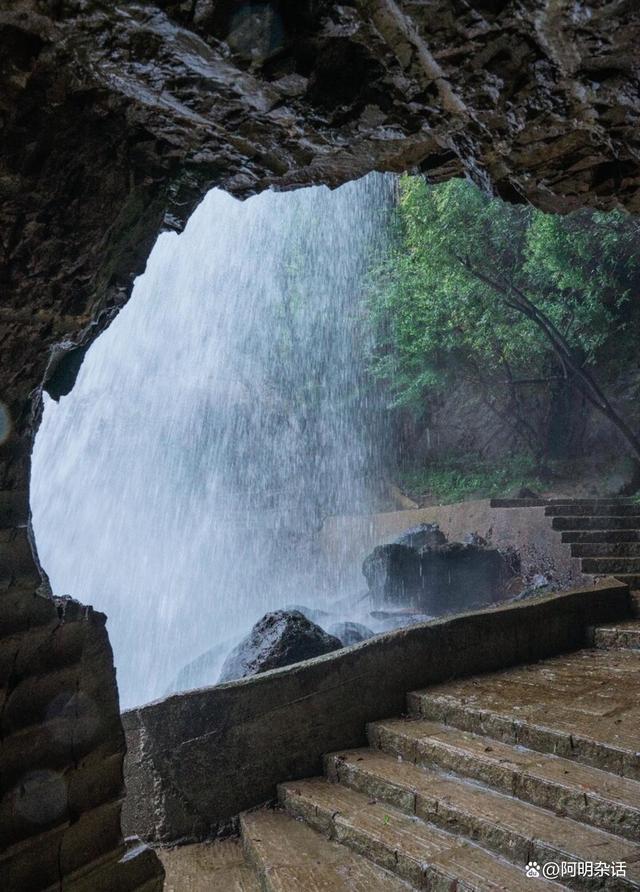
The star attraction is the 20-meter waterfall that earns the park its name. After summer rains, the flow is thunderous, sending up cool mists that drench the viewing platform; in drier months the water dwindles to delicate threads, more lyrical than dramatic. Behind the cascade, a damp, fern-lined tunnel can be traversed on foot—an atmospheric echo of the secret passages at England's Cheddar Gorge. Visitors should wear sturdy, non-slip shoes, as the algae-coated rocks become treacherous when wet.
**The Mountain Lake and Bamboo Valleys**
Halfway up the trail, the placid Tianchi—or "Heavenly Pool"—reflects the surrounding camphor and bamboo forests in glassy silence. A flat, wheelchair-friendly boardwalk circles its edge, making it ideal for families with small children or photographers chasing dawn mist. Deeper into the park, the aptly named Butterfly Valley comes alive each spring with clouds of swallowtails, while the Dream Stream trail winds past boulder-strewn brooks reminiscent of Japan's Arashiyama groves. The air here is consistently 3–5°C cooler than downtown Dongguan, earning the park its reputation as a genuine "forest oxygen bar."
**Summit Views Over the Pearl River Delta**
A flight of stone steps—steep but well-maintained—climbs to the 378-meter peak crowned by the rustic Shuiliang Pavilion. The reward is a near-270-degree panorama sweeping across Dongguan's southern districts, with the hazy silhouettes of Shenzhen's skyscrapers glimmering on the horizon. Sunset transforms the urban skyline into a golden frieze, a spectacle comparable to viewing Florence from Piazza Michelangelo, though here the city below is a forest of glass towers rather than terracotta domes. Benches around the pavilion invite a slow, tea-length pause before the descent.
**Practical Tips for Visitors**
The park is entirely free and open roughly from 5:30 a.m. to 7:30 p.m., though some gates stop admitting visitors around 8:30 p.m. To catch the waterfall at full force, time your visit for one or two days after a substantial rain; clear summer mornings before 10 a.m. or late afternoons offer the most comfortable temperatures. Bring your own water and snacks—on-site vendors are scarce and pricey—and pack insect repellent, sun protection, and grippy hiking shoes. Allow two to three hours for a comfortable visit, more if you plan to explore the temple ruins and photograph the summit at sunset.
**A Cascade Carved in Stone**
The name "Water Curtain Cave" evokes the fantastical grottoes of Chinese mythology, yet this Dongguan landmark is firmly rooted in geology rather than legend. The cliff-side inscription "Pengdong Water Curtain," carved during the Ming dynasty (1368–1644), commemorates the same silvery cascade that draws visitors today—roughly contemporary with Shakespeare's London. The site belongs to the Lingnan tradition of scholar-poet landscapes, where waterfalls were revered as places where heaven's moisture met the earth, much as the Romantic poets would later celebrate waterfalls in the Alps two centuries afterward.
**Echoes of a Song-Era Sanctuary**
Cloaked in subtropical forest, the partially restored Xishan Temple traces its origins to the Song dynasty (960–1279), an era when Marco Polo's forebears were still trading along the Silk Road. Its crimson walls, grey-tiled roofs, and restrained ornamentation reflect the austere elegance typical of southern Chinese Buddhist architecture, offering a contemplative counterpoint to the bolder, gilded temples of Beijing. Wandering the incense-scented courtyards feels akin to stumbling upon a forgotten Cistercian abbey in the Pyrenees—quiet, weathered, and steeped in devotion.
**The Waterfall and Its Hidden Passage**
The star attraction is the 20-meter waterfall that earns the park its name. After summer rains, the flow is thunderous, sending up cool mists that drench the viewing platform; in drier months the water dwindles to delicate threads, more lyrical than dramatic. Behind the cascade, a damp, fern-lined tunnel can be traversed on foot—an atmospheric echo of the secret passages at England's Cheddar Gorge. Visitors should wear sturdy, non-slip shoes, as the algae-coated rocks become treacherous when wet.
**The Mountain Lake and Bamboo Valleys**
Halfway up the trail, the placid Tianchi—or "Heavenly Pool"—reflects the surrounding camphor and bamboo forests in glassy silence. A flat, wheelchair-friendly boardwalk circles its edge, making it ideal for families with small children or photographers chasing dawn mist. Deeper into the park, the aptly named Butterfly Valley comes alive each spring with clouds of swallowtails, while the Dream Stream trail winds past boulder-strewn brooks reminiscent of Japan's Arashiyama groves. The air here is consistently 3–5°C cooler than downtown Dongguan, earning the park its reputation as a genuine "forest oxygen bar."
**Summit Views Over the Pearl River Delta**
A flight of stone steps—steep but well-maintained—climbs to the 378-meter peak crowned by the rustic Shuiliang Pavilion. The reward is a near-270-degree panorama sweeping across Dongguan's southern districts, with the hazy silhouettes of Shenzhen's skyscrapers glimmering on the horizon. Sunset transforms the urban skyline into a golden frieze, a spectacle comparable to viewing Florence from Piazza Michelangelo, though here the city below is a forest of glass towers rather than terracotta domes. Benches around the pavilion invite a slow, tea-length pause before the descent.
**Practical Tips for Visitors**
The park is entirely free and open roughly from 5:30 a.m. to 7:30 p.m., though some gates stop admitting visitors around 8:30 p.m. To catch the waterfall at full force, time your visit for one or two days after a substantial rain; clear summer mornings before 10 a.m. or late afternoons offer the most comfortable temperatures. Bring your own water and snacks—on-site vendors are scarce and pricey—and pack insect repellent, sun protection, and grippy hiking shoes. Allow two to three hours for a comfortable visit, more if you plan to explore the temple ruins and photograph the summit at sunset.