Lianhua Mountain Tourist Area
⭐ 4.60
Lianhua Mountain Tourist Area, Panyu District, Guangzhou, Guangdong Province, China
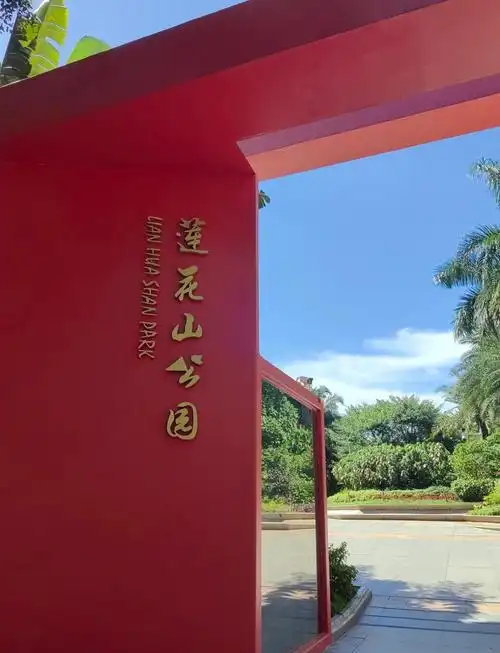 Lianhua Mountain's history stretches back to the Western Han Dynasty, more than two thousand years ago, when craftsmen began extracting red sandstone from its cliffs. The massive excavation left behind soaring crimson rock faces and cavernous grottoes that geologists call "artificial Danxia"—a landscape every bit as theatrical as the natural hoodoos of Cappadocia, yet shaped entirely by human hands. Walk the old quarry trails and you trace the slow chiseling of generations, a process that, like the great Roman quarries at Carrara, fed building projects across an empire.
The mountain's three signature landmarks each tell a different chapter of Chinese history. The Ming Dynasty Lotus Pagoda, an elegant five-story octagonal brick tower built in the Wanli era, offers panoramic views across the Lion Sea and Pearl River mouth—comparable to the vantage from a Tuscan campanile or a Dutch lighthouse. The adjacent Lotus City, a Qing Dynasty fortress constructed during the Kangxi reign, served as a coastal defense outpost and later saw action during the 19th-century Opium Wars, linking this peaceful park to one of the defining conflicts of European-Chinese relations.
Dominating the skyline is the 40.88-meter bronze statue of Guanyin, the Buddhist bodhisattva of mercy, sheathed in gold leaf and gazing out to sea. Standing taller than Rome's Trevi Fountain is wide, it holds the record as the world's tallest gilded Guanyin and forms the spiritual heart of the complex. Below it, the Guanyin Square draws pilgrims from across Lingnan, while curious visitors will appreciate the strange beauty of the Swallow Rock and Flying Eagle Cliff formations—wind- and water-sculpted sandstone walls that have become favorites among photographers and geologists alike.
The site lies about 40 kilometers southeast of central Guangzhou, in Shilou Town, Panyu District. Gates open daily from 7:00 a.m. to 5:00 p.m., with adult tickets at 54 RMB; seniors aged 60–64 and full-time students pay 27 RMB, while those 65 and over enter free. Climbing the pagoda costs an extra 2 RMB, and electric shuttle tickets run 10 RMB per one-way ride. Plan for two to three hours, and time your visit around the June-to-August Lotus Festival for the most spectacular floral displays.
Beat the midday heat by arriving at 8:30 a.m., when soft light bathes the quarry walls and crowds are still thin. Enter through the West Gate and follow a logical loop: start with the lotus ponds in the Lotus Fairy Realm, then descend into the ancient quarry for photographs, continue to the Guanyin Square for a moment of reflection, climb the Ming pagoda for sweeping river views, and finish with a walk through the historic Lotus City before returning. The entire circuit is walkable, though tired legs will appreciate the shuttle bus, and on-site snack vendors offer welcome respite from the Lingnan sun.
Lianhua Mountain's history stretches back to the Western Han Dynasty, more than two thousand years ago, when craftsmen began extracting red sandstone from its cliffs. The massive excavation left behind soaring crimson rock faces and cavernous grottoes that geologists call "artificial Danxia"—a landscape every bit as theatrical as the natural hoodoos of Cappadocia, yet shaped entirely by human hands. Walk the old quarry trails and you trace the slow chiseling of generations, a process that, like the great Roman quarries at Carrara, fed building projects across an empire.
The mountain's three signature landmarks each tell a different chapter of Chinese history. The Ming Dynasty Lotus Pagoda, an elegant five-story octagonal brick tower built in the Wanli era, offers panoramic views across the Lion Sea and Pearl River mouth—comparable to the vantage from a Tuscan campanile or a Dutch lighthouse. The adjacent Lotus City, a Qing Dynasty fortress constructed during the Kangxi reign, served as a coastal defense outpost and later saw action during the 19th-century Opium Wars, linking this peaceful park to one of the defining conflicts of European-Chinese relations.
Dominating the skyline is the 40.88-meter bronze statue of Guanyin, the Buddhist bodhisattva of mercy, sheathed in gold leaf and gazing out to sea. Standing taller than Rome's Trevi Fountain is wide, it holds the record as the world's tallest gilded Guanyin and forms the spiritual heart of the complex. Below it, the Guanyin Square draws pilgrims from across Lingnan, while curious visitors will appreciate the strange beauty of the Swallow Rock and Flying Eagle Cliff formations—wind- and water-sculpted sandstone walls that have become favorites among photographers and geologists alike.
The site lies about 40 kilometers southeast of central Guangzhou, in Shilou Town, Panyu District. Gates open daily from 7:00 a.m. to 5:00 p.m., with adult tickets at 54 RMB; seniors aged 60–64 and full-time students pay 27 RMB, while those 65 and over enter free. Climbing the pagoda costs an extra 2 RMB, and electric shuttle tickets run 10 RMB per one-way ride. Plan for two to three hours, and time your visit around the June-to-August Lotus Festival for the most spectacular floral displays.
Beat the midday heat by arriving at 8:30 a.m., when soft light bathes the quarry walls and crowds are still thin. Enter through the West Gate and follow a logical loop: start with the lotus ponds in the Lotus Fairy Realm, then descend into the ancient quarry for photographs, continue to the Guanyin Square for a moment of reflection, climb the Ming pagoda for sweeping river views, and finish with a walk through the historic Lotus City before returning. The entire circuit is walkable, though tired legs will appreciate the shuttle bus, and on-site snack vendors offer welcome respite from the Lingnan sun.