Haixinsha Park
⭐ 4.20
Haixinsha Park, Tianhe District, Guangzhou City, Guangdong Province, China
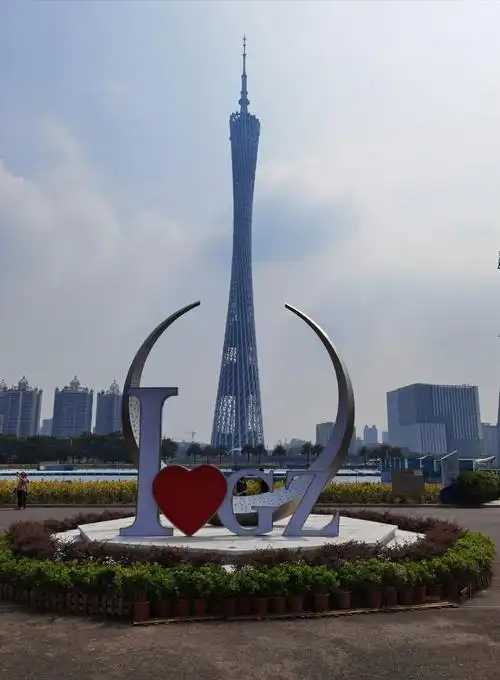 Haixinsha began life as a sandbar in the Pearl River, much like the Île de la Cité in Paris before Haussmann reshaped it, a thin strip of land visible only at low tide. In November 2010, it staged the opening and closing ceremonies of the 16th Asian Games, an event that positioned Guangzhou alongside Sydney, Doha, and Incheon on Asia's premier sporting circuit. When the Games ended, rather than demolishing the arena as many host cities have done, planners converted it into a public park, following the adaptive-reuse model championed by London's 2012 Olympic Park or Barcelona's Montjuïc.
The architectural leftovers give the place its drama. The 86-meter torch tower still commands the island, recalling the sweeping spires of Calatrava's Montjuïc communications tower or the torch of Barcelona's 1992 Olympics. Behind it looms the 8,000-square-meter curved LED sail screen, which once carried projected imagery to billions of viewers and now reads as monumental industrial sculpture. A 270-degree waterfront grandstand wraps the river-facing side, while a broad floating boardwalk known locally as the "Avenue of Stars" reaches across the water to the southern bank.
Culturally, the park serves as Guangzhou's living sports museum, an open-air archive where the city's coming-of-age as a global metropolis is written in steel, light, and water. Every National Day, lantern festival, or visiting concert, the torch tower and sail screen are reawakened with synchronized light shows, drawing crowds to a stage that has hosted everyone from Chinese pop idols to international symphony orchestras. It is the rare Olympic venue that has stayed relevant, a parallel to Munich's Olympiapark, which similarly transitioned from Cold-War-era symbol to everyday leisure ground.
Practicalities are refreshingly simple. Admission is free, and the park is open daily from 07:00 to 23:00. Take the APM metro line—Guangzhou's driverless rubber-tyred shuttle, itself an attraction—and alight at Haixinsha Station, Exit A, which deposits you directly on the island. The musical fountain performs three times on Tuesday through Sunday evenings, at 19:30, 20:30, and 21:30, but takes Mondays and rainy days off for maintenance. Food concessions on the islet are limited, so bring water or plan to dine in the Zhujiang New Town mall district just across the bridge.
The smartest visit begins in late afternoon, around 17:30 to 18:30, when the setting sun paints the CBD skyscrapers in amber and the Pearl River turns to molten gold. Stay for the official illumination of Canton Tower shortly after dusk, then stake out a waterside bench for the 20:30 fountain show, when jets dance against the lit-up skyline. Allow roughly ninety minutes to two hours for a full circuit, longer if you are photographing or picnicking.
What makes Haixinsha worth the detour is its improbable vantage point. Few city parks anywhere in the world let you frame a slender TV tower reminiscent of the Eiffel Tower gone asymmetrical, a cable-stayed bridge à la Millau, and a futuristic opera house in one unbroken panorama. It is the single best place to grasp contemporary Guangzhou, where 2,000 years of maritime-trade history tilt confidently into a high-rise, high-tech future.
Haixinsha began life as a sandbar in the Pearl River, much like the Île de la Cité in Paris before Haussmann reshaped it, a thin strip of land visible only at low tide. In November 2010, it staged the opening and closing ceremonies of the 16th Asian Games, an event that positioned Guangzhou alongside Sydney, Doha, and Incheon on Asia's premier sporting circuit. When the Games ended, rather than demolishing the arena as many host cities have done, planners converted it into a public park, following the adaptive-reuse model championed by London's 2012 Olympic Park or Barcelona's Montjuïc.
The architectural leftovers give the place its drama. The 86-meter torch tower still commands the island, recalling the sweeping spires of Calatrava's Montjuïc communications tower or the torch of Barcelona's 1992 Olympics. Behind it looms the 8,000-square-meter curved LED sail screen, which once carried projected imagery to billions of viewers and now reads as monumental industrial sculpture. A 270-degree waterfront grandstand wraps the river-facing side, while a broad floating boardwalk known locally as the "Avenue of Stars" reaches across the water to the southern bank.
Culturally, the park serves as Guangzhou's living sports museum, an open-air archive where the city's coming-of-age as a global metropolis is written in steel, light, and water. Every National Day, lantern festival, or visiting concert, the torch tower and sail screen are reawakened with synchronized light shows, drawing crowds to a stage that has hosted everyone from Chinese pop idols to international symphony orchestras. It is the rare Olympic venue that has stayed relevant, a parallel to Munich's Olympiapark, which similarly transitioned from Cold-War-era symbol to everyday leisure ground.
Practicalities are refreshingly simple. Admission is free, and the park is open daily from 07:00 to 23:00. Take the APM metro line—Guangzhou's driverless rubber-tyred shuttle, itself an attraction—and alight at Haixinsha Station, Exit A, which deposits you directly on the island. The musical fountain performs three times on Tuesday through Sunday evenings, at 19:30, 20:30, and 21:30, but takes Mondays and rainy days off for maintenance. Food concessions on the islet are limited, so bring water or plan to dine in the Zhujiang New Town mall district just across the bridge.
The smartest visit begins in late afternoon, around 17:30 to 18:30, when the setting sun paints the CBD skyscrapers in amber and the Pearl River turns to molten gold. Stay for the official illumination of Canton Tower shortly after dusk, then stake out a waterside bench for the 20:30 fountain show, when jets dance against the lit-up skyline. Allow roughly ninety minutes to two hours for a full circuit, longer if you are photographing or picnicking.
What makes Haixinsha worth the detour is its improbable vantage point. Few city parks anywhere in the world let you frame a slender TV tower reminiscent of the Eiffel Tower gone asymmetrical, a cable-stayed bridge à la Millau, and a futuristic opera house in one unbroken panorama. It is the single best place to grasp contemporary Guangzhou, where 2,000 years of maritime-trade history tilt confidently into a high-rise, high-tech future.