Chen Clan Ancestral Hall Scenic Area
⭐ 4.70
Chen Clan Ancestral Hall Scenic Area, Guangzhou, Guangdong Province, China
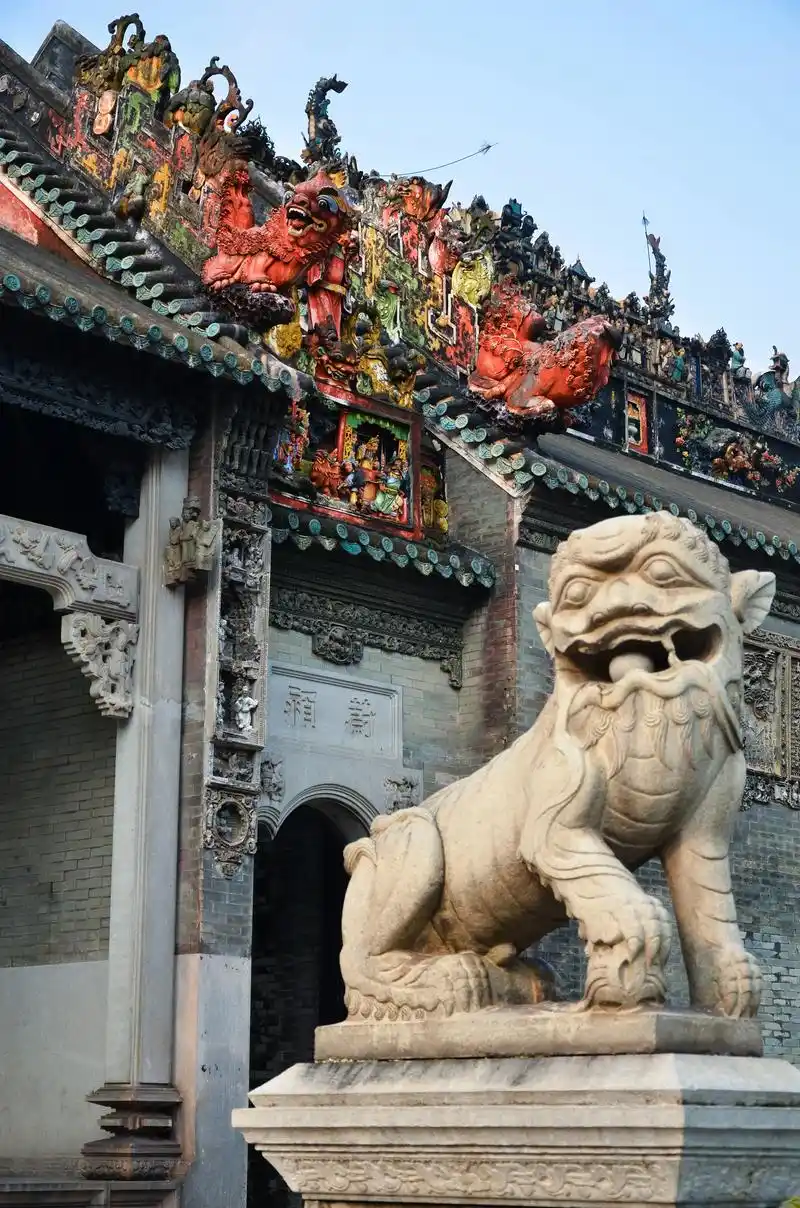 The Chen Clan Ancestral Hall was erected between 1888 and 1895, funded collectively by the Chen surname families of all seventy-two counties of Guangdong province. Picture the communal ambition of a medieval European cathedral chapter or a Renaissance guild hall—the project united diaspora kin to create both a hostel for scholars traveling to the provincial examinations and a ceremonial shrine to their shared ancestors. While Europe's great Gothic cathedrals were rising six centuries earlier, this Lingnan masterpiece represents a parallel flowering of vernacular craftsmanship, now preserved as a National Key Cultural Relic Protection Unit.
Architecturally, the complex follows the classic Lingnan "three-entry, three-route, nine-hall, two-wing" layout, organized on a strict central axis like a Chinese answer to a French château or Italian palazzo. Visitors pass through colorful glazed-tile gateways into shaded courtyards and narrow alleys paved in time-patinated green brick. Each successive hall deepens the sense of enclosure and ceremony, with the central Juxian Hall serving as the climax—a serene chamber whose timber ceiling, lattice screens, and ceremonial dais evoke the contemplative atmosphere of a Spanish Mudéjar patio or a Portuguese azulejo-lined cloister.
What distinguishes Chen Clan from any European counterpart is the riotous density of its seven signature crafts—wood, brick, and stone carving, ceramic and lime sculpture, cast ironwork, and polychrome painting—woven together without a single decorative gap. The 27-meter ceramic ridge crowning Juxian Hall alone contains 284 narrative scenes and 224 human figures, each tile fired in the Shiwan kilns and assembled like a Tang Dynasty picture scroll frozen in clay. Equally breathtaking are the 16 double-sided pierced wooden screen doors, whose reverse faces tell entirely different stories from the fronts—an artistry recalling medieval ivory carving, but executed in fragrant Cantonese hardwood.
Today the compound houses the Guangdong Folk Art Museum, where rotating exhibitions showcase living Cantonese traditions: Cantonese embroidery, polychrome porcelain, and Shiwan ceramic figurines—crafts that still sustain workshops in nearby Foshan. For travelers seeking to understand the cultural bedrock beneath modern Shenzhen's skyscrapers and Hong Kong's neon, the hall offers essential context. It functions simultaneously as temple, school, museum, and architectural encyclopedia—a place where the Cantonese identity is preserved, performed, and passed forward to new generations.
Entry costs a remarkably modest ¥10 (around $1.50), and the hall sits a three-minute stroll from Exit D of Chen Clan Ancestral Hall Station, served by Metro Lines 1 and 8. Free Chinese-language guided tours depart from the main gate at 10:00 and 15:00; English audio guides are available at the entrance. Elevators and barrier-free ramps make the site accessible to travelers of all ages. Aim for a weekday morning between 9:00 and 11:00 to enjoy the carvings in near-solitude and warm directional light.
Plan on two to three hours to follow the recommended route: main courtyard → cast-iron terrace balustrades → Juxian Hall core → side-wing folk craft galleries → rear garden → creative-stamp souvenir shop. On exiting, walk west to Xihua Road for classic Xiguan snacks—shrimp wonton noodles and boat congee—before continuing to the revitalized Yongqing Fang lanes and the colonial-era Shamian Island. Few sites in southern China reward a morning's visit so generously for so little effort.
The Chen Clan Ancestral Hall was erected between 1888 and 1895, funded collectively by the Chen surname families of all seventy-two counties of Guangdong province. Picture the communal ambition of a medieval European cathedral chapter or a Renaissance guild hall—the project united diaspora kin to create both a hostel for scholars traveling to the provincial examinations and a ceremonial shrine to their shared ancestors. While Europe's great Gothic cathedrals were rising six centuries earlier, this Lingnan masterpiece represents a parallel flowering of vernacular craftsmanship, now preserved as a National Key Cultural Relic Protection Unit.
Architecturally, the complex follows the classic Lingnan "three-entry, three-route, nine-hall, two-wing" layout, organized on a strict central axis like a Chinese answer to a French château or Italian palazzo. Visitors pass through colorful glazed-tile gateways into shaded courtyards and narrow alleys paved in time-patinated green brick. Each successive hall deepens the sense of enclosure and ceremony, with the central Juxian Hall serving as the climax—a serene chamber whose timber ceiling, lattice screens, and ceremonial dais evoke the contemplative atmosphere of a Spanish Mudéjar patio or a Portuguese azulejo-lined cloister.
What distinguishes Chen Clan from any European counterpart is the riotous density of its seven signature crafts—wood, brick, and stone carving, ceramic and lime sculpture, cast ironwork, and polychrome painting—woven together without a single decorative gap. The 27-meter ceramic ridge crowning Juxian Hall alone contains 284 narrative scenes and 224 human figures, each tile fired in the Shiwan kilns and assembled like a Tang Dynasty picture scroll frozen in clay. Equally breathtaking are the 16 double-sided pierced wooden screen doors, whose reverse faces tell entirely different stories from the fronts—an artistry recalling medieval ivory carving, but executed in fragrant Cantonese hardwood.
Today the compound houses the Guangdong Folk Art Museum, where rotating exhibitions showcase living Cantonese traditions: Cantonese embroidery, polychrome porcelain, and Shiwan ceramic figurines—crafts that still sustain workshops in nearby Foshan. For travelers seeking to understand the cultural bedrock beneath modern Shenzhen's skyscrapers and Hong Kong's neon, the hall offers essential context. It functions simultaneously as temple, school, museum, and architectural encyclopedia—a place where the Cantonese identity is preserved, performed, and passed forward to new generations.
Entry costs a remarkably modest ¥10 (around $1.50), and the hall sits a three-minute stroll from Exit D of Chen Clan Ancestral Hall Station, served by Metro Lines 1 and 8. Free Chinese-language guided tours depart from the main gate at 10:00 and 15:00; English audio guides are available at the entrance. Elevators and barrier-free ramps make the site accessible to travelers of all ages. Aim for a weekday morning between 9:00 and 11:00 to enjoy the carvings in near-solitude and warm directional light.
Plan on two to three hours to follow the recommended route: main courtyard → cast-iron terrace balustrades → Juxian Hall core → side-wing folk craft galleries → rear garden → creative-stamp souvenir shop. On exiting, walk west to Xihua Road for classic Xiguan snacks—shrimp wonton noodles and boat congee—before continuing to the revitalized Yongqing Fang lanes and the colonial-era Shamian Island. Few sites in southern China reward a morning's visit so generously for so little effort.