Qingguo Lane
⭐ 4.50
Qingguo Lane, Tianning District, Changzhou, Jiangsu, China
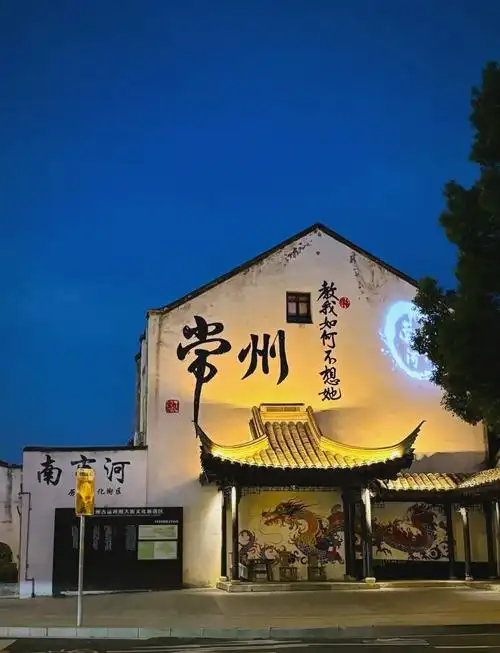 Step into Qiguo Lane and you are walking into a living chapter of China's late-imperial and early-modern story. The lane predates 1581 and earned its original name, "Thousand-Fruit Lane," from the bustling wholesale fruit trade that flourished on the Grand Canal—a waterway completed in the same century that Michelangelo was finishing the Sistine Chapel. Over four centuries it produced a remarkable roster of statesmen, revolutionaries, and reformers, including Communist intellectual Qu Qiubai and railroad pioneer Sheng Xuanhuai, earning it the reputation of Changzhou's answer to Edinburgh's Royal Mile or Florence's Via Tornabuoni.
The architecture reads like a primer on Jiangnan domestic design, with hallmark whitewashed walls, dark tile roofs, carved brick gateways, and latticed wooden windows. The lane is laid out on a "nine alleys, eight mansions" plan, anchored by a 400-meter flagstone spine, and the Tang family estates remain the most intact, particularly the Zhenhe Hall, now a memorial to Ming patriot-scholar Tang Jingchuan. Compared to Venice's quieter campi or the timber-framed lanes of Strasbourg's Petite France, the atmosphere here is unmistakably southern Chinese, yet similarly intimate and meticulously restored.
Beyond the architecture, the lane functions as a dispersed open-air museum. Small, free cultural spaces—among them the Qiguo Lane Memory Hall, the Zhou Youguang Library, and the Zhao Yuanren Art Center—open roughly 9:30 a.m. to 5:30 p.m. with Monday closures common. These venues trace Changzhou's literary lineage and house artifacts of figures who shaped Chinese language reform, comparative linguistics, and twentieth-century music. Expect exhibits labeled primarily in Chinese, so a translation app or pre-visit reading greatly enhances the experience.
Practicalities are refreshingly straightforward. Enter from Heping Road or Jinling Middle Road; the closest metro is Line 1's Culture Palace Station, about 500 meters on foot. Wear flat, comfortable shoes for the cobbled flagstones, plan for a two- to three-hour wander, and time your arrival after 4 p.m. to capture the transition from soft daylight to the lantern-glow over the canal. Evening brings a magical inversion—red lanterns mirrored in still water—while summer visitors can rent kayaks until 10 p.m. or settle into a riverside teahouse for a sip of local silver-thread noodles.
What sets Qiguo Lane apart is its rare balance of depth and accessibility. You will not find the crowds of Suzhou's Pingjiang Road or the commercial polish of Hangzhou's Hefang Street; instead, you encounter a neighborhood that still feels lived-in, anchored by the same canal that once linked Beijing to Hangzhou and carried emperors, scholars, and merchants alike. Add a tasting of local specialties—qingguo cakes, wonton soup, and silver-thread noodles—and you have one of the Yangtze Delta's most rewarding half-day stops for travelers seeking the quieter, soulful face of historic China.
Step into Qiguo Lane and you are walking into a living chapter of China's late-imperial and early-modern story. The lane predates 1581 and earned its original name, "Thousand-Fruit Lane," from the bustling wholesale fruit trade that flourished on the Grand Canal—a waterway completed in the same century that Michelangelo was finishing the Sistine Chapel. Over four centuries it produced a remarkable roster of statesmen, revolutionaries, and reformers, including Communist intellectual Qu Qiubai and railroad pioneer Sheng Xuanhuai, earning it the reputation of Changzhou's answer to Edinburgh's Royal Mile or Florence's Via Tornabuoni.
The architecture reads like a primer on Jiangnan domestic design, with hallmark whitewashed walls, dark tile roofs, carved brick gateways, and latticed wooden windows. The lane is laid out on a "nine alleys, eight mansions" plan, anchored by a 400-meter flagstone spine, and the Tang family estates remain the most intact, particularly the Zhenhe Hall, now a memorial to Ming patriot-scholar Tang Jingchuan. Compared to Venice's quieter campi or the timber-framed lanes of Strasbourg's Petite France, the atmosphere here is unmistakably southern Chinese, yet similarly intimate and meticulously restored.
Beyond the architecture, the lane functions as a dispersed open-air museum. Small, free cultural spaces—among them the Qiguo Lane Memory Hall, the Zhou Youguang Library, and the Zhao Yuanren Art Center—open roughly 9:30 a.m. to 5:30 p.m. with Monday closures common. These venues trace Changzhou's literary lineage and house artifacts of figures who shaped Chinese language reform, comparative linguistics, and twentieth-century music. Expect exhibits labeled primarily in Chinese, so a translation app or pre-visit reading greatly enhances the experience.
Practicalities are refreshingly straightforward. Enter from Heping Road or Jinling Middle Road; the closest metro is Line 1's Culture Palace Station, about 500 meters on foot. Wear flat, comfortable shoes for the cobbled flagstones, plan for a two- to three-hour wander, and time your arrival after 4 p.m. to capture the transition from soft daylight to the lantern-glow over the canal. Evening brings a magical inversion—red lanterns mirrored in still water—while summer visitors can rent kayaks until 10 p.m. or settle into a riverside teahouse for a sip of local silver-thread noodles.
What sets Qiguo Lane apart is its rare balance of depth and accessibility. You will not find the crowds of Suzhou's Pingjiang Road or the commercial polish of Hangzhou's Hefang Street; instead, you encounter a neighborhood that still feels lived-in, anchored by the same canal that once linked Beijing to Hangzhou and carried emperors, scholars, and merchants alike. Add a tasting of local specialties—qingguo cakes, wonton soup, and silver-thread noodles—and you have one of the Yangtze Delta's most rewarding half-day stops for travelers seeking the quieter, soulful face of historic China.