Hongmei Park
⭐ 4.20
Changzhou, Jiangsu, China
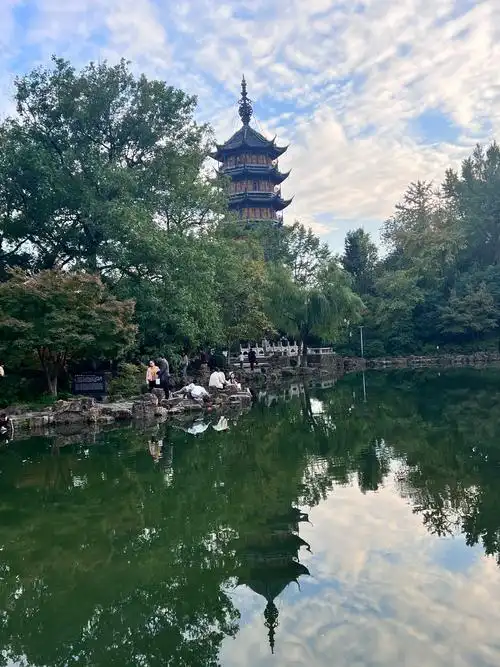 Red Plum Park's origins stretch back to the Southern Dynasties period (5th–6th century AD), an era when the Roman Empire had recently collapsed and Anglo-Saxon kingdoms were forming in Britain. The park's centerpiece, Wenbi Pagoda—"Literary Brush Pagoda"—was first erected during the Qi and Liang dynasties and has stood for over 1,500 years, making it older than the Tower of London and predating most medieval European landmarks still in use today. This ancient seven-story brick tower, comparable in purpose to an early European campanile, has witnessed imperial dynasties, wars, and the rise of modern Changzhou.
The park follows the classic "three zones, eight scenes" layout typical of Chinese garden design: the southern section devoted to historical monuments, the northwest to recreation, and the east to educational exhibits. Climbing Wenbi Pagoda rewards visitors with sweeping city views—similar in spirit to ascending a medieval cathedral tower, though the experience culminates in a quintessentially Chinese panorama of tiled rooftops and garden pavilions below. Nearby, the Qing-dynasty Red Plum Pavilion embodies refined Jiangnan aesthetics: dark timber beams, upturned eaves, and intimate courtyards designed for quiet contemplation of plum blossoms in winter's fading light.
Plum blossom appreciation holds a cultural place in China comparable to cherry blossom viewing in Japan or tulip fervor in the Netherlands—a seasonal ritual inspiring poets and painters for centuries. From late winter through early spring, the park's plum groves transform into a fragrant, snow-dusted wonderland that has enchanted literati since the Song dynasty. The park also forms part of Jiangsu's official "Grand Canal Hundred Scenes," linking it to the UNESCO World Heritage Grand Canal—an engineering marvel predating Europe's major canal systems by centuries.
What truly distinguishes Red Plum Park from purely historical sites is its role as Changzhou's "urban living room." At dawn and dusk, elderly residents practice tai chi, amateur opera singers perform Kunqu melodies, and children chase each other along lakeside paths. This authentic slice of local life—reminiscent of how Paris's Luxembourg Gardens or London's Hyde Park serve as communal gathering spaces—blends classical Chinese aesthetics with contemporary urban culture. The interplay of opera singers, drifting incense, and lotus-filled ponds offers a sensory experience impossible to manufacture.
The park is entirely free and requires no reservation. Take Metro Line 2 to Hongmei Park Station. Small fees apply only for climbing Wenbi Pagoda (¥5) and entering the Red Plum Pavilion interior (¥5), both payable via QR code. The recommended route enters at the south gate, passing through the Jiaxian Memorial Archway to Wenbi Pagoda, then onward to Red Plum Pavilion and the Yingmei Lakeside Walk, exiting via the north or west gate—a leisurely 2–3 hour stroll. The park pairs naturally with nearby Tianning Temple and Qingguo Lane historic district.
Red Plum Park offers travelers a concentrated dose of Changzhou's 1,500-year story in a single walkable space. August visitors should arrive after 16:30 to escape peak heat and enjoy golden-hour light perfect for photographing lotus blooms reflecting Tianning Pagoda. Bring water and snacks (on-site dining is limited), plus sun protection, rain gear, and mosquito repellent during humid months. Weekends draw crowds—early mornings or weekday afternoons offer quieter contemplation. Maintain respectful distance from local opera performers and chess players absorbed in their daily rituals.
Red Plum Park's origins stretch back to the Southern Dynasties period (5th–6th century AD), an era when the Roman Empire had recently collapsed and Anglo-Saxon kingdoms were forming in Britain. The park's centerpiece, Wenbi Pagoda—"Literary Brush Pagoda"—was first erected during the Qi and Liang dynasties and has stood for over 1,500 years, making it older than the Tower of London and predating most medieval European landmarks still in use today. This ancient seven-story brick tower, comparable in purpose to an early European campanile, has witnessed imperial dynasties, wars, and the rise of modern Changzhou.
The park follows the classic "three zones, eight scenes" layout typical of Chinese garden design: the southern section devoted to historical monuments, the northwest to recreation, and the east to educational exhibits. Climbing Wenbi Pagoda rewards visitors with sweeping city views—similar in spirit to ascending a medieval cathedral tower, though the experience culminates in a quintessentially Chinese panorama of tiled rooftops and garden pavilions below. Nearby, the Qing-dynasty Red Plum Pavilion embodies refined Jiangnan aesthetics: dark timber beams, upturned eaves, and intimate courtyards designed for quiet contemplation of plum blossoms in winter's fading light.
Plum blossom appreciation holds a cultural place in China comparable to cherry blossom viewing in Japan or tulip fervor in the Netherlands—a seasonal ritual inspiring poets and painters for centuries. From late winter through early spring, the park's plum groves transform into a fragrant, snow-dusted wonderland that has enchanted literati since the Song dynasty. The park also forms part of Jiangsu's official "Grand Canal Hundred Scenes," linking it to the UNESCO World Heritage Grand Canal—an engineering marvel predating Europe's major canal systems by centuries.
What truly distinguishes Red Plum Park from purely historical sites is its role as Changzhou's "urban living room." At dawn and dusk, elderly residents practice tai chi, amateur opera singers perform Kunqu melodies, and children chase each other along lakeside paths. This authentic slice of local life—reminiscent of how Paris's Luxembourg Gardens or London's Hyde Park serve as communal gathering spaces—blends classical Chinese aesthetics with contemporary urban culture. The interplay of opera singers, drifting incense, and lotus-filled ponds offers a sensory experience impossible to manufacture.
The park is entirely free and requires no reservation. Take Metro Line 2 to Hongmei Park Station. Small fees apply only for climbing Wenbi Pagoda (¥5) and entering the Red Plum Pavilion interior (¥5), both payable via QR code. The recommended route enters at the south gate, passing through the Jiaxian Memorial Archway to Wenbi Pagoda, then onward to Red Plum Pavilion and the Yingmei Lakeside Walk, exiting via the north or west gate—a leisurely 2–3 hour stroll. The park pairs naturally with nearby Tianning Temple and Qingguo Lane historic district.
Red Plum Park offers travelers a concentrated dose of Changzhou's 1,500-year story in a single walkable space. August visitors should arrive after 16:30 to escape peak heat and enjoy golden-hour light perfect for photographing lotus blooms reflecting Tianning Pagoda. Bring water and snacks (on-site dining is limited), plus sun protection, rain gear, and mosquito repellent during humid months. Weekends draw crowds—early mornings or weekday afternoons offer quieter contemplation. Maintain respectful distance from local opera performers and chess players absorbed in their daily rituals.