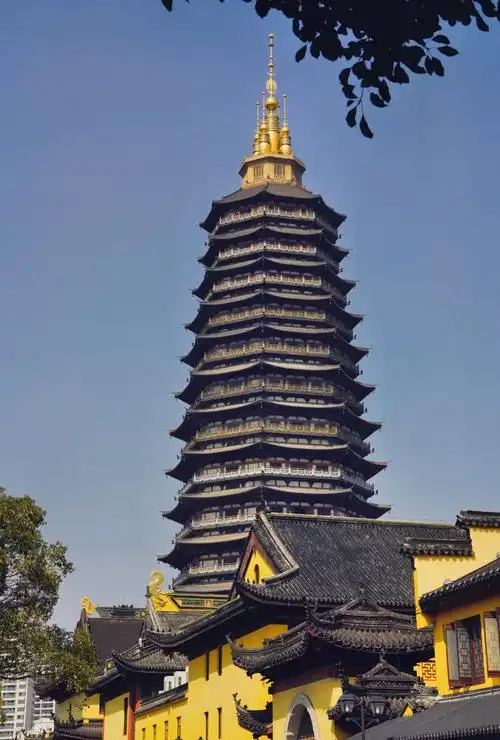
Stepping into Tianning Temple is to travel back to a China of profound political fragmentation. The temple's origins lie in the Sui Dynasty (601–604 CE), but the surviving Wenfeng Pagoda was raised in 952 CE, during the brief Later Zhou—one of the Five Dynasties that ruled northern China after the Tang collapse. Contemporaneous with the height of the Holy Roman Empire under the Ottonian dynasty and the final consolidation of Anglo-Saxon England, this was an era when Buddhist institutions served as anchors of cultural continuity amid chaos. Anyang itself, the temple's home city, claims an even deeper pedigree: it was the last capital of the Shang Dynasty (c. 1300 BCE), predating classical Greece.
The pagoda's most arresting feature is its rebellious silhouette. Traditional Chinese pagodas taper gently upward, as seen in the famous Big Wild Goose Pagoda at Xi'an or Kyoto's graceful five-story towers. Wenfeng does the opposite: its broad, ornate upper stories loom over a slender base, producing the inverted-umbrella profile unique among the country's hundreds of surviving ancient pagodas. Far from a whimsical flourish, this design exploits what engineers call a low-center-of-gravity "tumbler effect," distributing seismic stress downward. The result is a structure that has survived over a thousand years of Henan earthquakes with barely a lean.
Closer inspection rewards visitors with late-Tang artistic DNA preserved in brick. Each of the octagon's eight faces carries high-relief panels depicting episodes from the life of the Buddha—his birth, his preaching—alongside auspicious motifs of dragons and coiled pillars. The flowing lines and confident three-dimensional modeling echo the sculptural tradition of Tang cave temples such as Longmen and Dunhuang. For scholars of Buddhist art and medieval craftsmanship, Wenfeng offers a rare window onto the transitional aesthetics of the Five Dynasties, when imperial patronage had weakened but monastic workshops continued to produce masterworks.
Practical planning is refreshingly simple. The temple sits at No. 2 Wenfeng South Street in Anyang's Wenfeng District and opens free of charge daily, generally 08:30–18:00, with extended hours to 20:30 from May through October. A spiral staircase of 72 steps once wound up through the tower; visitors should phone 0372-5923227 in advance to confirm current climbing policies. Allow 30 to 45 minutes for a focused visit. The site remains an active Buddhist place of worship, so dress modestly and refrain from photography or loud conversation inside any halls.
What makes Tianning truly worth the trip is its place within Anyang's remarkable cultural constellation. Within a short radius lie Yinxu, the UNESCO-listed ruins of the Shang royal city where oracle bones were first inscribed; the Museum of Chinese Writing, dedicated to the evolution of the script; and surviving stretches of the Ming-era Zhangde city wall. Combining Tianning with these neighbors creates a single unforgettable day tracing over three millennia of Chinese civilization—from the birth of writing and bronze-age kingship, through Buddhist medieval artistry, to imperial Ming fortifications.
Consider visiting at dawn or late afternoon, when the warm brick glows in raking light and the surrounding old neighborhood reveals its everyday rhythms—an atmospheric counterpoint to the more famous, busier pagodas of central and southern China.