Dongshan
⭐ 4.00
Second Floor, West Side of New Passenger Station, Nianzishan District, Qiqihar City, Heilongjiang Province, China
 Set amid the rolling steppe of western Heilongjiang, Snake Cave Mountain holds evidence of human occupation dating back tens of thousands of years. The Paleolithic site here was authenticated by Jia Lanpo, the Chinese archaeologist celebrated for his work on Peking Man, placing the location alongside Europe's famous Ice Age sites such as Altamira in Spain and Lascaux in France. A small but thoughtfully curated museum in the visitor center displays stone tools and woolly mammoth tusks, offering a rare window into prehistoric life on the Manchurian plains far from the European caves familiar to most Western travelers.
The mountain itself is sculpted entirely from weathered granite, producing a surreal gallery of animal-shaped monoliths — a coiled serpent, a tortoise, a grazing ox, and a frog — scattered along the hiking trails. This distinguishes the park clearly from the limestone karst of Guilin or the red sandstone of Danxia, and Western visitors may find the outcrops reminiscent of the fantastical tors of England's Dartmoor or the eroded granite formations of Finland's Lapland. Most striking is a four-meter-tall natural stone Buddha face, certified by a Buddhist association as an authentic geological marvel and now the park's defining image.
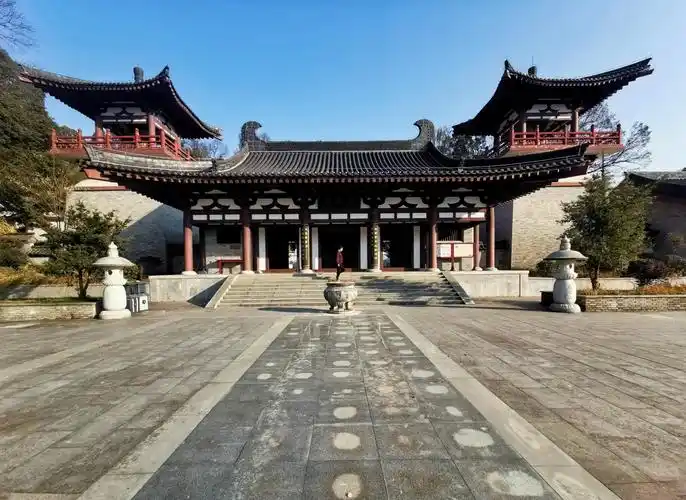
Built into the hillside in 2001, Fo'er Temple pairs solemn Buddhist architecture with ancient cliff carvings and a grove of spruces pruned to spell the character for "Buddha." The forested paths linking the temple to its sacred rocks create a contemplative atmosphere that recalls the mountain monasteries of Mount Athos or Tibet's hermitages, though on a far gentler scale. Pilgrims and casual visitors alike pause here to absorb the quiet blend of nature and devotion that characterizes much of Northeast China's religious heritage.
A recommended loop takes visitors from the visitor center and its prehistoric exhibit, up the stone steps past the animal-shaped rocks, to Fo'er Temple, into the namesake Snake Cave, and down to the Yalu River bank for a walk or a rafting trip. The Yalu River drift, billed as "the first drift of western Heilongjiang," is a gentle summer adventure suitable for families, complemented by camping grounds and a high-altitude zip line. Allow three to four hours for the full circuit, and plan around the seasonal calendar.
The park is roughly 150 kilometers west of Qiqihar and is best reached by car or chartered minibus, as public transport is limited. Admission is around 5 yuan, with rafting and zip-lining priced separately. April brings spectacular forsythia blossoms, May through August offers cool weather ideal for hiking and drifting, and September lights the hillsides in autumn red and gold. Facilities are modest, so bring water and snacks; rustic foot-of-the-mountain restaurants serve hearty Northeastern dishes such as diguo stew, a fitting reward after a day exploring this little-known corner of China's wild north.
Set amid the rolling steppe of western Heilongjiang, Snake Cave Mountain holds evidence of human occupation dating back tens of thousands of years. The Paleolithic site here was authenticated by Jia Lanpo, the Chinese archaeologist celebrated for his work on Peking Man, placing the location alongside Europe's famous Ice Age sites such as Altamira in Spain and Lascaux in France. A small but thoughtfully curated museum in the visitor center displays stone tools and woolly mammoth tusks, offering a rare window into prehistoric life on the Manchurian plains far from the European caves familiar to most Western travelers.
The mountain itself is sculpted entirely from weathered granite, producing a surreal gallery of animal-shaped monoliths — a coiled serpent, a tortoise, a grazing ox, and a frog — scattered along the hiking trails. This distinguishes the park clearly from the limestone karst of Guilin or the red sandstone of Danxia, and Western visitors may find the outcrops reminiscent of the fantastical tors of England's Dartmoor or the eroded granite formations of Finland's Lapland. Most striking is a four-meter-tall natural stone Buddha face, certified by a Buddhist association as an authentic geological marvel and now the park's defining image.
Built into the hillside in 2001, Fo'er Temple pairs solemn Buddhist architecture with ancient cliff carvings and a grove of spruces pruned to spell the character for "Buddha." The forested paths linking the temple to its sacred rocks create a contemplative atmosphere that recalls the mountain monasteries of Mount Athos or Tibet's hermitages, though on a far gentler scale. Pilgrims and casual visitors alike pause here to absorb the quiet blend of nature and devotion that characterizes much of Northeast China's religious heritage.
A recommended loop takes visitors from the visitor center and its prehistoric exhibit, up the stone steps past the animal-shaped rocks, to Fo'er Temple, into the namesake Snake Cave, and down to the Yalu River bank for a walk or a rafting trip. The Yalu River drift, billed as "the first drift of western Heilongjiang," is a gentle summer adventure suitable for families, complemented by camping grounds and a high-altitude zip line. Allow three to four hours for the full circuit, and plan around the seasonal calendar.
The park is roughly 150 kilometers west of Qiqihar and is best reached by car or chartered minibus, as public transport is limited. Admission is around 5 yuan, with rafting and zip-lining priced separately. April brings spectacular forsythia blossoms, May through August offers cool weather ideal for hiking and drifting, and September lights the hillsides in autumn red and gold. Facilities are modest, so bring water and snacks; rustic foot-of-the-mountain restaurants serve hearty Northeastern dishes such as diguo stew, a fitting reward after a day exploring this little-known corner of China's wild north.