Yuanzhou Ancient City
⭐ 3.60
Yuanzhou Ancient City, Yuanzhou District, Yichun City, Jiangxi Province, China
 Yuanzhou's story stretches back to the Western Han dynasty, when General Guan Ying founded a fortified settlement around 200 BCE, making this stretch of the Xiujiang River bank the original seed of modern Yichun. Like Rome layered atop itself, the city has accumulated successive eras of architecture and engineering, from Tang waterworks to Southern Tang astronomy and Republican-era commerce. A sensitive 2026 micro-renewal has knit scattered ruins and monuments into a continuous heritage corridor, allowing visitors to trace the city's evolution on foot without paying an entry fee.
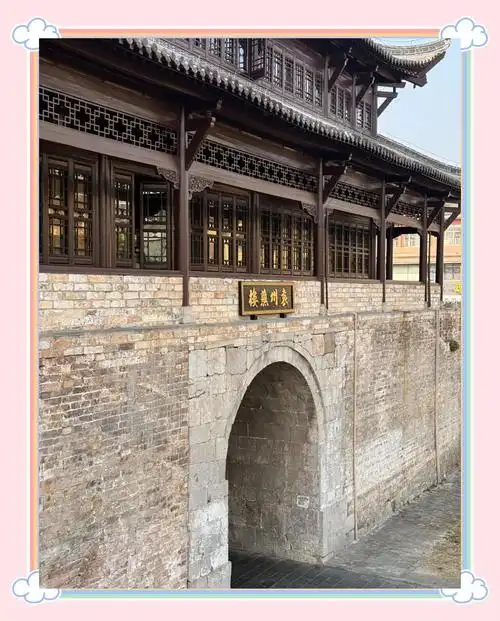
The Republic-era arcade streets along Zhongshan Middle Road are the visual showpiece, evoking the covered porticoes of Lisbon or Naples but rendered in the gray-brick and carved-beam vocabulary of Ganxi vernacular housing. Decorative friezes of plum, orchid, chrysanthemum, and bamboo hint at literati taste, while the arcades themselves provided welcome shade for merchants and shoppers, just as they did in colonial Hong Kong or Hanoi. At the river's edge, Xiujiang Gate rises as a stately watchtower whose upper floors command sweeping views of both banks at dusk.
The undisputed cultural crown is the Yuanzhou Drum Tower, a nationally protected monument and one of the earliest surviving municipal timekeeping observatories, predating Europe's famous Greenwich and Uraniborg by centuries. Its Southern Tang–era structure testifies to sophisticated pre-telescopic astronomy, where drums and bells once announced the hours to the entire prefecture. Nearby, Lingquan Pool and Li Canal Park preserve the engineering of Tang-dynasty officials who tapped mountain springs to irrigate the city, a feat comparable to Roman aqueduct ingenuity in scale and ambition.
The complex also embraces a Dacheng Hall honoring Confucius, anchoring a Confucian temple precinct that links Yuanzhou to the broader East Asian tradition of scholar-officials and civil examinations. Together with the arcade lanes, river gate, observatory, and water gardens, these monuments form a multilayered cultural landscape where visitors can read Chinese civilization across multiple dynasties within a single stroll.
Practical access is straightforward: the entire district is free to enter, with underground parking available and frequent buses connecting from Yichun Railway Station. Some lanes remain under final restoration, so checking the "Yichun Fabu" WeChat public account before departure is wise. The recommended itinerary is to arrive late afternoon, dine on local Ganxi dishes along Zhongshan Road, climb Xiujiang Gate for the sunset illumination, and conclude with a quiet circuit of the Drum Tower and Lingquan Pool.
Why visit? Yuanzhou offers a rare glimpse of an inland Chinese city that has not been entirely polished for tourism, where grand historical claims sit comfortably beside frying woks and laundry lines. For Western travelers saturated with Great Wall and Forbidden City crowds, this living old town provides an unscripted, human-scaled encounter with Jiangxi's heritage, best savored at the gentlest hour of the day.
Yuanzhou's story stretches back to the Western Han dynasty, when General Guan Ying founded a fortified settlement around 200 BCE, making this stretch of the Xiujiang River bank the original seed of modern Yichun. Like Rome layered atop itself, the city has accumulated successive eras of architecture and engineering, from Tang waterworks to Southern Tang astronomy and Republican-era commerce. A sensitive 2026 micro-renewal has knit scattered ruins and monuments into a continuous heritage corridor, allowing visitors to trace the city's evolution on foot without paying an entry fee.
The Republic-era arcade streets along Zhongshan Middle Road are the visual showpiece, evoking the covered porticoes of Lisbon or Naples but rendered in the gray-brick and carved-beam vocabulary of Ganxi vernacular housing. Decorative friezes of plum, orchid, chrysanthemum, and bamboo hint at literati taste, while the arcades themselves provided welcome shade for merchants and shoppers, just as they did in colonial Hong Kong or Hanoi. At the river's edge, Xiujiang Gate rises as a stately watchtower whose upper floors command sweeping views of both banks at dusk.
The undisputed cultural crown is the Yuanzhou Drum Tower, a nationally protected monument and one of the earliest surviving municipal timekeeping observatories, predating Europe's famous Greenwich and Uraniborg by centuries. Its Southern Tang–era structure testifies to sophisticated pre-telescopic astronomy, where drums and bells once announced the hours to the entire prefecture. Nearby, Lingquan Pool and Li Canal Park preserve the engineering of Tang-dynasty officials who tapped mountain springs to irrigate the city, a feat comparable to Roman aqueduct ingenuity in scale and ambition.
The complex also embraces a Dacheng Hall honoring Confucius, anchoring a Confucian temple precinct that links Yuanzhou to the broader East Asian tradition of scholar-officials and civil examinations. Together with the arcade lanes, river gate, observatory, and water gardens, these monuments form a multilayered cultural landscape where visitors can read Chinese civilization across multiple dynasties within a single stroll.
Practical access is straightforward: the entire district is free to enter, with underground parking available and frequent buses connecting from Yichun Railway Station. Some lanes remain under final restoration, so checking the "Yichun Fabu" WeChat public account before departure is wise. The recommended itinerary is to arrive late afternoon, dine on local Ganxi dishes along Zhongshan Road, climb Xiujiang Gate for the sunset illumination, and conclude with a quiet circuit of the Drum Tower and Lingquan Pool.
Why visit? Yuanzhou offers a rare glimpse of an inland Chinese city that has not been entirely polished for tourism, where grand historical claims sit comfortably beside frying woks and laundry lines. For Western travelers saturated with Great Wall and Forbidden City crowds, this living old town provides an unscripted, human-scaled encounter with Jiangxi's heritage, best savored at the gentlest hour of the day.