Yuanzhou Government Office
⭐ 2.80
Yuanshan Street, Yuanzhou District, Yichun City, Jiangxi Province, China
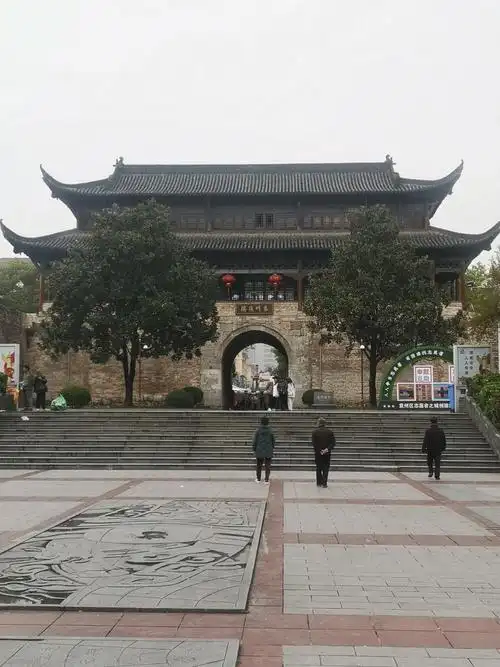 Built in 944 CE, the Yuanzhou Drum Tower represents an astonishingly early example of municipal scientific infrastructure—older than the Norman Conquest of England and roughly contemporaneous with the height of the Abbasid Caliphate's cultural golden age. When this tower began tracking celestial movements, Latin Christendom was still establishing its first monastic learning centers and the great cathedrals of Europe were little more than foundations. The structure pre-dates the renowned Gaocheng Observatory at Dengfeng—a UNESCO World Heritage Site—by 76 years, making it arguably China's most important surviving testament to local-level Tang-Song era astronomy, comparable in significance to Britain's Old Royal Observatory at Greenwich for what it reveals about pre-modern science and statecraft.
The tower's most striking feature is its unusual π-shaped layout, which literally spans Gulou Road via vaulted arches supported by angled struts—an arrangement rarely seen in surviving Chinese architecture and somewhat reminiscent of a Roman aqueduct crossing a thoroughfare. Rising roughly 14 meters across two stories, the lower arcade allows pedestrians to flow beneath, while the upper level opens onto twin north-south observation decks specifically designed for celestial tracking. This dual-purpose design—simultaneously a functional timepiece, an astronomical platform, and a civic landmark—reflects the sophisticated understanding that science and urban symbolism were inseparable in classical Chinese city planning, much as Florence's cathedral clock combined civic pride with calendrical utility.
Beyond its astronomical function, the tower accumulates layers of literary and philosophical memory that connect it to the broader story of East Asian intellectual history. The great Tang-dynasty essayist Han Yu governed Yuanzhou as prefect in the ninth century, while the Neo-Confucian philosopher Wang Yangming reportedly lectured here in the sixteenth—echoing a tradition of scholar-officials who shaped provincial Chinese culture for centuries. The on-site astronomical plaza displays roughly fifteen replica instruments, including water clocks (clepsydras) and sundials, allowing visitors to grasp the practical mechanics of pre-mechanical timekeeping. For travelers interested in the humanities, the tower serves as a tangible thread linking poetry, philosophy, and the cosmos.
The Drum Tower sits squarely in the middle of Yichun's Gulou Pedestrian Street in the Yuanzhou District, with no vehicle access—visitors must walk in. Opening hours run Tuesday through Sunday, 8:30–11:45 and 14:00–17:00; the site closes on Mondays. Ticketed entry has resumed, and bringing a passport or ID is recommended for registration. The visit is largely self-guided, relying on interpretive panels and replica instruments, and typically takes 30 to 45 minutes. The surrounding pedestrian zone offers abundant restaurants and shops, though the lively commercial atmosphere somewhat dilutes the historic mood—a worthwhile trade-off for such an unusual architectural spectacle.
To appreciate the tower fully, visitors should arrive with some basic understanding of ancient timekeeping—knowing how water clocks measured hours through regulated drips, and how sundials required precise astronomical alignment, transforms a quick photo stop into a meaningful encounter with early science. Soft late-afternoon light offers the best views of Yichun's old-town skyline from the rooftop observation decks, when the setting sun bathes the surrounding rooftops in warm tones. Travelers with extra time can pair the visit with the nearby Changli Academy—founded in honor of poet-official Han Yu—and Yichun Terrace, crafting a half-day literary walking tour that traces the region's intellectual heritage from the Tang dynasty onward.
Built in 944 CE, the Yuanzhou Drum Tower represents an astonishingly early example of municipal scientific infrastructure—older than the Norman Conquest of England and roughly contemporaneous with the height of the Abbasid Caliphate's cultural golden age. When this tower began tracking celestial movements, Latin Christendom was still establishing its first monastic learning centers and the great cathedrals of Europe were little more than foundations. The structure pre-dates the renowned Gaocheng Observatory at Dengfeng—a UNESCO World Heritage Site—by 76 years, making it arguably China's most important surviving testament to local-level Tang-Song era astronomy, comparable in significance to Britain's Old Royal Observatory at Greenwich for what it reveals about pre-modern science and statecraft.
The tower's most striking feature is its unusual π-shaped layout, which literally spans Gulou Road via vaulted arches supported by angled struts—an arrangement rarely seen in surviving Chinese architecture and somewhat reminiscent of a Roman aqueduct crossing a thoroughfare. Rising roughly 14 meters across two stories, the lower arcade allows pedestrians to flow beneath, while the upper level opens onto twin north-south observation decks specifically designed for celestial tracking. This dual-purpose design—simultaneously a functional timepiece, an astronomical platform, and a civic landmark—reflects the sophisticated understanding that science and urban symbolism were inseparable in classical Chinese city planning, much as Florence's cathedral clock combined civic pride with calendrical utility.
Beyond its astronomical function, the tower accumulates layers of literary and philosophical memory that connect it to the broader story of East Asian intellectual history. The great Tang-dynasty essayist Han Yu governed Yuanzhou as prefect in the ninth century, while the Neo-Confucian philosopher Wang Yangming reportedly lectured here in the sixteenth—echoing a tradition of scholar-officials who shaped provincial Chinese culture for centuries. The on-site astronomical plaza displays roughly fifteen replica instruments, including water clocks (clepsydras) and sundials, allowing visitors to grasp the practical mechanics of pre-mechanical timekeeping. For travelers interested in the humanities, the tower serves as a tangible thread linking poetry, philosophy, and the cosmos.
The Drum Tower sits squarely in the middle of Yichun's Gulou Pedestrian Street in the Yuanzhou District, with no vehicle access—visitors must walk in. Opening hours run Tuesday through Sunday, 8:30–11:45 and 14:00–17:00; the site closes on Mondays. Ticketed entry has resumed, and bringing a passport or ID is recommended for registration. The visit is largely self-guided, relying on interpretive panels and replica instruments, and typically takes 30 to 45 minutes. The surrounding pedestrian zone offers abundant restaurants and shops, though the lively commercial atmosphere somewhat dilutes the historic mood—a worthwhile trade-off for such an unusual architectural spectacle.
To appreciate the tower fully, visitors should arrive with some basic understanding of ancient timekeeping—knowing how water clocks measured hours through regulated drips, and how sundials required precise astronomical alignment, transforms a quick photo stop into a meaningful encounter with early science. Soft late-afternoon light offers the best views of Yichun's old-town skyline from the rooftop observation decks, when the setting sun bathes the surrounding rooftops in warm tones. Travelers with extra time can pair the visit with the nearby Changli Academy—founded in honor of poet-official Han Yu—and Yichun Terrace, crafting a half-day literary walking tour that traces the region's intellectual heritage from the Tang dynasty onward.