Yichun Pavilion
⭐ 3.20
Yichun Pavilion, Yuanzhou District, Yichun City, Jiangxi Province, China
 **Historical Context**
The pavilion commemorates one of the most consequential literary figures of the Tang dynasty (618–907 CE), a period roughly contemporary with Charlemagne's court in Europe or the Abbasid flowering in Baghdad. Han Yu (768–824), sometimes called the "Shakespeare of Chinese prose," was demoted to prefect of the remote Yuanzhou prefecture (modern Yichun) for daring to criticize Emperor Muzong's veneration of a Buddhist relic—a political imbroglio echoing the religious tensions of medieval Europe. Despite his brief tenure of less than a year, he abolished local slave practices and founded village schools, reforms that anticipated similar humanitarian concerns voiced in the West more than a millennium later.
**Architecture**
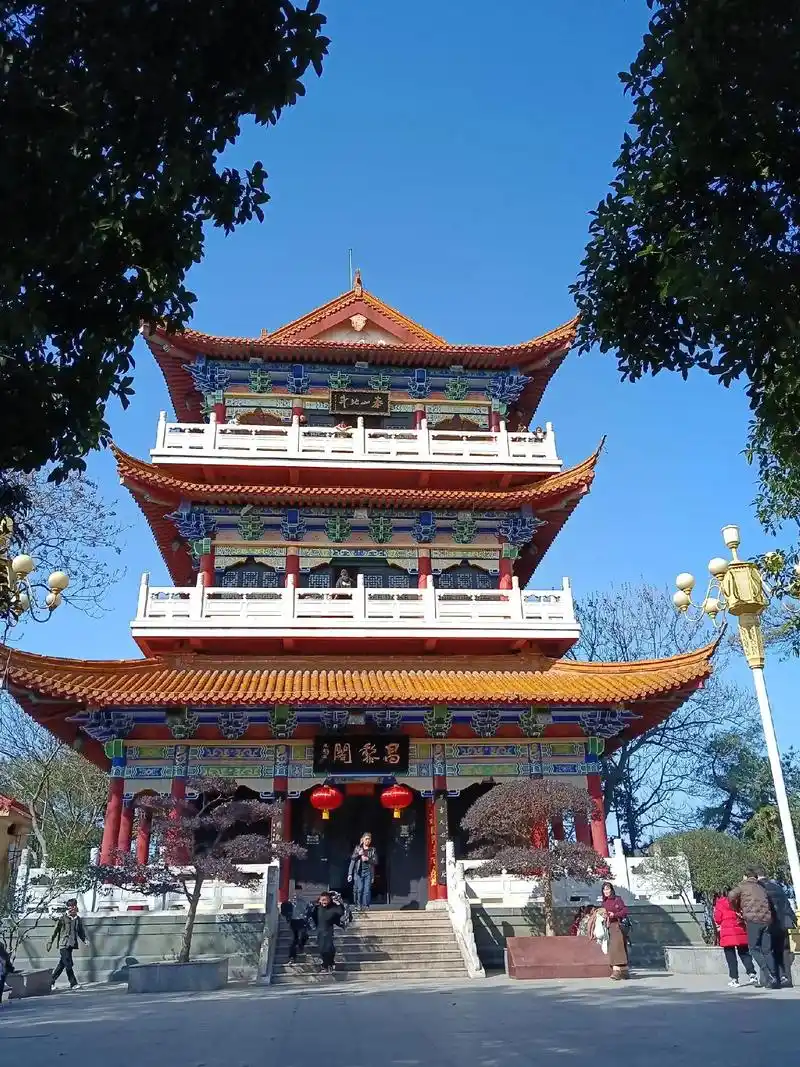
Modeled on classic Tang palace design, the pavilion rises 21 meters with 519 square meters of floor space, crowned by golden-glazed tiles and dramatically upswept eaves that evoke the celestial imagery of Dunhuang murals. Its three-tiered layout unfolds as a scholarly procession: the Jinghan Hall displays Han Yu's portrait, the Lianqing Studio traces his life through artifacts, and the Shengyou Tower tops the structure with an open viewing platform. The pavilion's gilded silhouette against forested Yuanshan recalls a miniature Forbidden City nestled among green hills, offering a visual contrast that makes it Yichun's most photogenic landmark.
**Cultural Significance**
Changli Pavilion serves as both a scenic overlook and an open-air classroom for Tang-Song literature. Inside, painted panels and inscribed couplets vividly retell Han Yu's governance of Yuanzhou and his literary triumphs, including his immortal poem "Written on the Way to Blue Pass, Shown to My Nephew Sun Xiang." The pavilion's cultural reach extended dramatically in 2018, when China's national Mid-Autumn Festival gala erected a 1:1 replica on its stage, broadcasting Yichun's heritage to an audience of hundreds of millions and cementing the pavilion as the city's signature cultural ambassador.
**Practical Visit Information**
The pavilion sits at the summit of Yuanshan Park and is free to enter, with visiting hours typically running 8:00–18:00 (extended during summer months). Approach via the East Gate or North Gate and allow 20–30 minutes for the gentle stone-step ascent. Interior exhibition halls occasionally close for maintenance, so check park announcements before visiting. No on-site dining exists, so bring water or eat in Yichun's downtown afterward. Comfortable walking shoes are essential, particularly after rain when the granite steps become slick.
**Why Visit**
For history enthusiasts, families on educational trips, and photographers alike, Changli Pavilion offers a rare convergence of natural beauty and literary pilgrimage. The early morning and the hour before sunset bathe the golden roof in magical light, creating ideal conditions for landscape photography. Travelers who read Han Yu's biography or poems beforehand will find the experience deeply enriched. It is not a destination for thrill-seekers, but for those who appreciate tranquil contemplation among mountains steeped in classical Chinese heritage, it is unmissable.
**Historical Context**
The pavilion commemorates one of the most consequential literary figures of the Tang dynasty (618–907 CE), a period roughly contemporary with Charlemagne's court in Europe or the Abbasid flowering in Baghdad. Han Yu (768–824), sometimes called the "Shakespeare of Chinese prose," was demoted to prefect of the remote Yuanzhou prefecture (modern Yichun) for daring to criticize Emperor Muzong's veneration of a Buddhist relic—a political imbroglio echoing the religious tensions of medieval Europe. Despite his brief tenure of less than a year, he abolished local slave practices and founded village schools, reforms that anticipated similar humanitarian concerns voiced in the West more than a millennium later.
**Architecture**
Modeled on classic Tang palace design, the pavilion rises 21 meters with 519 square meters of floor space, crowned by golden-glazed tiles and dramatically upswept eaves that evoke the celestial imagery of Dunhuang murals. Its three-tiered layout unfolds as a scholarly procession: the Jinghan Hall displays Han Yu's portrait, the Lianqing Studio traces his life through artifacts, and the Shengyou Tower tops the structure with an open viewing platform. The pavilion's gilded silhouette against forested Yuanshan recalls a miniature Forbidden City nestled among green hills, offering a visual contrast that makes it Yichun's most photogenic landmark.
**Cultural Significance**
Changli Pavilion serves as both a scenic overlook and an open-air classroom for Tang-Song literature. Inside, painted panels and inscribed couplets vividly retell Han Yu's governance of Yuanzhou and his literary triumphs, including his immortal poem "Written on the Way to Blue Pass, Shown to My Nephew Sun Xiang." The pavilion's cultural reach extended dramatically in 2018, when China's national Mid-Autumn Festival gala erected a 1:1 replica on its stage, broadcasting Yichun's heritage to an audience of hundreds of millions and cementing the pavilion as the city's signature cultural ambassador.
**Practical Visit Information**
The pavilion sits at the summit of Yuanshan Park and is free to enter, with visiting hours typically running 8:00–18:00 (extended during summer months). Approach via the East Gate or North Gate and allow 20–30 minutes for the gentle stone-step ascent. Interior exhibition halls occasionally close for maintenance, so check park announcements before visiting. No on-site dining exists, so bring water or eat in Yichun's downtown afterward. Comfortable walking shoes are essential, particularly after rain when the granite steps become slick.
**Why Visit**
For history enthusiasts, families on educational trips, and photographers alike, Changli Pavilion offers a rare convergence of natural beauty and literary pilgrimage. The early morning and the hour before sunset bathe the golden roof in magical light, creating ideal conditions for landscape photography. Travelers who read Han Yu's biography or poems beforehand will find the experience deeply enriched. It is not a destination for thrill-seekers, but for those who appreciate tranquil contemplation among mountains steeped in classical Chinese heritage, it is unmissable.