Mount Yuan
⭐ 4.20
Yuan Mountain Park, Yuanzhou District, Yichun City, Jiangxi Province, China
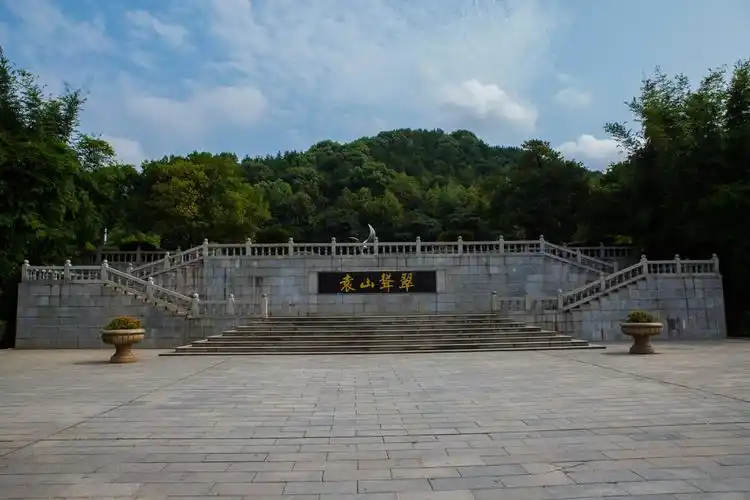 The mountain takes its name from Yuan Jing, a reclusive scholar of the Eastern Han dynasty (25–220 CE) who withdrew here from official life, much as Saint Benedict later sought solitude at Monte Cassino. His hermitage gave the river below its name and, through it, the entire prefecture of Yuanzhou. In 818 CE the great Tang dynasty essayist Han Yu served as prefect, founded a local academy, and championed education in the region. The pavilion at the summit commemorates this "literary master of a hundred generations" — a figure often ranked alongside Dante for his enduring impact on the Chinese literary language.
The Changli Pavilion is a striking wooden tower in classic Tang style, its upturned eaves and tiered roofs recalling the great Buddhist pagodas of Nara and Kyoto. Inside the park, Changli Plaza, the Hall of Notables, and a long stele-lined walkway showcase roughly 100 meters of carved Han Yu poetry. Among the most prized stones is the "Grand Pen, Mighty Prose" stele, traditionally attributed to the brush of the Qianlong Emperor during his 18th-century southern tours. Together these features turn an easy hilltop climb into a genuine literary pilgrimage.
The park functions as Yichun's living memory, condensing the origin of the city's name and its historic association with Confucian learning into a single public space. The Yichun Bamboo Garden, established after the 2011 Bamboo Culture Festival, preserves the Jiangnan aesthetic of swaying bamboo groves that long inspired Chinese landscape painting. To wander here is to step into the same scene depicted in scrolls by Ming and Qing masters — a place where literary history and natural beauty remain inseparably linked.
Admission is free and no reservation is required. Drivers can navigate to "Yuan Mountain Park" and use the free lot at the South Gate on Tonggu Road; alternatively, city buses 5, 7, 13, 17, and 19 all stop at Yuan Mountain Park Station. There are no convenience stores or vending machines inside, so bring your own water and snacks. Allow two to three hours for a full loop, including the climb to the summit.
Nearly 40 hectares of woodland feature camphor trees and osmanthus, filling the air with fragrance from late summer through autumn, while 15 hectares of water includes lotus ponds, an aviary, and the cascading Fan Yin Waterfall. A 3-kilometer footpath winds through the greenery, with cool streams offering relief during the hot months. Early morning or late afternoon are the best times to visit — the light is soft, the air is cool, and the sunset from the pavilion is unforgettable. Wear sturdy shoes (stone steps grow slick after rain) and bring insect repellent, and consider pairing the climb with a trip to nearby Mingyue Mountain or the hot springs at Wentang for a fuller Jiangxi experience.
The mountain takes its name from Yuan Jing, a reclusive scholar of the Eastern Han dynasty (25–220 CE) who withdrew here from official life, much as Saint Benedict later sought solitude at Monte Cassino. His hermitage gave the river below its name and, through it, the entire prefecture of Yuanzhou. In 818 CE the great Tang dynasty essayist Han Yu served as prefect, founded a local academy, and championed education in the region. The pavilion at the summit commemorates this "literary master of a hundred generations" — a figure often ranked alongside Dante for his enduring impact on the Chinese literary language.
The Changli Pavilion is a striking wooden tower in classic Tang style, its upturned eaves and tiered roofs recalling the great Buddhist pagodas of Nara and Kyoto. Inside the park, Changli Plaza, the Hall of Notables, and a long stele-lined walkway showcase roughly 100 meters of carved Han Yu poetry. Among the most prized stones is the "Grand Pen, Mighty Prose" stele, traditionally attributed to the brush of the Qianlong Emperor during his 18th-century southern tours. Together these features turn an easy hilltop climb into a genuine literary pilgrimage.
The park functions as Yichun's living memory, condensing the origin of the city's name and its historic association with Confucian learning into a single public space. The Yichun Bamboo Garden, established after the 2011 Bamboo Culture Festival, preserves the Jiangnan aesthetic of swaying bamboo groves that long inspired Chinese landscape painting. To wander here is to step into the same scene depicted in scrolls by Ming and Qing masters — a place where literary history and natural beauty remain inseparably linked.
Admission is free and no reservation is required. Drivers can navigate to "Yuan Mountain Park" and use the free lot at the South Gate on Tonggu Road; alternatively, city buses 5, 7, 13, 17, and 19 all stop at Yuan Mountain Park Station. There are no convenience stores or vending machines inside, so bring your own water and snacks. Allow two to three hours for a full loop, including the climb to the summit.
Nearly 40 hectares of woodland feature camphor trees and osmanthus, filling the air with fragrance from late summer through autumn, while 15 hectares of water includes lotus ponds, an aviary, and the cascading Fan Yin Waterfall. A 3-kilometer footpath winds through the greenery, with cool streams offering relief during the hot months. Early morning or late afternoon are the best times to visit — the light is soft, the air is cool, and the sunset from the pavilion is unforgettable. Wear sturdy shoes (stone steps grow slick after rain) and bring insect repellent, and consider pairing the climb with a trip to nearby Mingyue Mountain or the hot springs at Wentang for a fuller Jiangxi experience.