Mount Mingyue
⭐ 4.50
Yushu, Changchun, Jilin Province, China
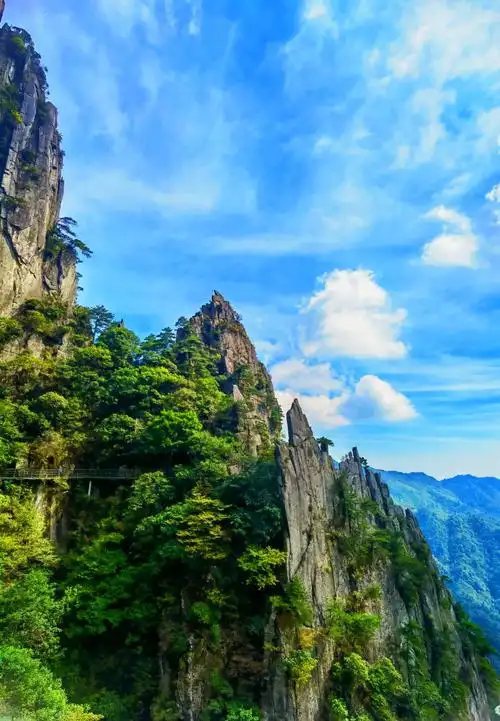 Steeped in over a millennium of spiritual history, Mingyue Mountain takes its name from a crescent-shaped summit that has long evoked the moon in Chinese poetry and folklore. It served as a cradle for the Weiyang school of Zen Buddhism during the Tang dynasty, with the ancient Yangshan Temple still drawing pilgrims today. Ming dynasty explorer Xu Xiake, often compared to a Chinese equivalent of Alexander von Humboldt, trekked here in 1638 and praised the "hundred-foot cascades and cloud-wrapped cliffs." Local legend traces the Moon Goddess Chang'e's ascent to heaven from the mountain's Starmoon Cave, layering the landscape with celestial mythology that rivals the romantic aura of Italy's Mont Blanc or the moonlit lore of Delphi.
The mountain's architecture is as dramatic as its scenery. The Qingyun Plank Road clings to sheer cliffsides like a wooden ribbon in the sky, recalling the vertiginous galleries of Norway's Trolltunga trail. Beneath it, Yun Valley Falls plunges 119 meters in a curtain of mist, earning its title as the tallest waterfall in the Jiangnan region. Higher still, Moon Lake rests in a glacial basin of astonishing turquoise, a mirror reflecting alpine ridges that change with every season—cherry blossoms in spring, emerald haze in summer, crimson maples in autumn, and frosted silver in winter.
Beyond its visual grandeur, Mingyue Mountain is celebrated for the natural hot springs of Wentang Town, where geothermally heated water rich in selenium bubbles up year-round at a soothing 68 to 72°C. Locals have soaked here for centuries, and the mineral pools rival the therapeutic baths of Hungary's Budapest or Iceland's Blue Lagoon. After a day of hiking, slipping into these steaming, stone-edged basins while mist curls off the surface becomes the mountain's signature indulgence, easing tired muscles and leaving skin luminous.
Modern cultural flourishes add a contemporary sparkle. Each evening, the large-scale outdoor spectacle "Moon Over the Ages" brings Yichun's history and moon mythology to life through dazzling light, sound, and choreography—an experience on par with Tuscany's storied light festivals. Visitors can also ride a charming forest railway through the woodlands, browse the lantern-lit Gujing Quan Street with its folk songs drifting from teahouses, or sample regional cuisine, making evenings as eventful as the days.
Reaching the park is straightforward: high-speed trains arrive at Yichun Station, from where local buses or taxis cover the final 15 kilometers to Wentang Town. Gates open roughly 7:00 to 17:00, and an entrance ticket runs about 80 yuan, with cable cars and shuttle buses available separately. One to two full days allow a comfortable pace, combining a summit hike at dawn, a waterfall walk by midday, and a candlelit soak at dusk.
For travelers seeking a single destination that blends sacred heritage, alpine drama, and indulgent wellness, Mingyue Mountain delivers an experience few Chinese parks can match. Its combination of moonlit mythology, cliff-hugging paths, and curative springs offers something for every age and temperament—whether you arrive as a seasoned trekker, a couples' retreat seeker, or a family in search of China's quieter, cooler wonder.
Steeped in over a millennium of spiritual history, Mingyue Mountain takes its name from a crescent-shaped summit that has long evoked the moon in Chinese poetry and folklore. It served as a cradle for the Weiyang school of Zen Buddhism during the Tang dynasty, with the ancient Yangshan Temple still drawing pilgrims today. Ming dynasty explorer Xu Xiake, often compared to a Chinese equivalent of Alexander von Humboldt, trekked here in 1638 and praised the "hundred-foot cascades and cloud-wrapped cliffs." Local legend traces the Moon Goddess Chang'e's ascent to heaven from the mountain's Starmoon Cave, layering the landscape with celestial mythology that rivals the romantic aura of Italy's Mont Blanc or the moonlit lore of Delphi.
The mountain's architecture is as dramatic as its scenery. The Qingyun Plank Road clings to sheer cliffsides like a wooden ribbon in the sky, recalling the vertiginous galleries of Norway's Trolltunga trail. Beneath it, Yun Valley Falls plunges 119 meters in a curtain of mist, earning its title as the tallest waterfall in the Jiangnan region. Higher still, Moon Lake rests in a glacial basin of astonishing turquoise, a mirror reflecting alpine ridges that change with every season—cherry blossoms in spring, emerald haze in summer, crimson maples in autumn, and frosted silver in winter.
Beyond its visual grandeur, Mingyue Mountain is celebrated for the natural hot springs of Wentang Town, where geothermally heated water rich in selenium bubbles up year-round at a soothing 68 to 72°C. Locals have soaked here for centuries, and the mineral pools rival the therapeutic baths of Hungary's Budapest or Iceland's Blue Lagoon. After a day of hiking, slipping into these steaming, stone-edged basins while mist curls off the surface becomes the mountain's signature indulgence, easing tired muscles and leaving skin luminous.
Modern cultural flourishes add a contemporary sparkle. Each evening, the large-scale outdoor spectacle "Moon Over the Ages" brings Yichun's history and moon mythology to life through dazzling light, sound, and choreography—an experience on par with Tuscany's storied light festivals. Visitors can also ride a charming forest railway through the woodlands, browse the lantern-lit Gujing Quan Street with its folk songs drifting from teahouses, or sample regional cuisine, making evenings as eventful as the days.
Reaching the park is straightforward: high-speed trains arrive at Yichun Station, from where local buses or taxis cover the final 15 kilometers to Wentang Town. Gates open roughly 7:00 to 17:00, and an entrance ticket runs about 80 yuan, with cable cars and shuttle buses available separately. One to two full days allow a comfortable pace, combining a summit hike at dawn, a waterfall walk by midday, and a candlelit soak at dusk.
For travelers seeking a single destination that blends sacred heritage, alpine drama, and indulgent wellness, Mingyue Mountain delivers an experience few Chinese parks can match. Its combination of moonlit mythology, cliff-hugging paths, and curative springs offers something for every age and temperament—whether you arrive as a seasoned trekker, a couples' retreat seeker, or a family in search of China's quieter, cooler wonder.