Zhangdefu Ancient City
⭐ 3.80
Wenfeng District, Anyang, Henan, China
 Anyang claims the rare distinction of being a "seven-dynasty ancient capital," but its deepest layer lies just outside this old quarter: the Yinxu ruins, where the oracle bones of the Shang dynasty were discovered in 1899, pushing Chinese written history back more than 3,000 years. Within the Zhangde Fu old city itself, however, history spans from the Northern Wei founding in 398 CE through the Ming refortification that gave the town its present grid. The streets echo the layered past of central China in a way comparable to how the medieval cores of Toledo or Bologna reveal successive cultural overlays—imperial, religious, and civic—still visible today.
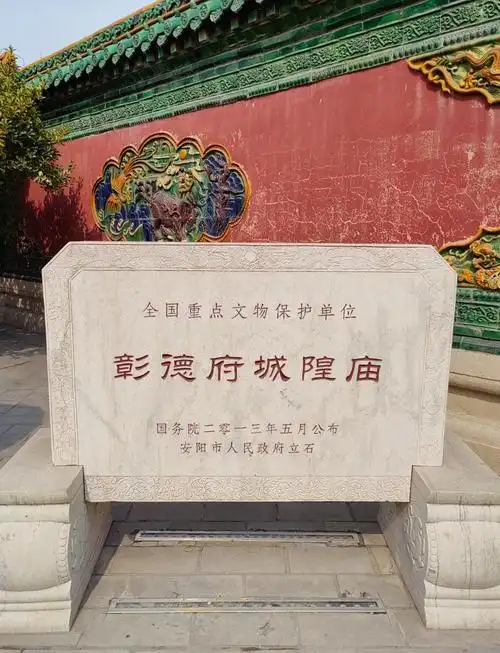
The city's architectural signature is the Wenfeng Pagoda, an unusual five-dynasty-era brick tower whose umbrella-like, top-heavy silhouette is unique in China. Unlike the slender spires of Bruges or the tiered pagodas of Kyoto, its inverted profile was traditionally believed to sharpen the literary fortunes of the city below. Climb to the top for sweeping views over the rust-tiled rooftops of the old quarter. Equally compelling is the City God Temple, a largely intact early-Ming wooden complex laid out across five sequential courtyards—a layout reminiscent of the Confucian temples in Qufu, but dedicated to the protective deity of the city walls.
Equally impressive is the Gaoge Temple, a raised pavilion-style structure built on a high platform as part of the Ming-era Prince Zhao's residence. Its heavy bracketed eaves and double-hipped roof hint at the imperial ambition of Anyang's princely court, recalling the elevated keeps of Japanese castles or the high halls of medieval European palaces. Together, these monuments give visitors a tangible sense of Ming-era provincial grandeur rarely preserved at this scale outside the great capital cities.
Since 2018, a meticulous "restore as original" campaign has revived the district as a vibrant cultural quarter. Cangxiang Street now ranks among China's national night-market zones, with its Houcang Lake light-and-water shows creating an evening spectacle comparable to the illuminated riverside walks of Strasbourg. West Street has been reimagined around traditional Chinese medicine heritage, while County-Front Street gathers non-heritage foods and century-old shops. The result is not a museum but a working neighborhood where residents still live alongside temples, shrines, and lantern-lit courtyards.
Practical visiting is straightforward. All streets and the three main monuments are free, though the City God Temple requires an online reservation and closes on Mondays. The quarter sits at Anyang's geographic center, easily reached by city bus, with public parking around the perimeter. Spring and autumn offer the most comfortable weather; evenings bring the magical lantern-lit atmosphere on Cangxiang Street, while early mornings reward visitors with quiet, cobbled calm on West Street. Wear flat shoes for the stone-flagged lanes, bring water in summer, and remember that this is a living neighborhood—keep voices low and respect local life.
For travelers with extra time, pair the old city with the nearby Museum of Chinese Writing and the Yinxu archaeological site, both of which illuminate Anyang's identity as the birthplace of oracle-bone script and the cradle of Shang civilization. Together they create a powerful two-thread itinerary: one tracing the prehistoric roots of Chinese civilization, the other walking through its Ming and Qing living heritage—an experience no visitor to central China should miss.
Anyang claims the rare distinction of being a "seven-dynasty ancient capital," but its deepest layer lies just outside this old quarter: the Yinxu ruins, where the oracle bones of the Shang dynasty were discovered in 1899, pushing Chinese written history back more than 3,000 years. Within the Zhangde Fu old city itself, however, history spans from the Northern Wei founding in 398 CE through the Ming refortification that gave the town its present grid. The streets echo the layered past of central China in a way comparable to how the medieval cores of Toledo or Bologna reveal successive cultural overlays—imperial, religious, and civic—still visible today.
The city's architectural signature is the Wenfeng Pagoda, an unusual five-dynasty-era brick tower whose umbrella-like, top-heavy silhouette is unique in China. Unlike the slender spires of Bruges or the tiered pagodas of Kyoto, its inverted profile was traditionally believed to sharpen the literary fortunes of the city below. Climb to the top for sweeping views over the rust-tiled rooftops of the old quarter. Equally compelling is the City God Temple, a largely intact early-Ming wooden complex laid out across five sequential courtyards—a layout reminiscent of the Confucian temples in Qufu, but dedicated to the protective deity of the city walls.
Equally impressive is the Gaoge Temple, a raised pavilion-style structure built on a high platform as part of the Ming-era Prince Zhao's residence. Its heavy bracketed eaves and double-hipped roof hint at the imperial ambition of Anyang's princely court, recalling the elevated keeps of Japanese castles or the high halls of medieval European palaces. Together, these monuments give visitors a tangible sense of Ming-era provincial grandeur rarely preserved at this scale outside the great capital cities.
Since 2018, a meticulous "restore as original" campaign has revived the district as a vibrant cultural quarter. Cangxiang Street now ranks among China's national night-market zones, with its Houcang Lake light-and-water shows creating an evening spectacle comparable to the illuminated riverside walks of Strasbourg. West Street has been reimagined around traditional Chinese medicine heritage, while County-Front Street gathers non-heritage foods and century-old shops. The result is not a museum but a working neighborhood where residents still live alongside temples, shrines, and lantern-lit courtyards.
Practical visiting is straightforward. All streets and the three main monuments are free, though the City God Temple requires an online reservation and closes on Mondays. The quarter sits at Anyang's geographic center, easily reached by city bus, with public parking around the perimeter. Spring and autumn offer the most comfortable weather; evenings bring the magical lantern-lit atmosphere on Cangxiang Street, while early mornings reward visitors with quiet, cobbled calm on West Street. Wear flat shoes for the stone-flagged lanes, bring water in summer, and remember that this is a living neighborhood—keep voices low and respect local life.
For travelers with extra time, pair the old city with the nearby Museum of Chinese Writing and the Yinxu archaeological site, both of which illuminate Anyang's identity as the birthplace of oracle-bone script and the cradle of Shang civilization. Together they create a powerful two-thread itinerary: one tracing the prehistoric roots of Chinese civilization, the other walking through its Ming and Qing living heritage—an experience no visitor to central China should miss.